Full Report
The numbers behind GoDaddy Inc.: as-reported financial statements and company metrics for FY2021–FY2025, traced to the source filings, opened with the share-price history those statements have to justify. Every linked figure opens the exact page of the filing it was printed on, with the statement row highlighted. Amounts in US$ millions unless noted.
Reading notes: Display units are US$ millions (weighted-average share counts are in thousands), per the filings' own units line: '(In millions, except shares in thousands and per share amounts)'. Revenue breakdown uses GoDaddy's 'revenue by major product type' cut (Applications and commerce; Core platform: domains; Core platform: other). FY2023-FY2025 are from the FY2025 Form 10-K (Note 2); FY2021-FY2022 are from the FY2022 Form 10-K, which recast those years into the same A C/Core structure adopted in 2023. The FY2021 Form 10-K itself still used the legacy Domains / Hosting and presence / Business applications categories. Segment EBITDA is GoDaddy's reported segment-profit measure (revenue less other segment items, excluding D A, net interest, taxes, equity-based compensation, and certain other items). Income statement 'Net income attributable to GoDaddy Inc.' is shown; the FY2021-FY2023 statements also carry small non-controlling interests. 'Total stockholders' equity (deficit)' likewise shows the amount attributable to GoDaddy Inc. (NCI of $1.5M/$2.5M/nil in FY2021/FY2022/FY2023 excluded); FY2024-FY2025 have no NCI.
Share Price — Full Available History — 11 Years
The stock closed at $88.92 on Jul 10, 2026 — up 345% over the window shown (+14.1% a year), trading between $20.00 and $214.35. At that close the stock trades at 14× FY2025 diluted EPS as reported below.
Source: market price feed, weekly closes, sampled from 2,836 source observations, Mar 2015–Jul 2026. Price return only, excludes dividends.
FY2025 at a Glance
Revenue (US$ millions)
Operating income (US$ millions)
Net income (US$ millions)
Diluted EPS
Source: FY2025 consolidated statements [1] [2] [3] [4]. Click any linked figure to open the filing page with the row highlighted.
Revenue by Major Product Type
| Revenue by Major Product Type | FY2021 | FY2022 | FY2023 | FY2024 | FY2025 |
|---|---|---|---|---|---|
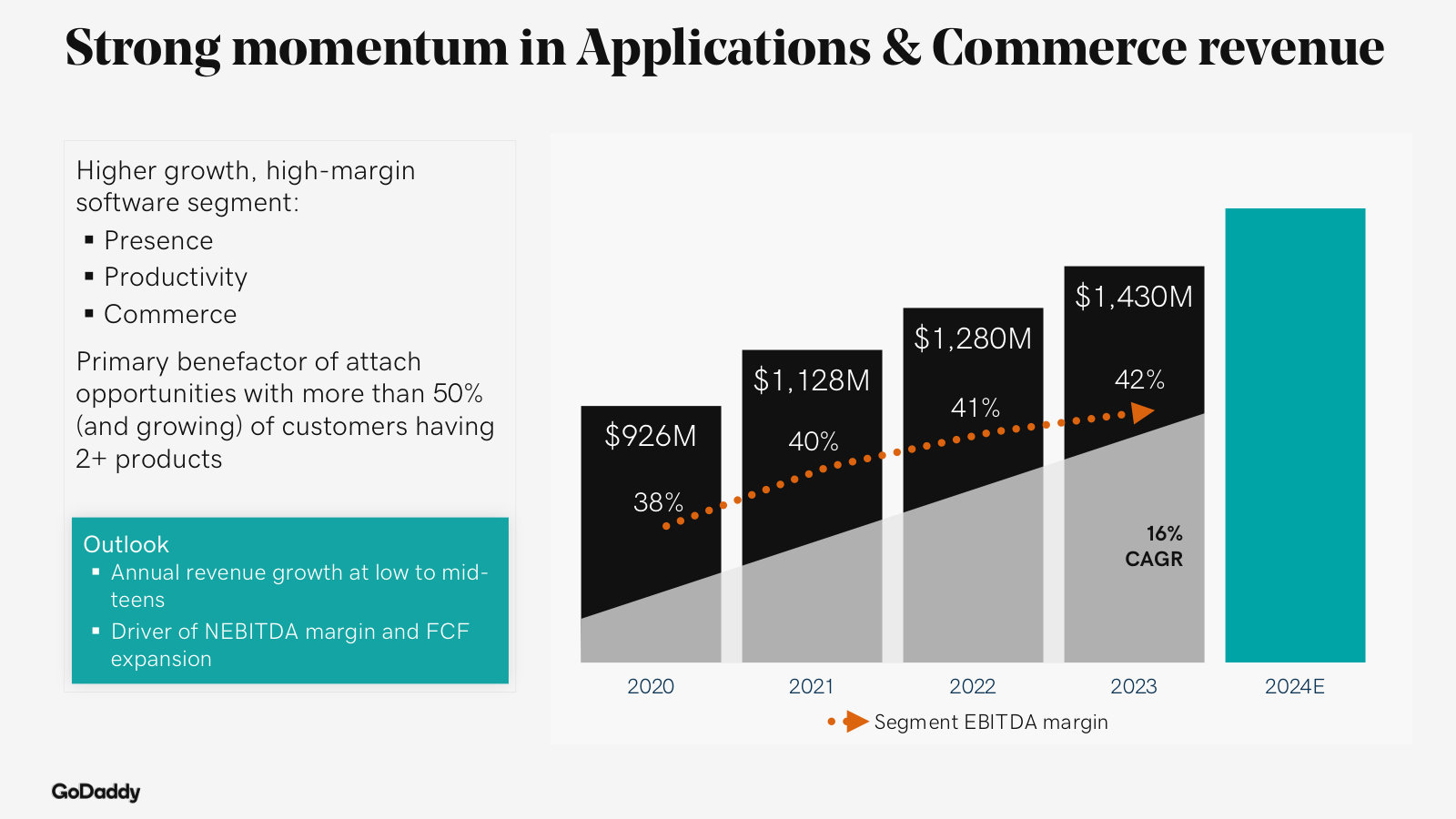
| Applications and commerce | 1,128 | 1,280 | 1,430 | 1,653 | 1,889 |
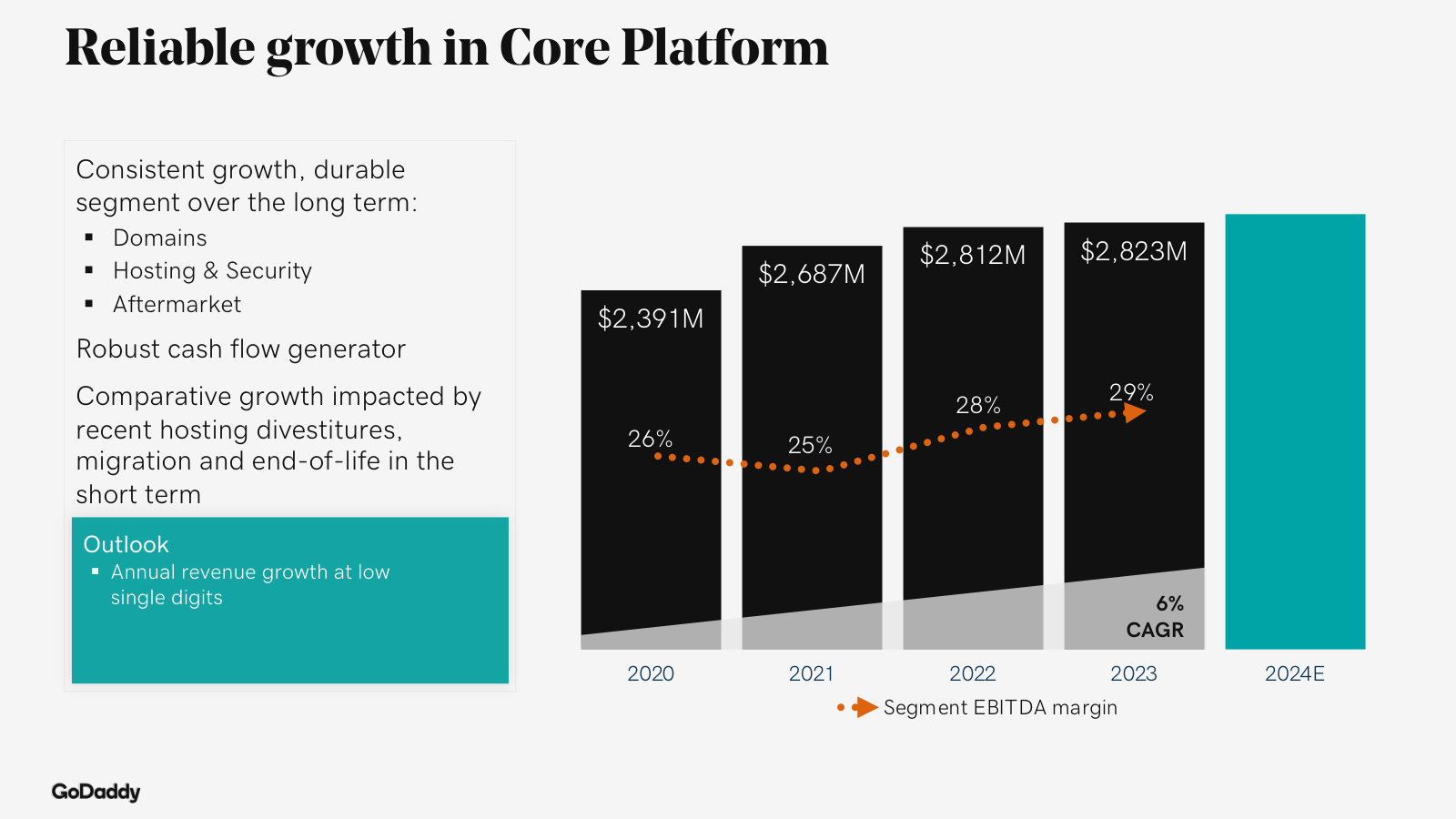
| Core platform: domains | 1,816 | 1,959 | 2,018 | 2,153 | 2,310 |
| Core platform: other | 872 | 852 | 805 | 768 | 752 |
| Total revenue | 3,816 | 4,091 | 4,254 | 4,573 | 4,951 |
| Total revenue growth, derived | — | +7.2% | +4.0% | +7.5% | +8.3% |
Source: Form 10-K Note 2, Disaggregated Revenue (revenue by major product type) [5] [6]. Click any linked figure to open the filing page with the row highlighted.
Segment EBITDA
| Segment EBITDA | FY2021 | FY2022 | FY2023 | FY2024 | FY2025 |
|---|---|---|---|---|---|
| Applications and Commerce (A C) Segment EBITDA | 448 | 523 | 594 | 739 | 857 |
| Core Segment EBITDA | 680 | 784 | 816 | 932 | 1,010 |
| Total Segment EBITDA | 1,127 | 1,306 | 1,411 | 1,671 | 1,867 |
Source: Form 10-K Note, Segment Information (Segment EBITDA by reportable segment) [7] [8]. Click any linked figure to open the filing page with the row highlighted.
Income Statement
Source: Consolidated Statements of Operations (in millions) [1] [2] [3] [4]. Click any linked figure to open the filing page with the row highlighted.
Columns marked E are consensus analyst estimates shown alongside reported results for direct comparison; they are not company guidance.
Estimate source: Yahoo Finance analyst consensus, as of 2026-07-13. Estimate figures link to the consensus source, not to filing pages.
Balance Sheet
Source: Consolidated Balance Sheets (in millions) [9] [10] [11] [12]. Click any linked figure to open the filing page with the row highlighted.
Cash Flow
Source: Consolidated Statements of Cash Flows (in millions) [13] [14] [15] [16]. Click any linked figure to open the filing page with the row highlighted.
Key Operating Metrics
| Key Operating Metrics | FY2021 | FY2022 | FY2023 | FY2024 | FY2025 |
|---|---|---|---|---|---|
| Total bookings | 4,232 | 4,414 | 4,603 | 5,039 | 5,400 |
| Annualized recurring revenue (ARR) | 3,434 | 3,570 | 3,729 | 4,043 | 4,336 |
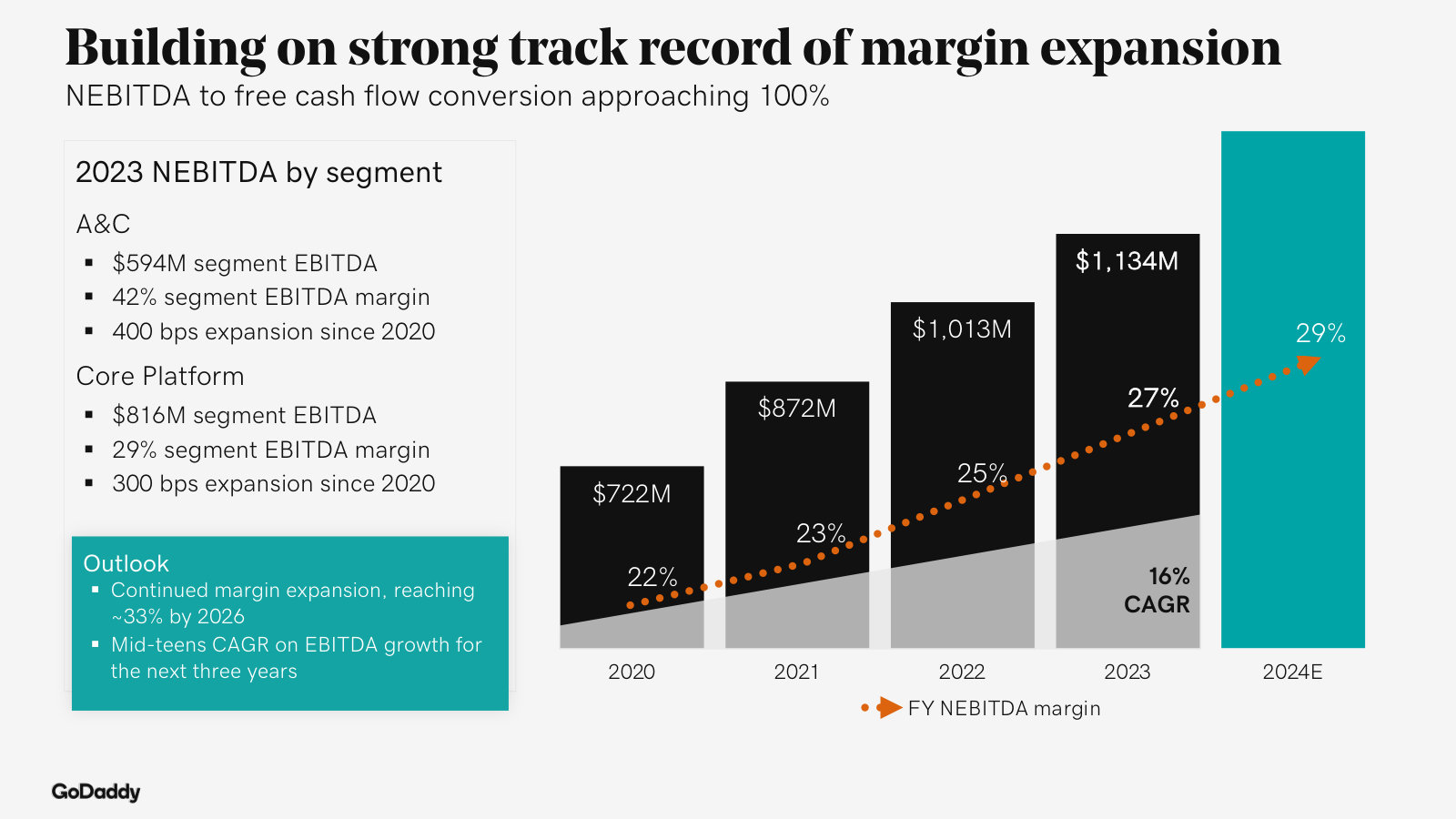
| Normalized EBITDA | 872 | 1,013 | 1,134 | 1,396 | 1,586 |
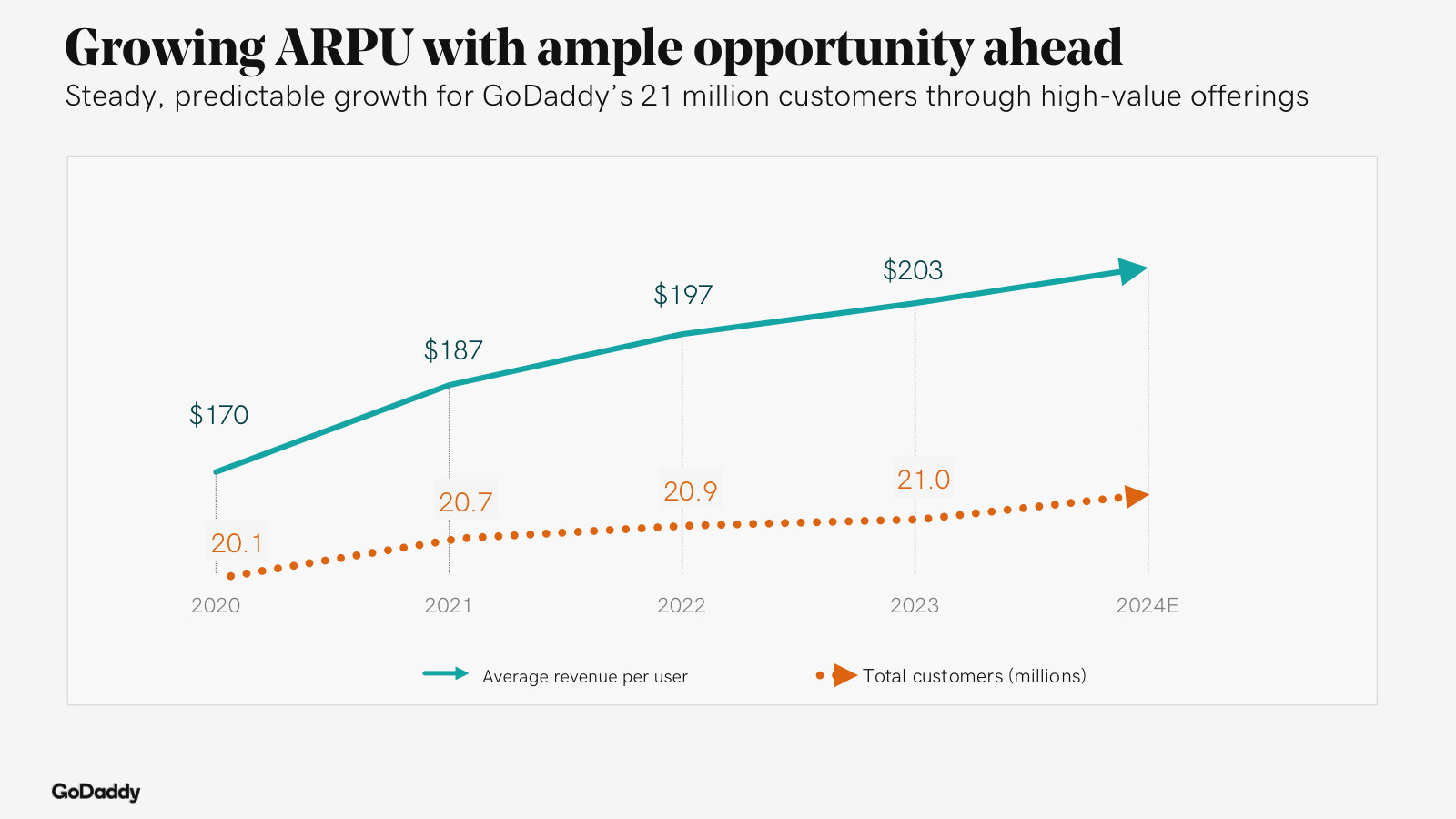
| Total customers at period end (thousands) | 20,701 | 20,897 | 21,026 | 20,511 | 20,422 |
| Average revenue per user — ARPU (US$) | 187 | 197 | 203 | 220 | 242 |
| Domains under management (thousands) | 84,400 | 83,857 | 83,554 | 81,013 | 80,793 |
Source: company filings [17] [18] [19] [20]. Click any linked figure to open the filing page with the row highlighted.
Customer Economics Retention
| Customer Economics Retention | FY2021 | FY2022 | FY2023 | FY2024 | FY2025 |
|---|---|---|---|---|---|
| Customer retention rate | 85.0% | 85.0% | 85.0% | 84.0% | 85.0% |
| Retention rate — customers with GoDaddy over 3 years | — | 93.0% | 92.0% | — | 90.0% |
| Customers spending over $500/year (millions) | — | 2 | 2 | — | 2 |
| Revenue generated by prior-year customers | — | — | — | — | 89.0% |
Source: company filings [21] [22] [23] [24]. Click any linked figure to open the filing page with the row highlighted.
International Footprint
| International Footprint | FY2021 | FY2022 | FY2023 | FY2024 | FY2025 |
|---|---|---|---|---|---|
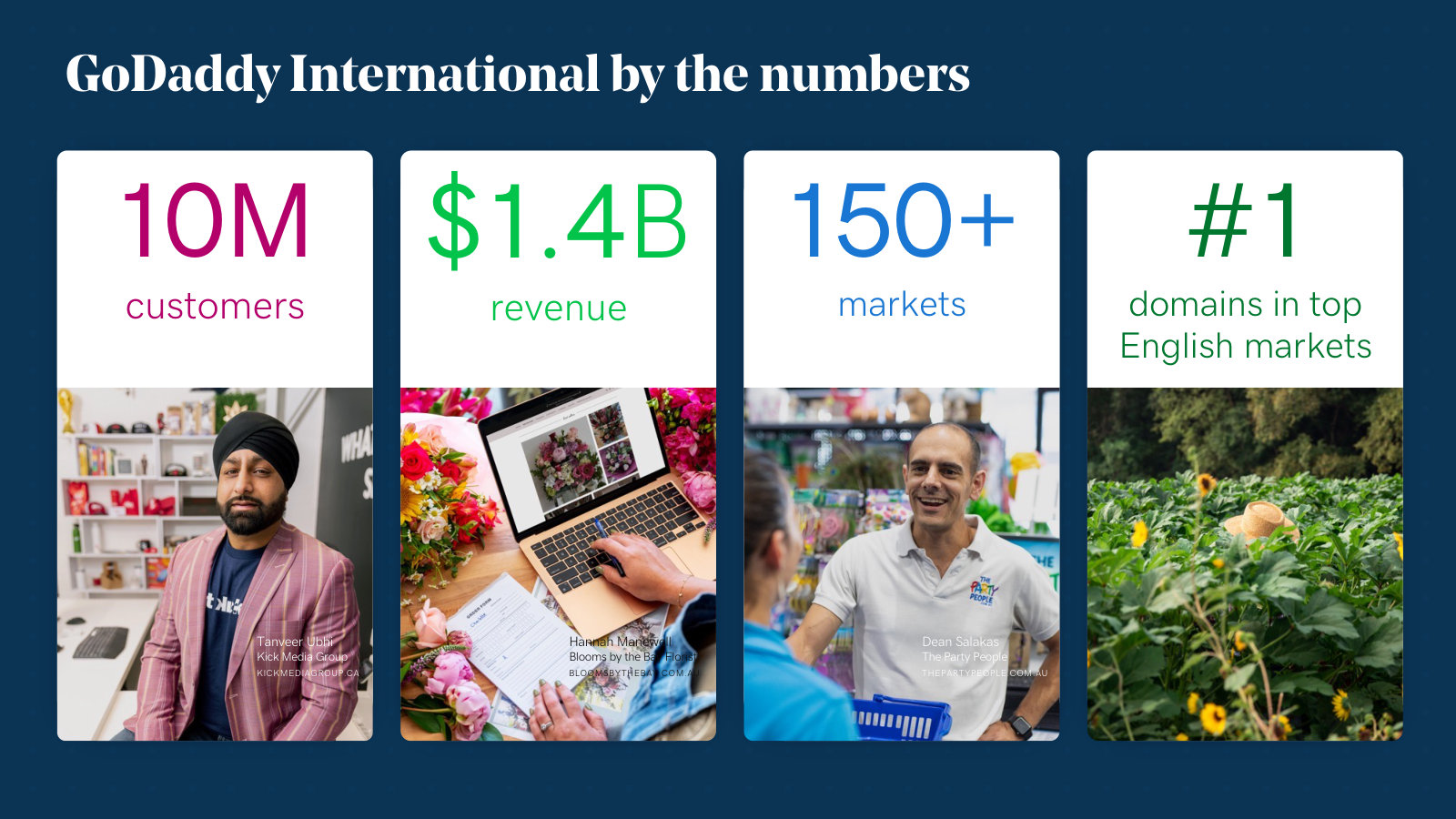
| International revenue | 1,271 | 1,334 | 1,381 | 1,460 | 1,627 |
| International revenue as % of total revenue | — | — | 32.0% | 32.0% | 33.0% |
| Customers outside the U.S. (millions) | — | 10 | 10 | — | 10 |
Source: company filings [25] [26] [27] [28]. Click any linked figure to open the filing page with the row highlighted.
Long-Term Record
| Fiscal year | Total revenue | Operating income | Net income attributable to GoDaddy Inc. | Diluted earnings per share | Operating cash flow |
|---|---|---|---|---|---|
| FY2016 | 1,848 | 50 | (16) | — | 386 |
| FY2017 | 2,232 | 67 | 136 | — | 476 |
| FY2018 | 2,660 | 150 | 77 | — | 560 |
| FY2019 | 2,988 | 203 | 137 | 0.76 | 723 |
| FY2020 | 3,317 | 272 | (495) | (2.94) | 765 |
| FY2021 | 3,816 | 382 | 242 | 1.42 | 829 |
| FY2022 | 4,091 | 499 | 352 | 2.19 | 980 |
| FY2023 | 4,254 | 547 | 1,375 | 9.08 | 1,048 |
| FY2024 | 4,573 | 894 | 937 | 6.45 | 1,288 |
| FY2025 | 4,951 | 1,127 | 875 | 6.22 | 1,599 |
Source: consolidated statements across filings; older years from the standardized feed [13] [1] [14] [2]. Click any linked figure to open the filing page with the row highlighted.
Operating KPIs
| KPI | FY2021 | FY2022 | FY2023 | FY2024 | FY2025 |
|---|---|---|---|---|---|
| Total customers | 20,701,000 | 20,897,000 | 21,026,000 | 20,511,000 | 20,422,000 |
| Annualized recurring revenue | 3,434 | 3,570 | 3,729 | 4,043 | 4,336 |
| Total bookings | 4,232 | 4,414 | 4,603 | 5,039 | 5,400 |
| Average revenue per user (ARPU, US$) | 187 | 197 | 203 | 220 | 242 |
| Domains under management | 84,400,000 | 83,857,000 | 83,554,000 | 81,013,000 | 80,793,000 |
Source: company-reported operating metrics [17]. Click any linked figure to open the filing page with the row highlighted.
Analyst Consensus
Current price
Mean target
Median target
High target
Low target
Estimate source: Yahoo Finance analyst consensus, as of 2026-07-13. Estimate figures link to the consensus source, not to filing pages.
Traceability
343 of 375 figures on this page (91%) link to the filing page where they are printed — click a linked figure to open the source PDF at that page with the row highlighted. Unlinked figures come from standardized data feeds or pre-filing years.
Display units are US$ millions (weighted-average share counts are in thousands), per the filings' own units line: '(In millions, except shares in thousands and per share amounts)'.
Revenue breakdown uses GoDaddy's 'revenue by major product type' cut (Applications and commerce; Core platform: domains; Core platform: other). FY2023-FY2025 are from the FY2025 Form 10-K (Note 2); FY2021-FY2022 are from the FY2022 Form 10-K, which recast those years into the same A C/Core structure adopted in 2023. The FY2021 Form 10-K itself still used the legacy Domains / Hosting and presence / Business applications categories.
Segment EBITDA is GoDaddy's reported segment-profit measure (revenue less other segment items, excluding D A, net interest, taxes, equity-based compensation, and certain other items).
Income statement 'Net income attributable to GoDaddy Inc.' is shown; the FY2021-FY2023 statements also carry small non-controlling interests. 'Total stockholders' equity (deficit)' likewise shows the amount attributable to GoDaddy Inc. (NCI of $1.5M/$2.5M/nil in FY2021/FY2022/FY2023 excluded); FY2024-FY2025 have no NCI.
FY2023 net income of $1,374.8M was inflated by a $971.8M income-tax benefit from the release of a deferred-tax valuation allowance; pre-tax income that year was $403.8M.
FY2016-FY2018 diluted EPS is left blank (not printed in the corpus filings, which span FY2021-FY2025 plus comparative columns back to FY2019).
FY2016-FY2020 long-term figures are from the standardized data feed (SEC XBRL) and are shown without page links; the corpus contains no filing older than the FY2021 Form 10-K.
Quarterly cash-flow single quarters are derived from printed year-to-date statements (see the cash-flow note); the data feed's quarterly cash-flow series does not extend to FY2025, so no feed cross-check was available for those derived cells — each reconciles exactly to the two printed year-to-date figures.
The standardized data feed reconciles to the filings within rounding across revenue, operating income, net income, cash flow, capex and equity; no material discrepancies were found.
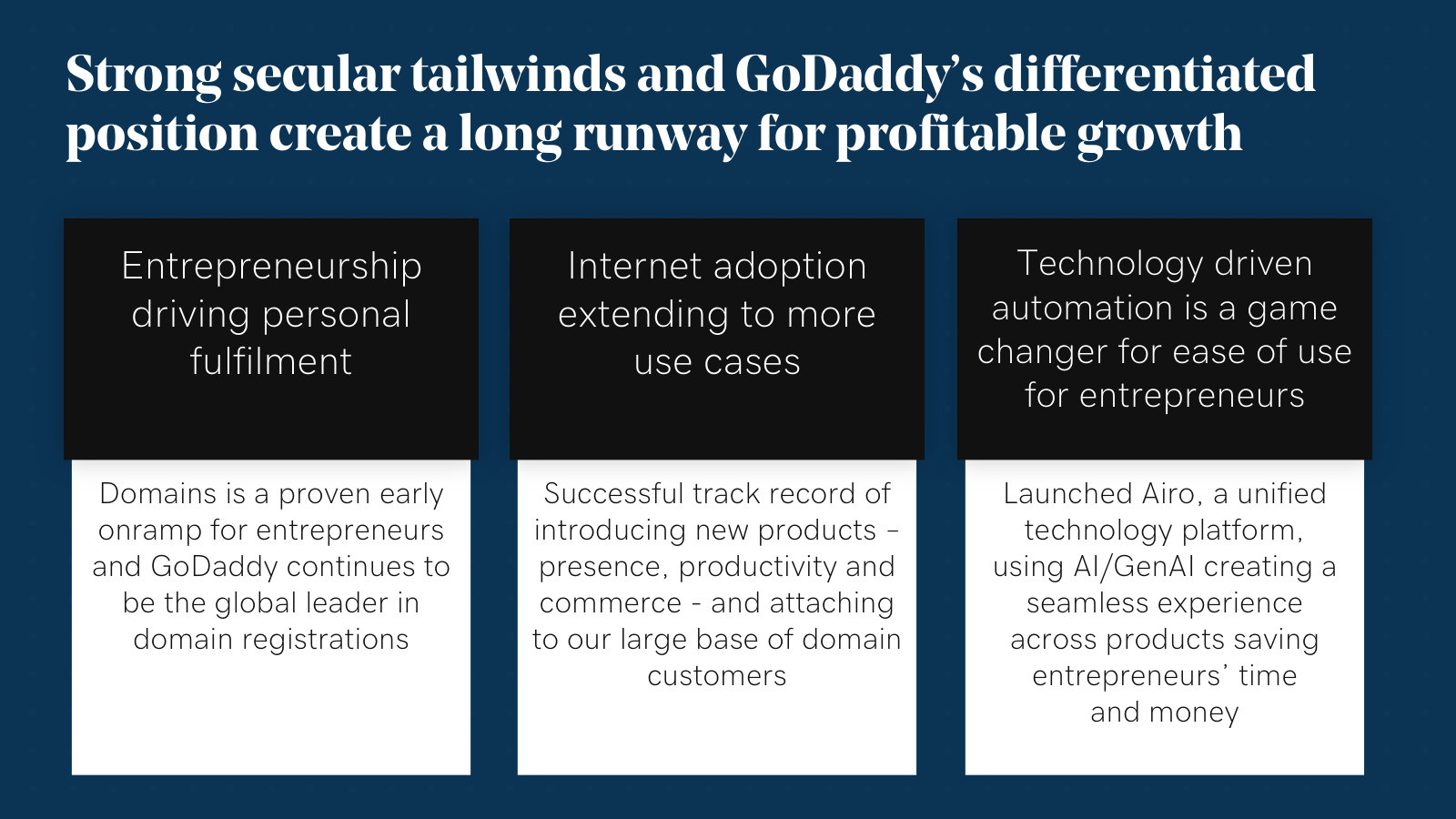
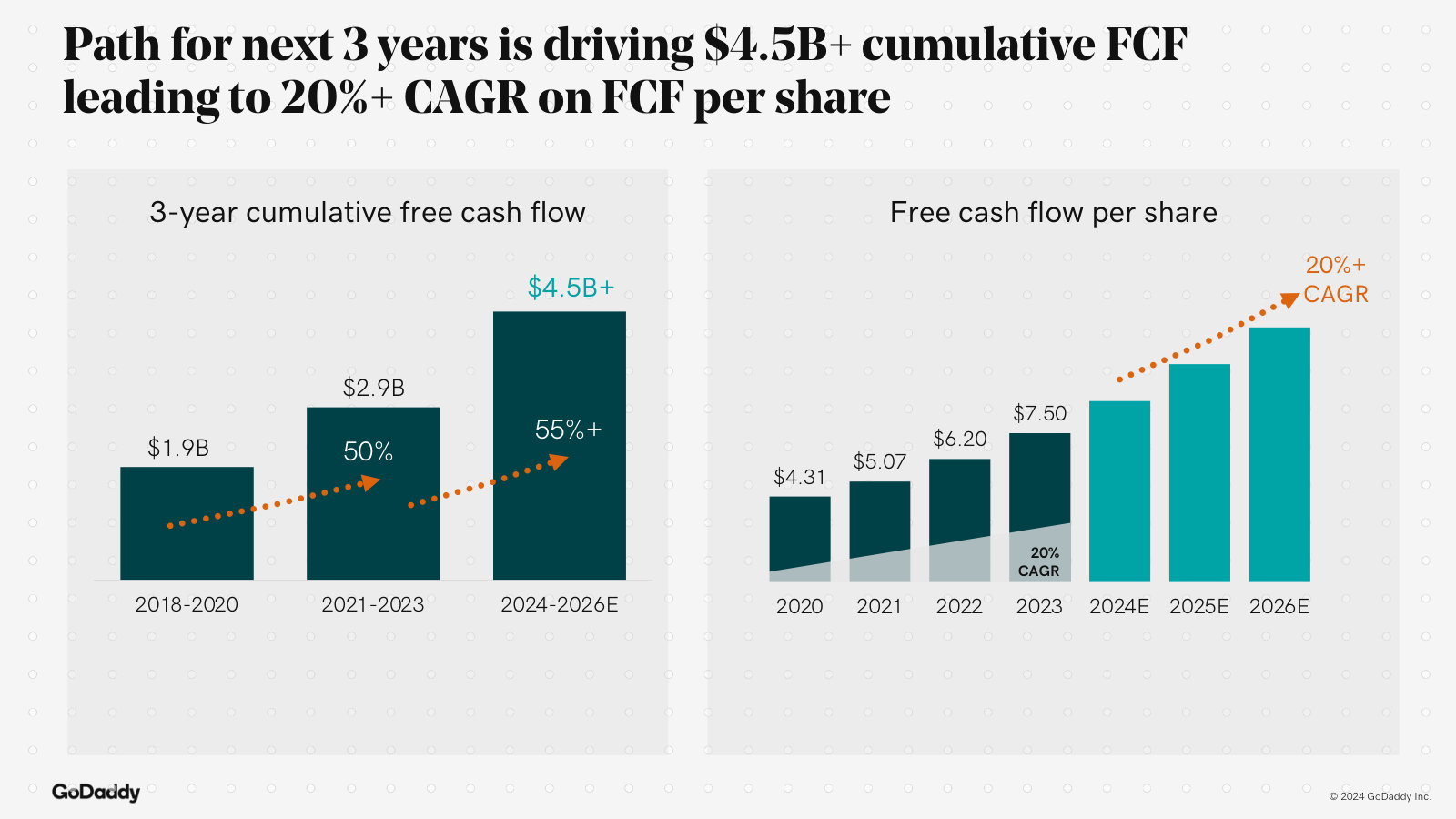
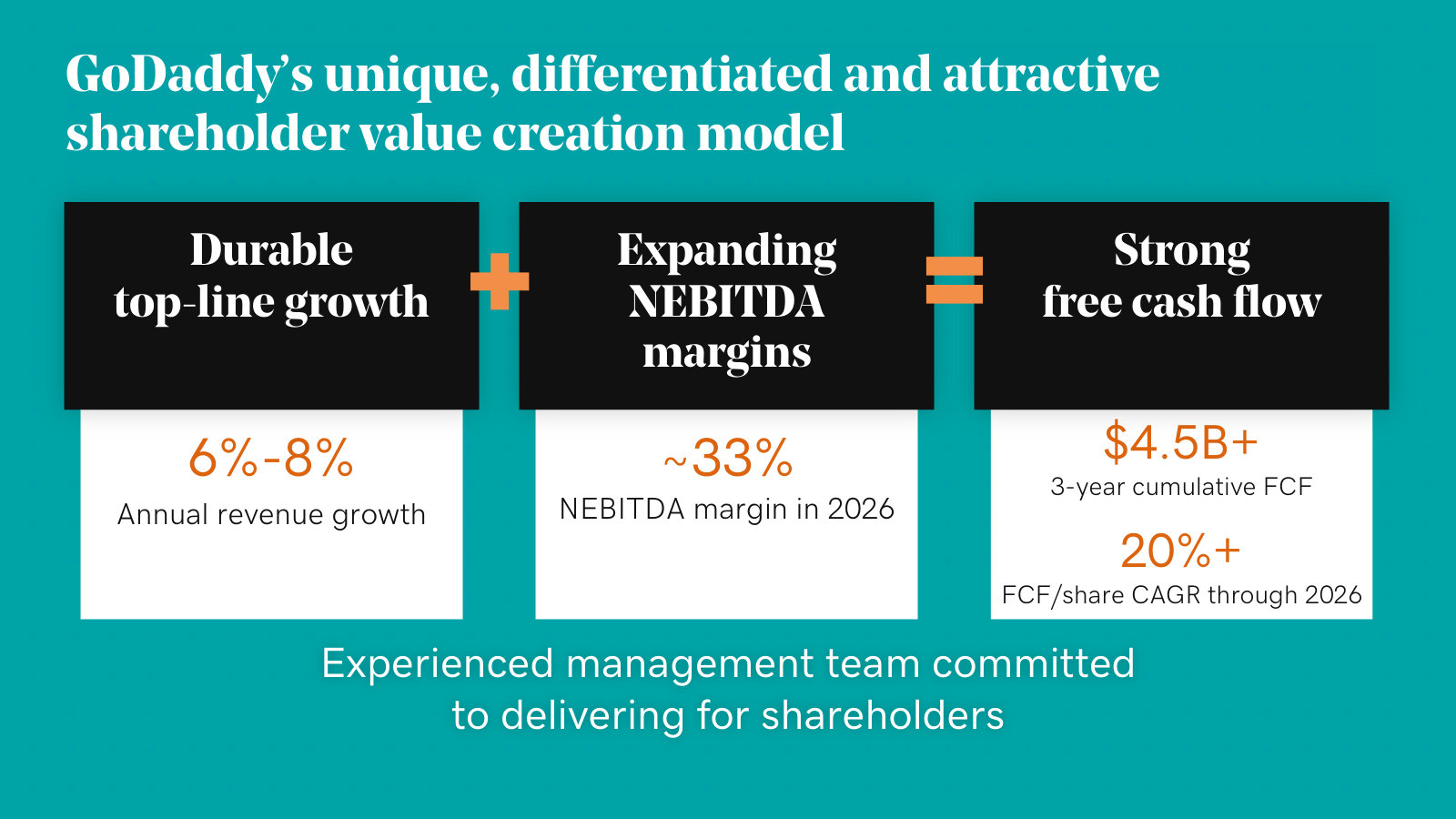
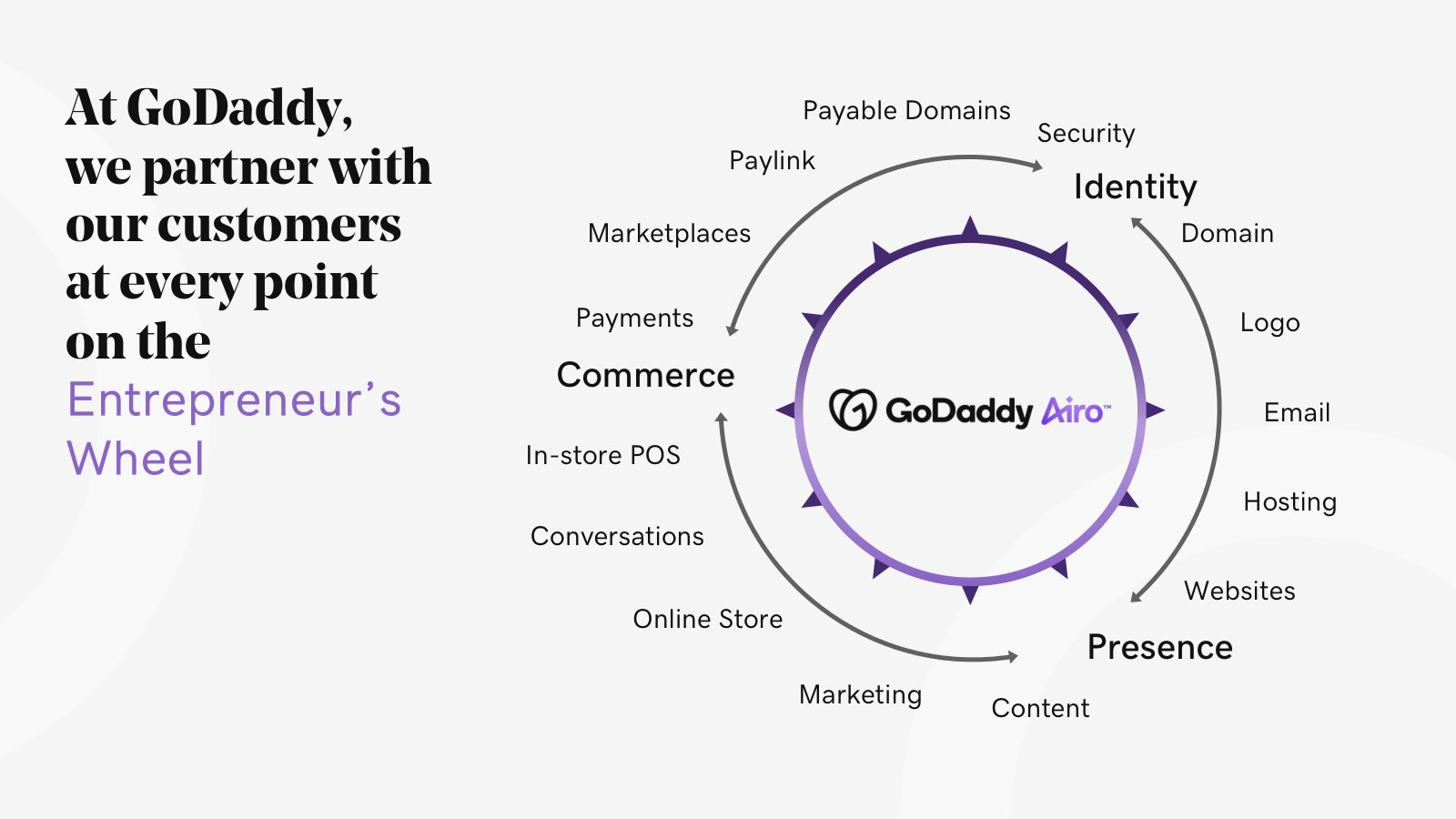
GoDaddy Inc.'s management explains the business in its own materials. The slides below do the most of that work, pulled from the documents preserved in Sources. Each source link opens the complete presentation at that slide in a new tab.
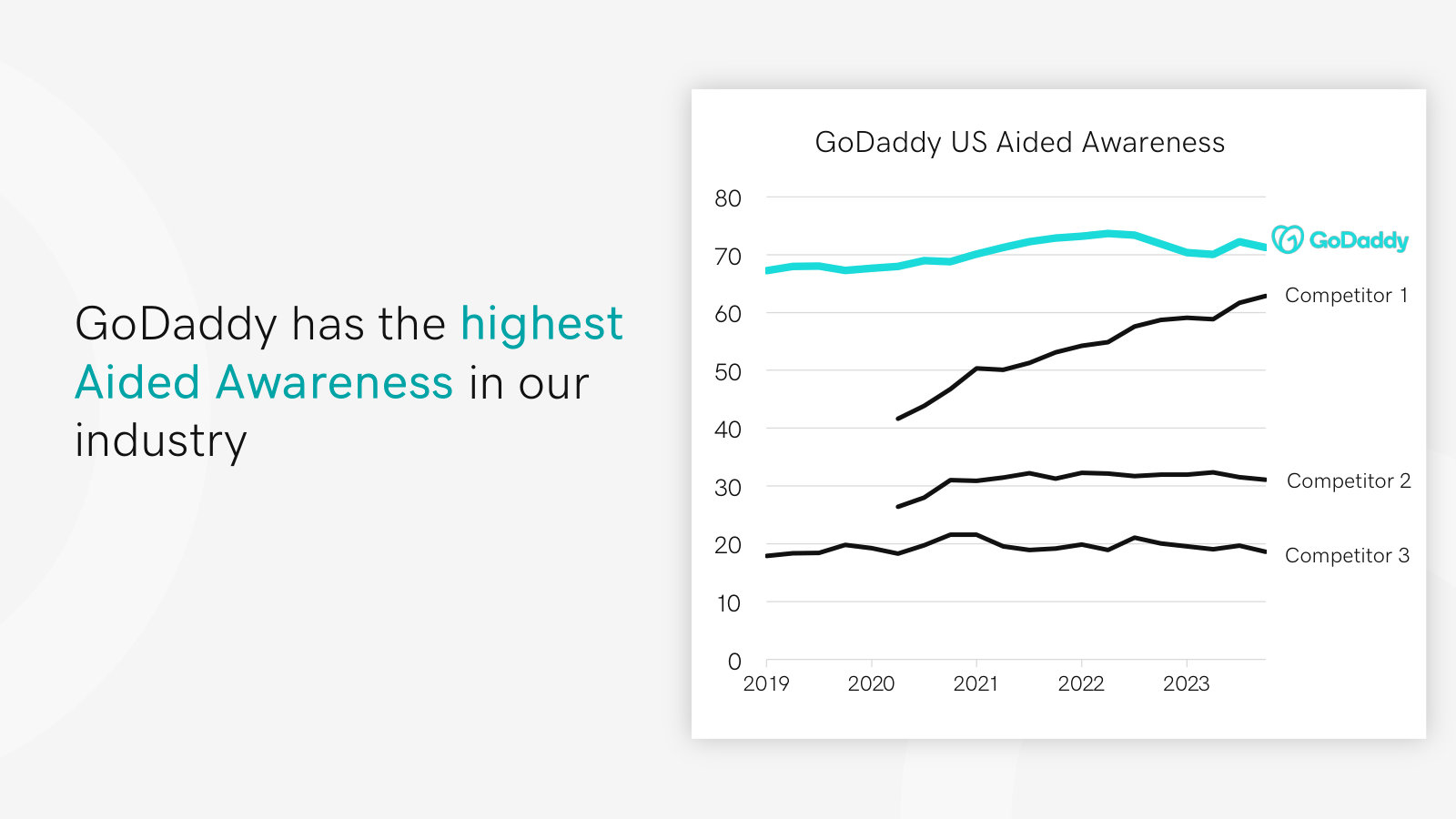
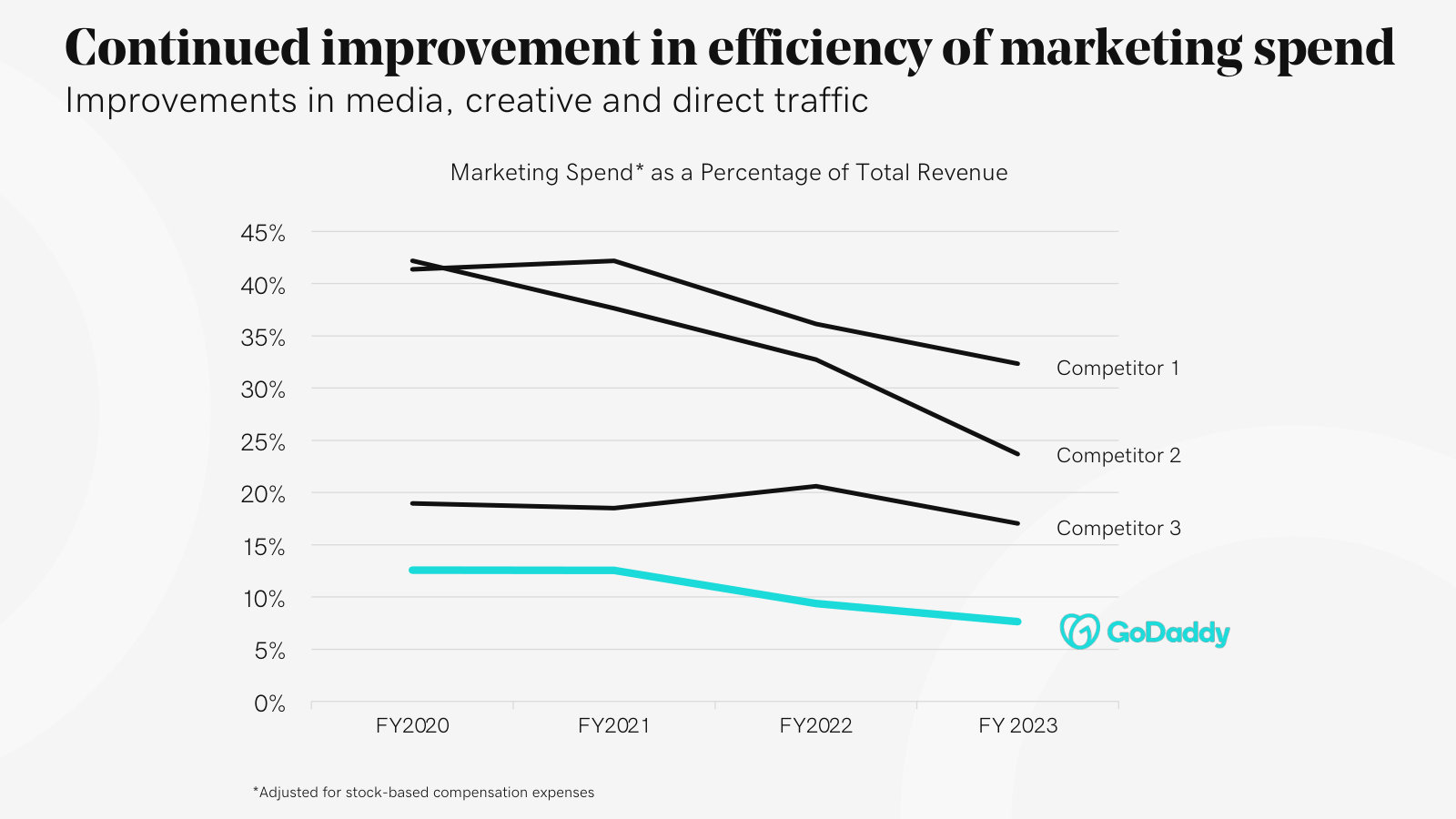
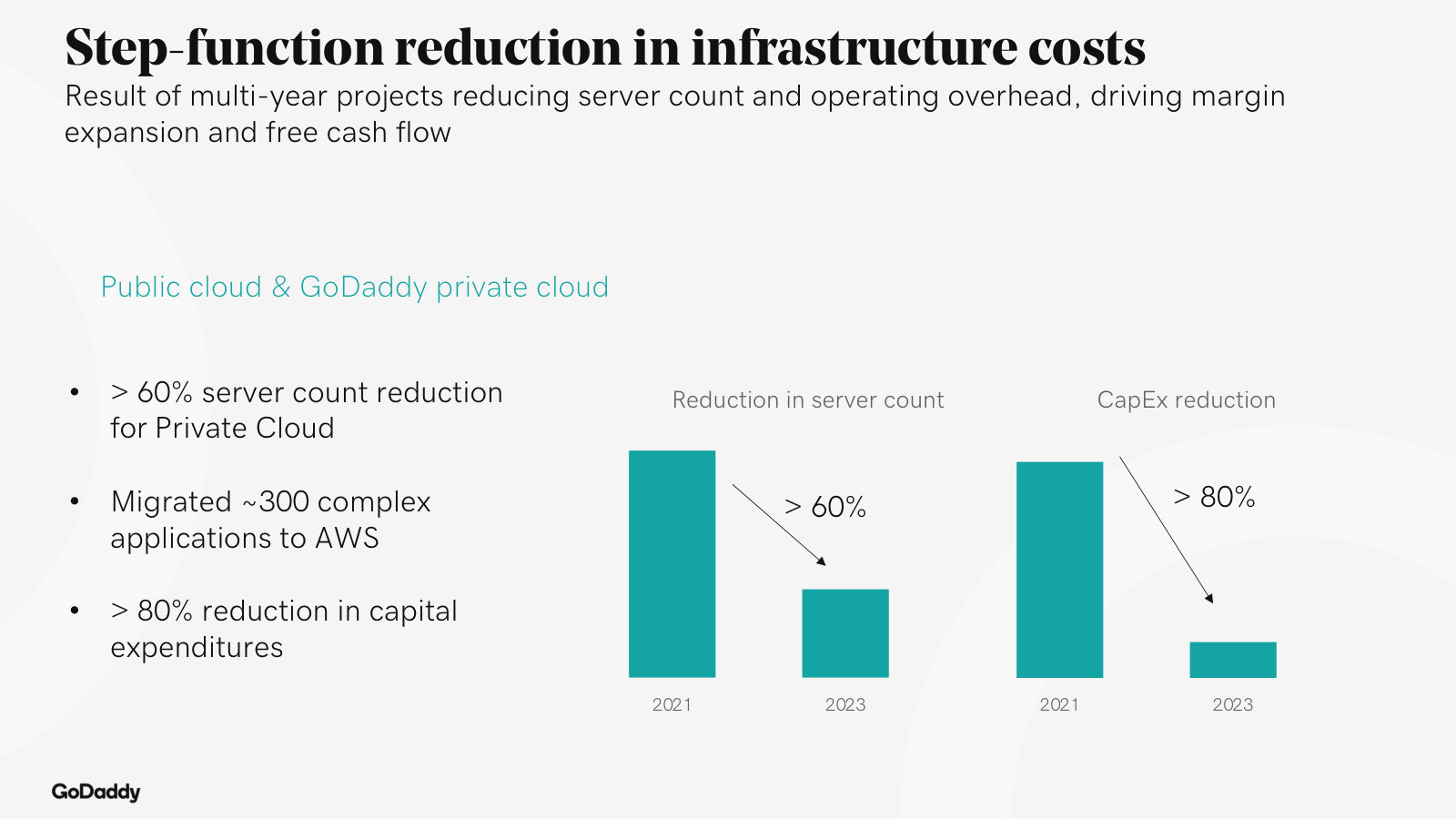
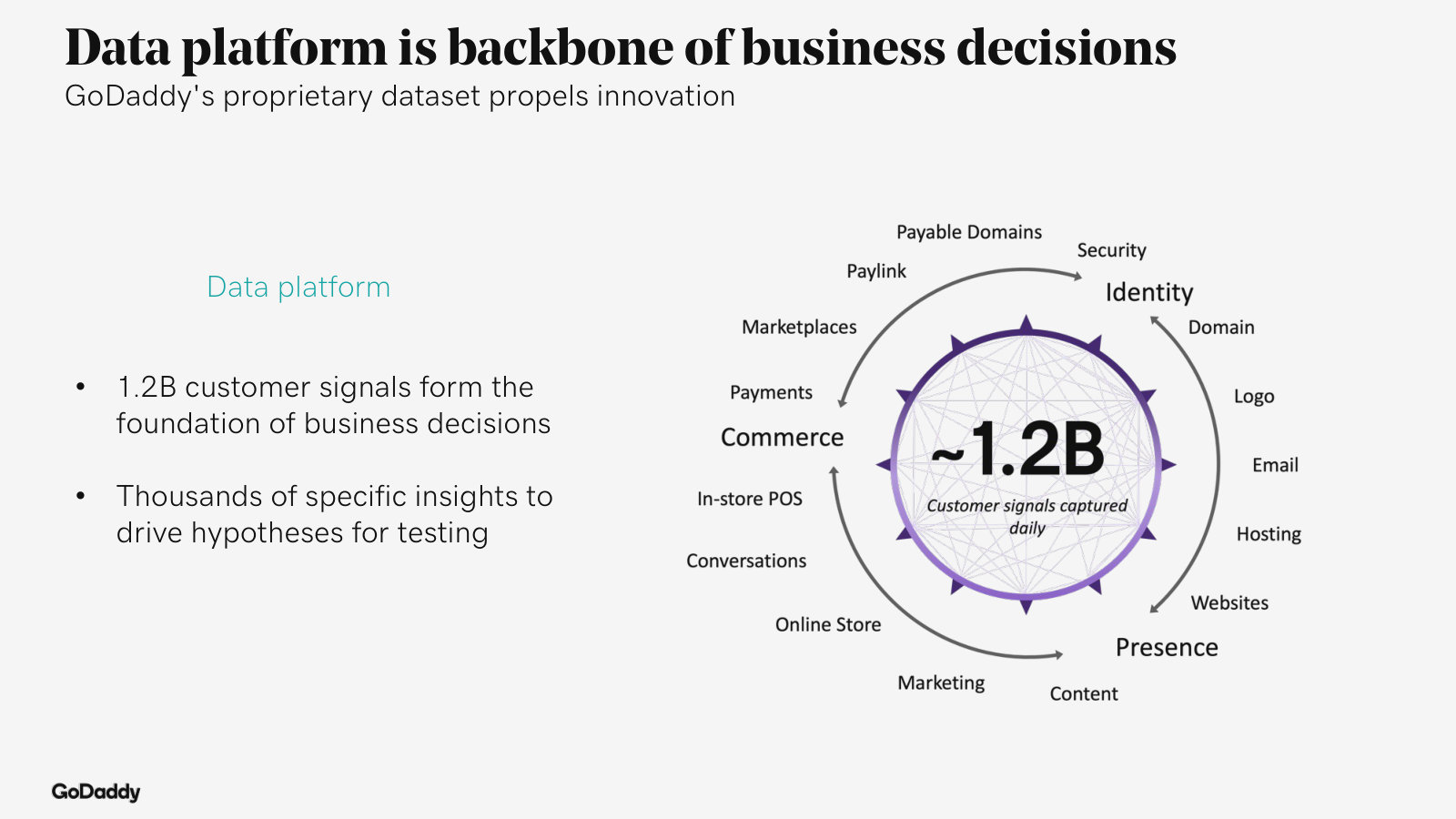
2024 Investor Day — 2024
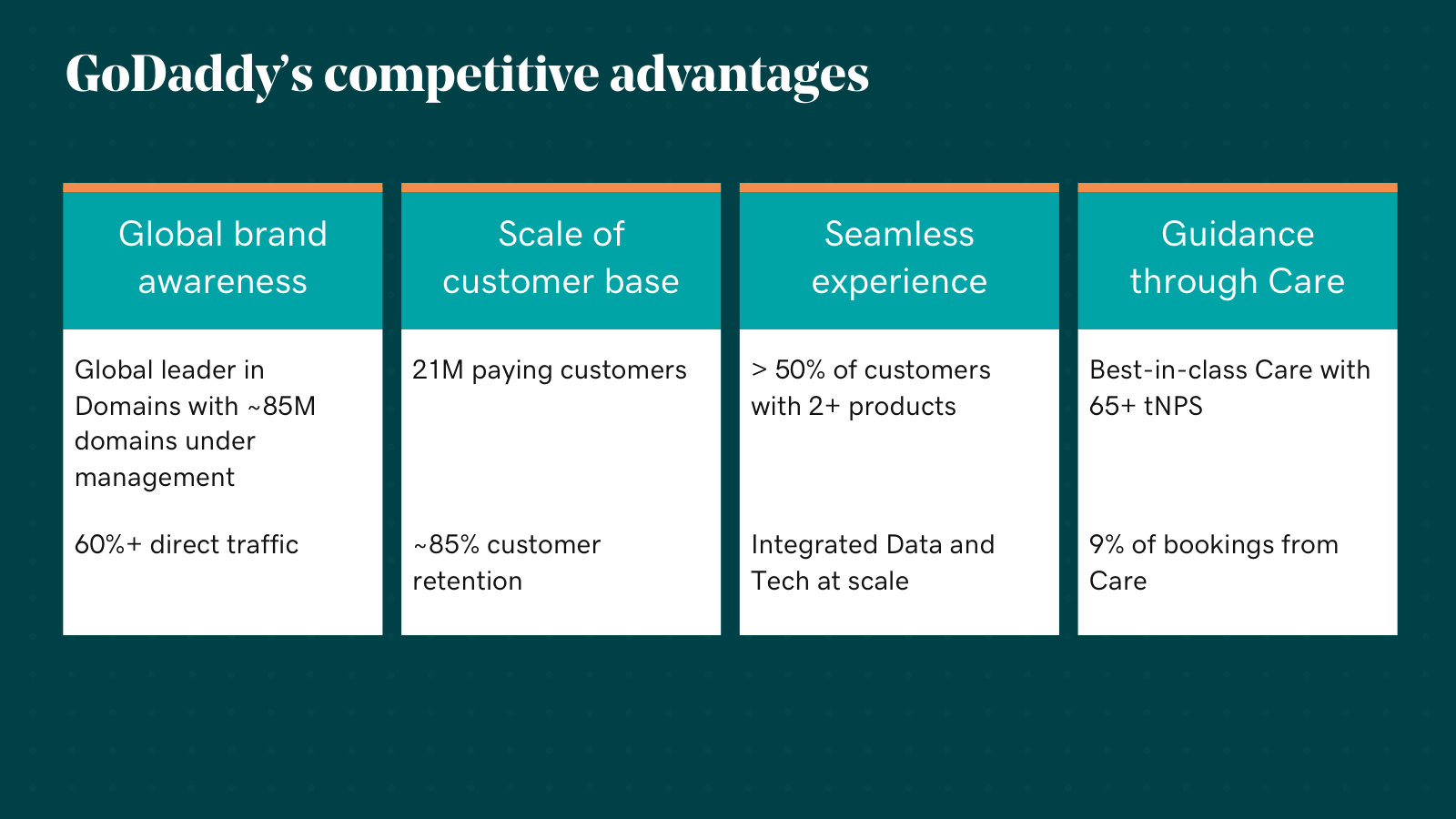
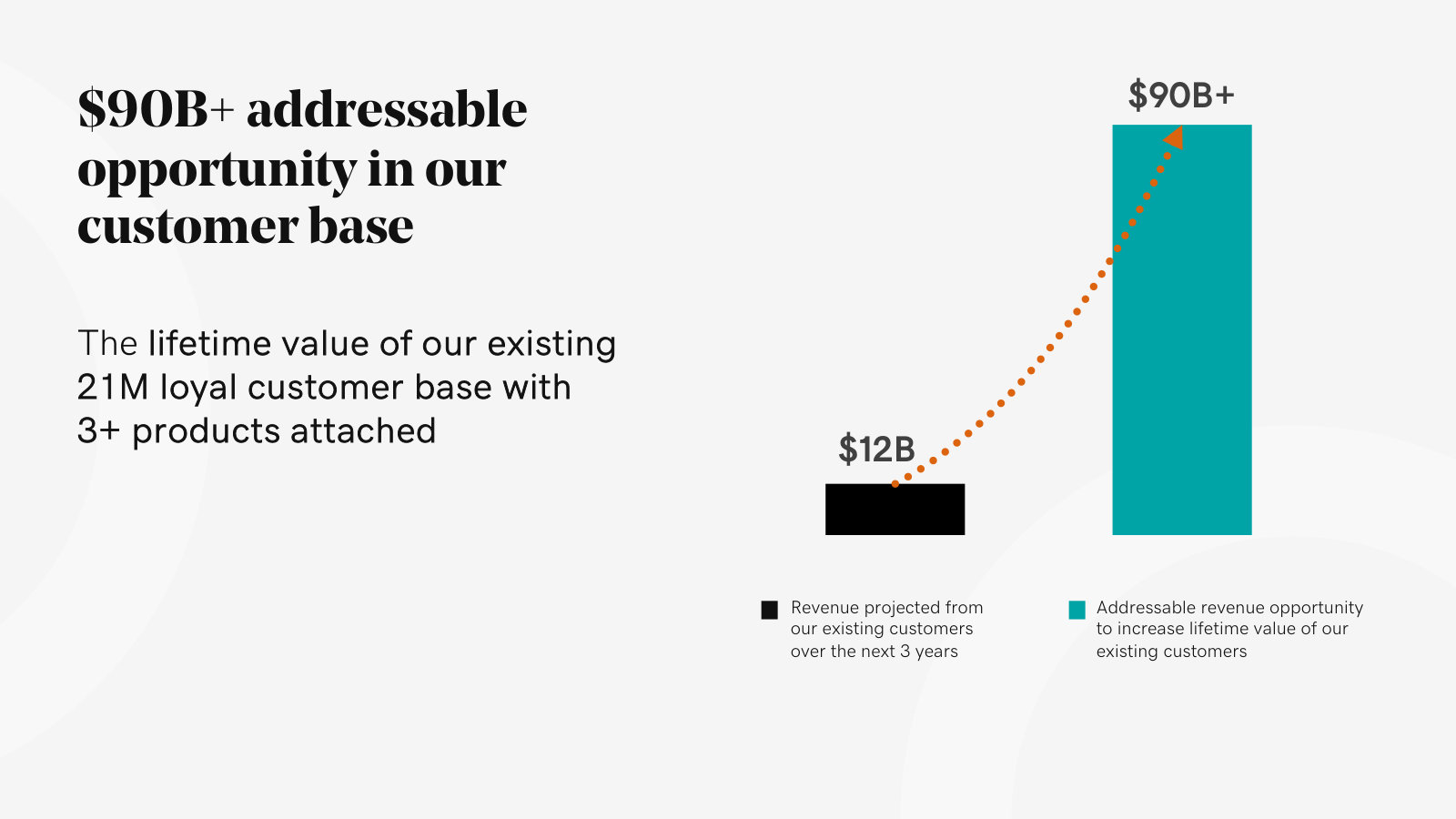
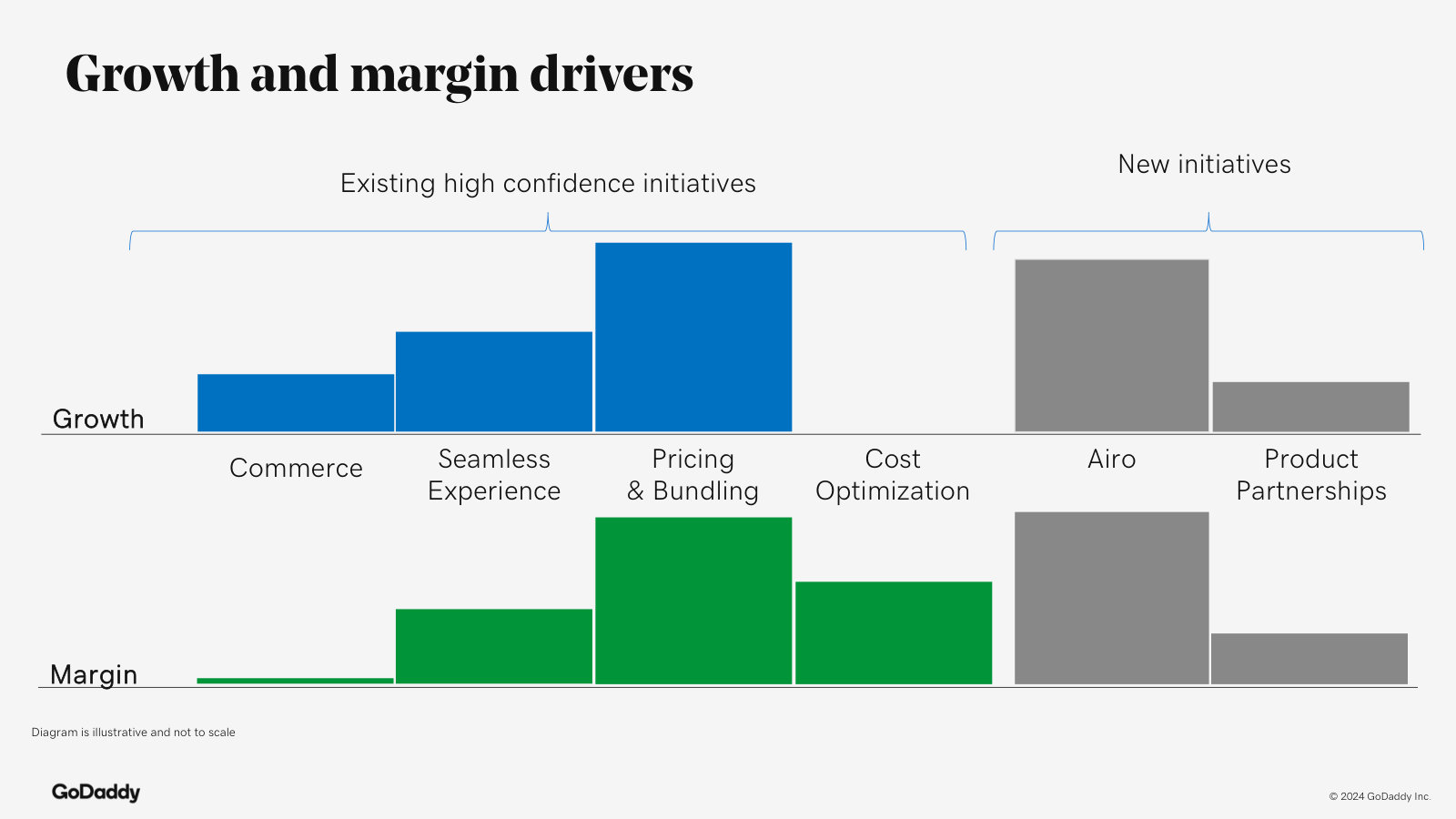
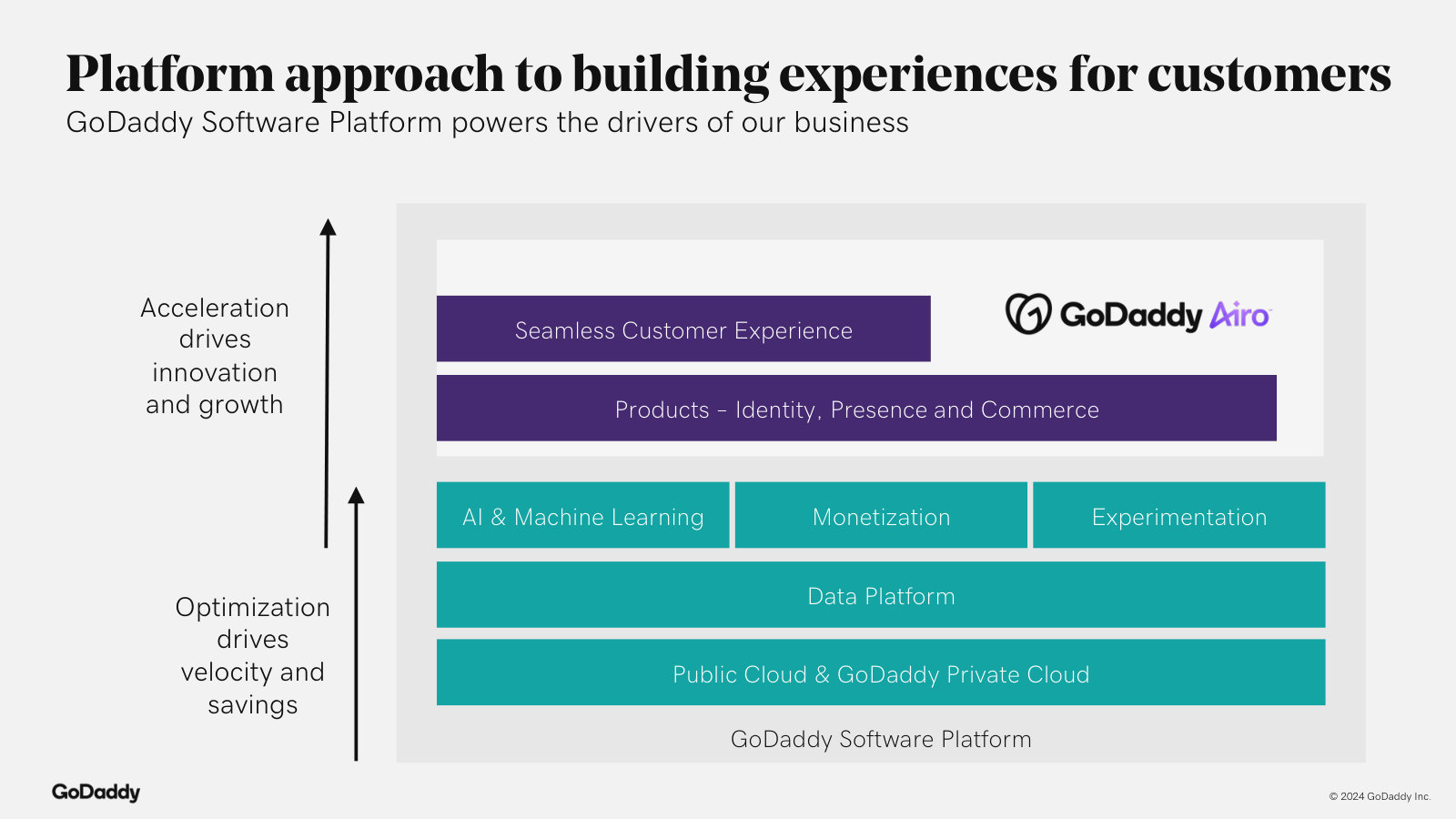
Management's fullest statement of strategy, business model, segments, unit economics and financial targets — the best zero-to-understanding starting point. · Open the full document →
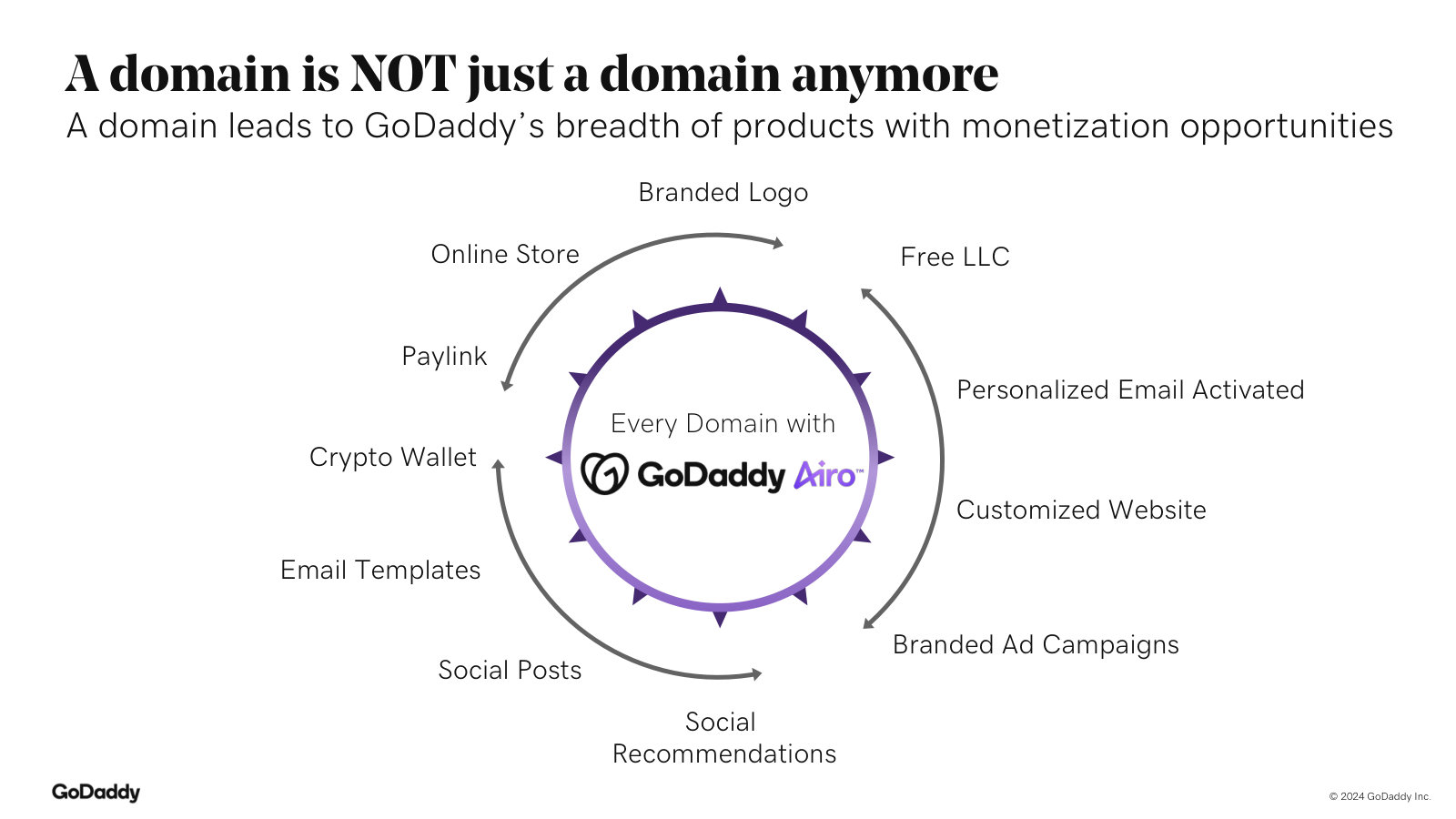

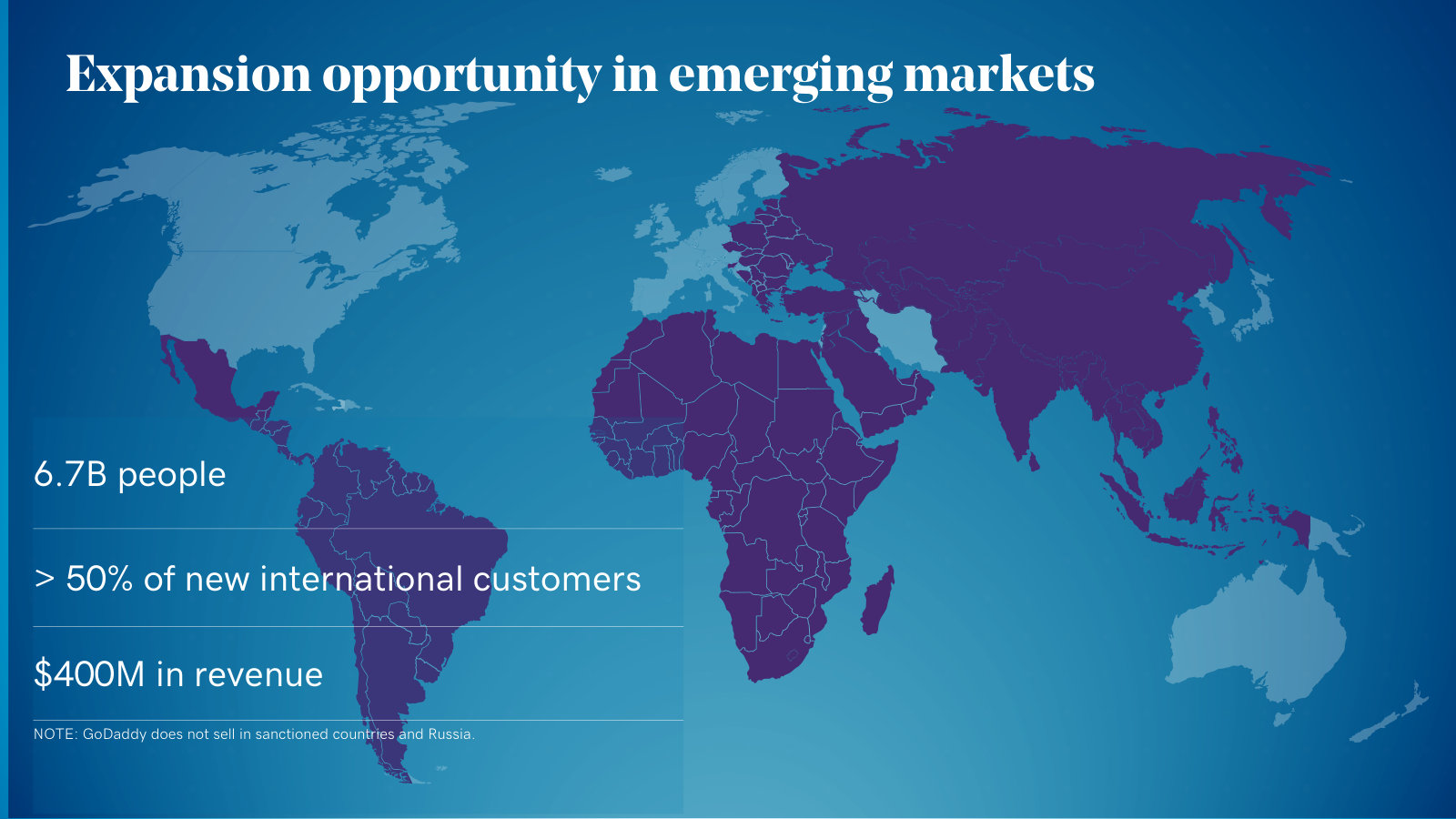
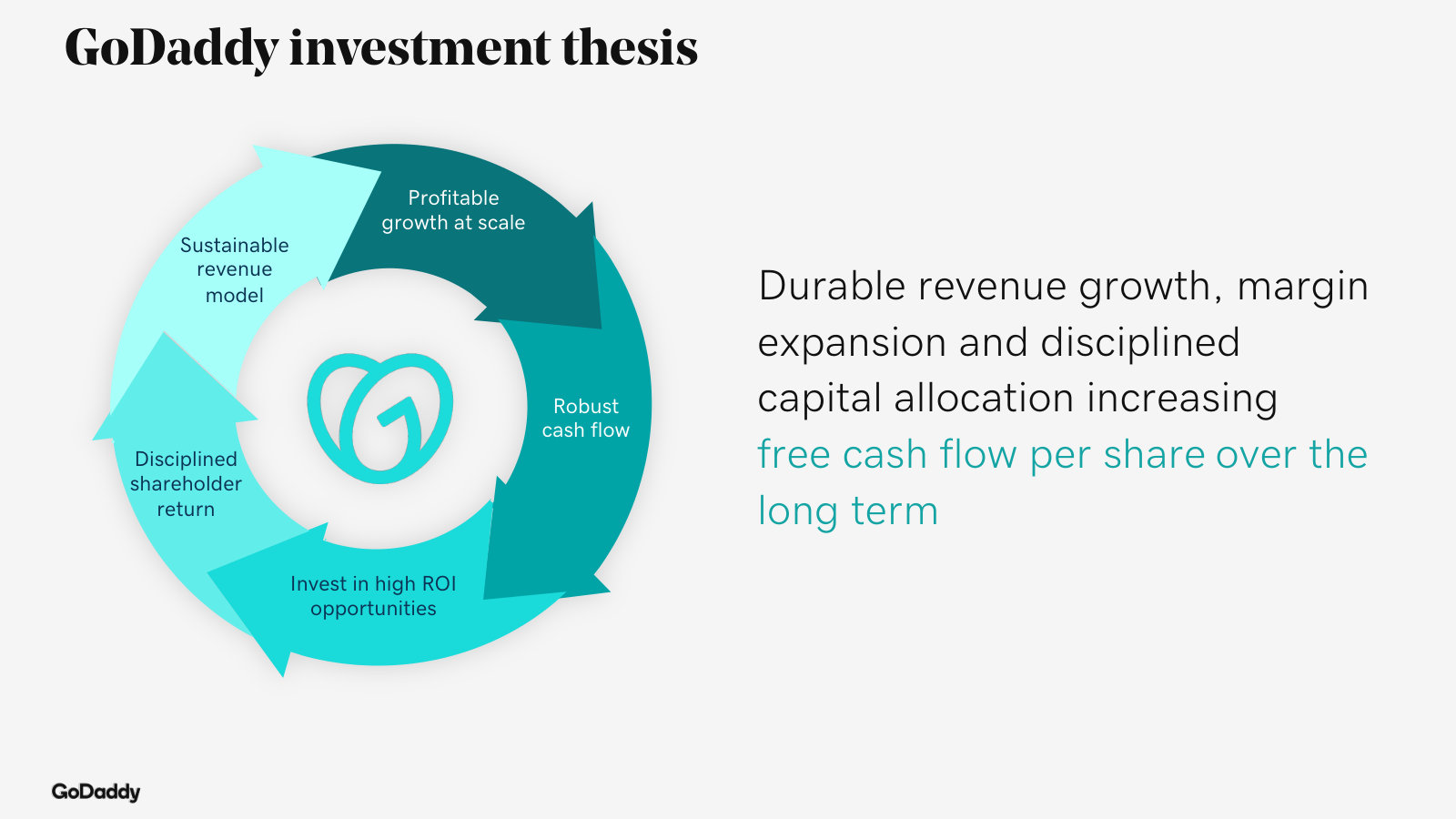
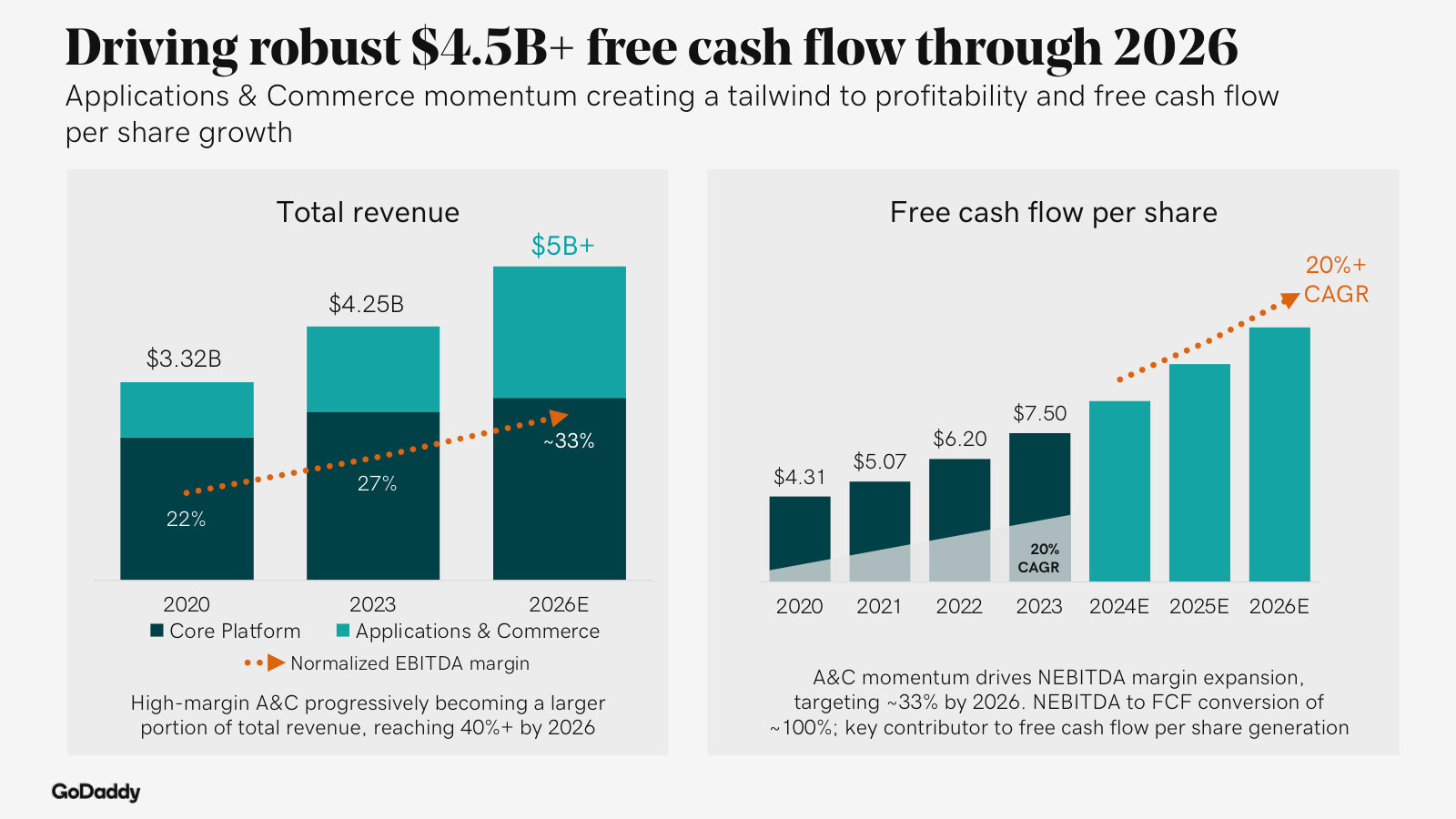
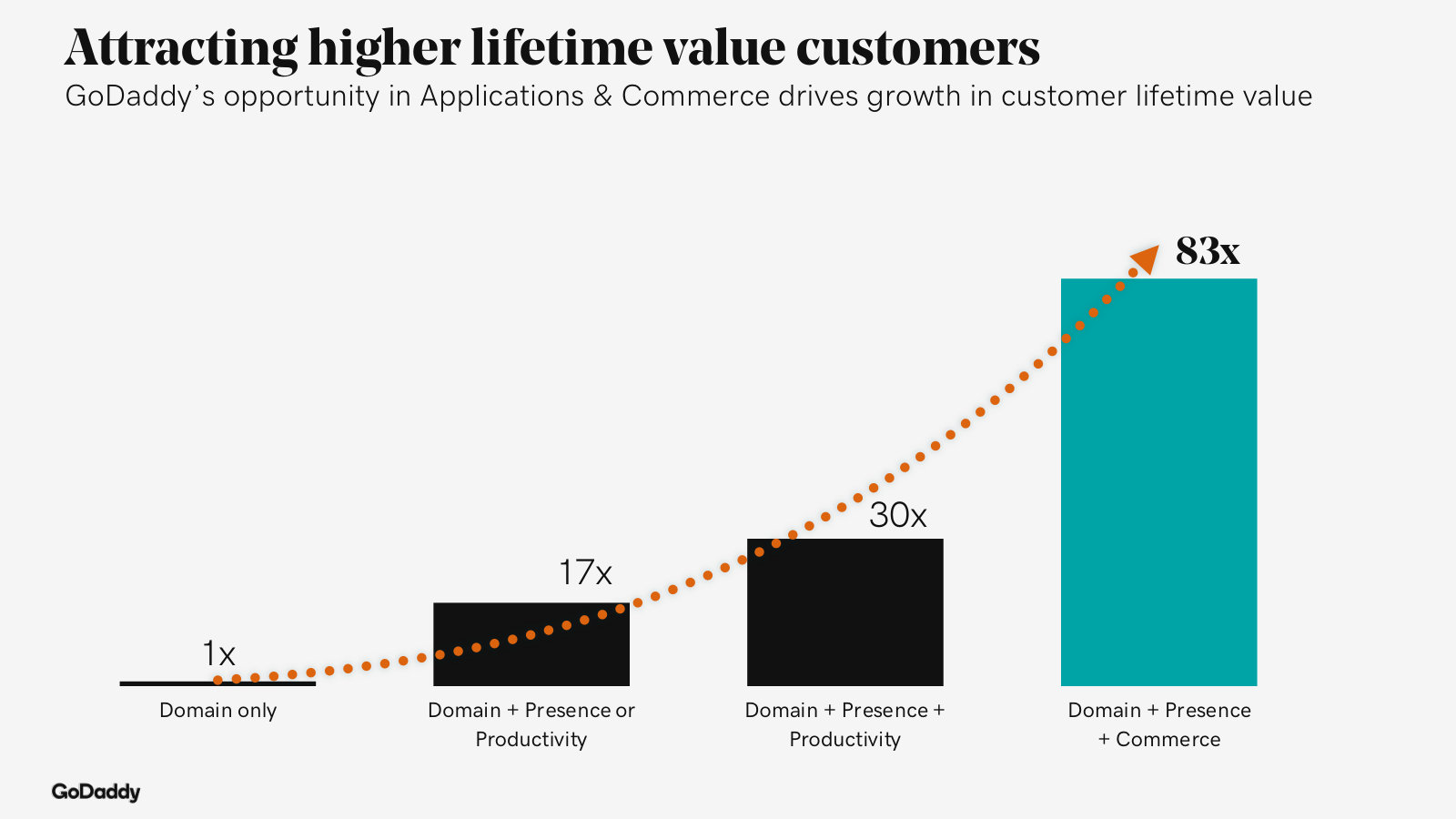
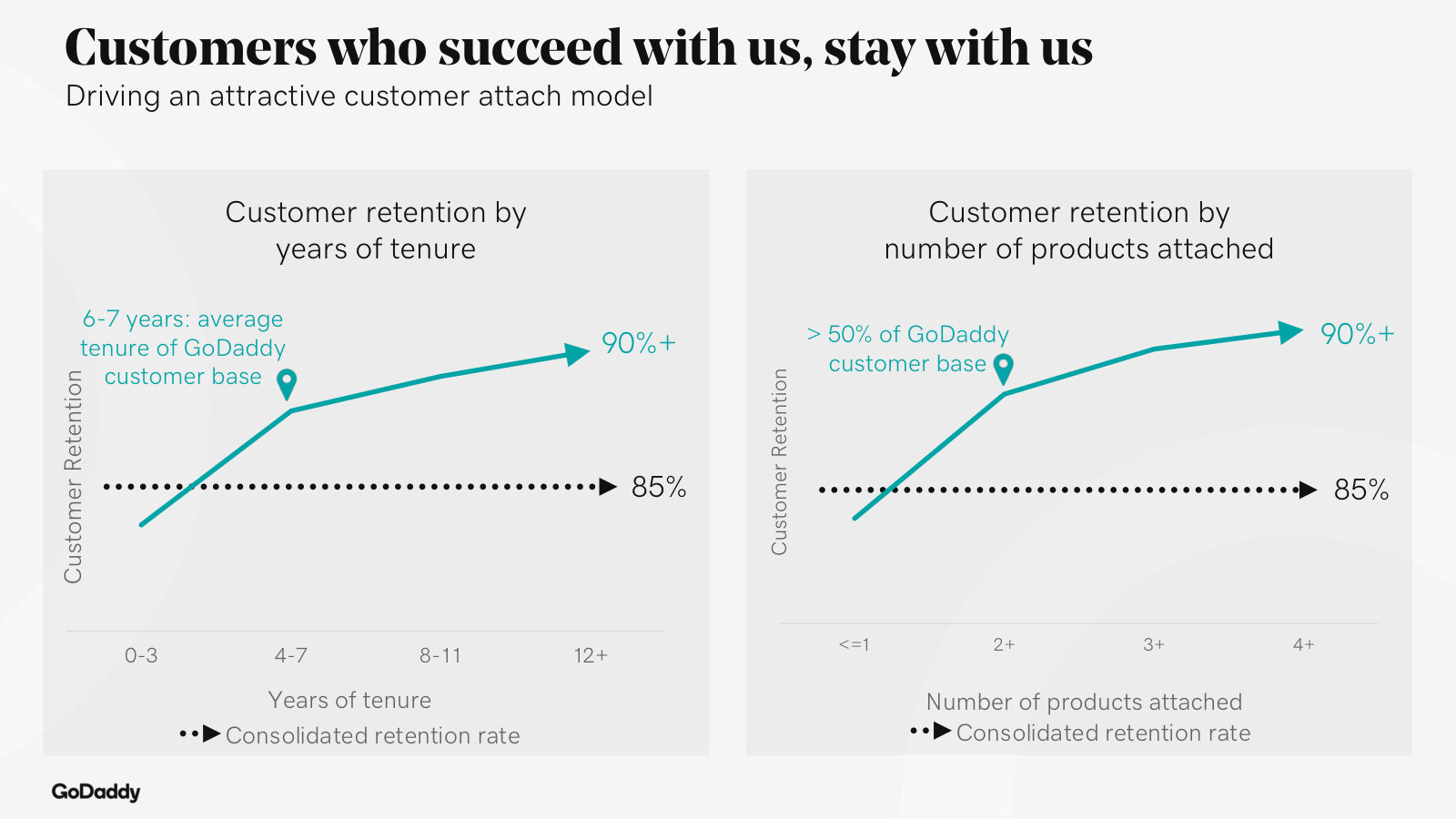
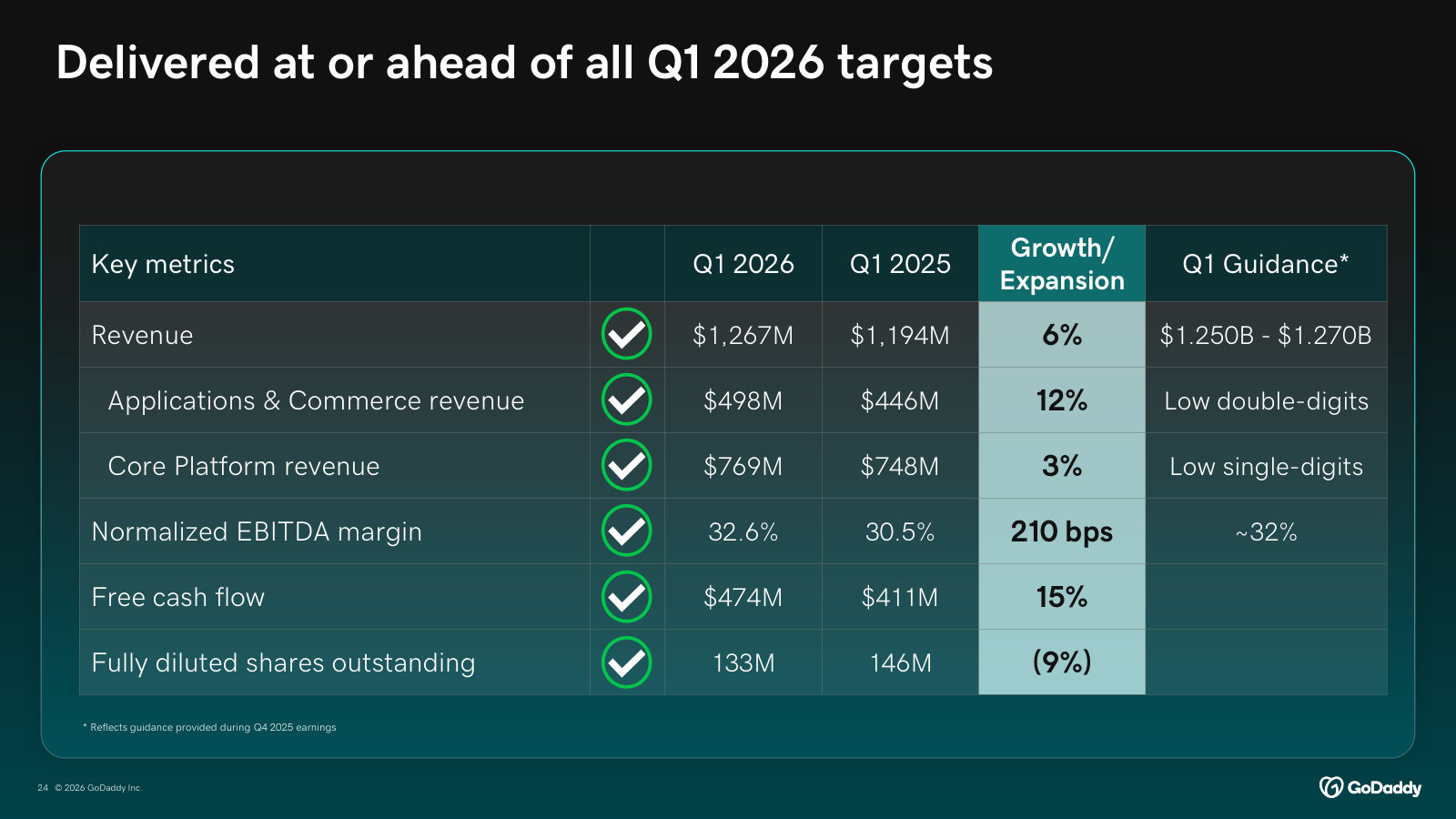
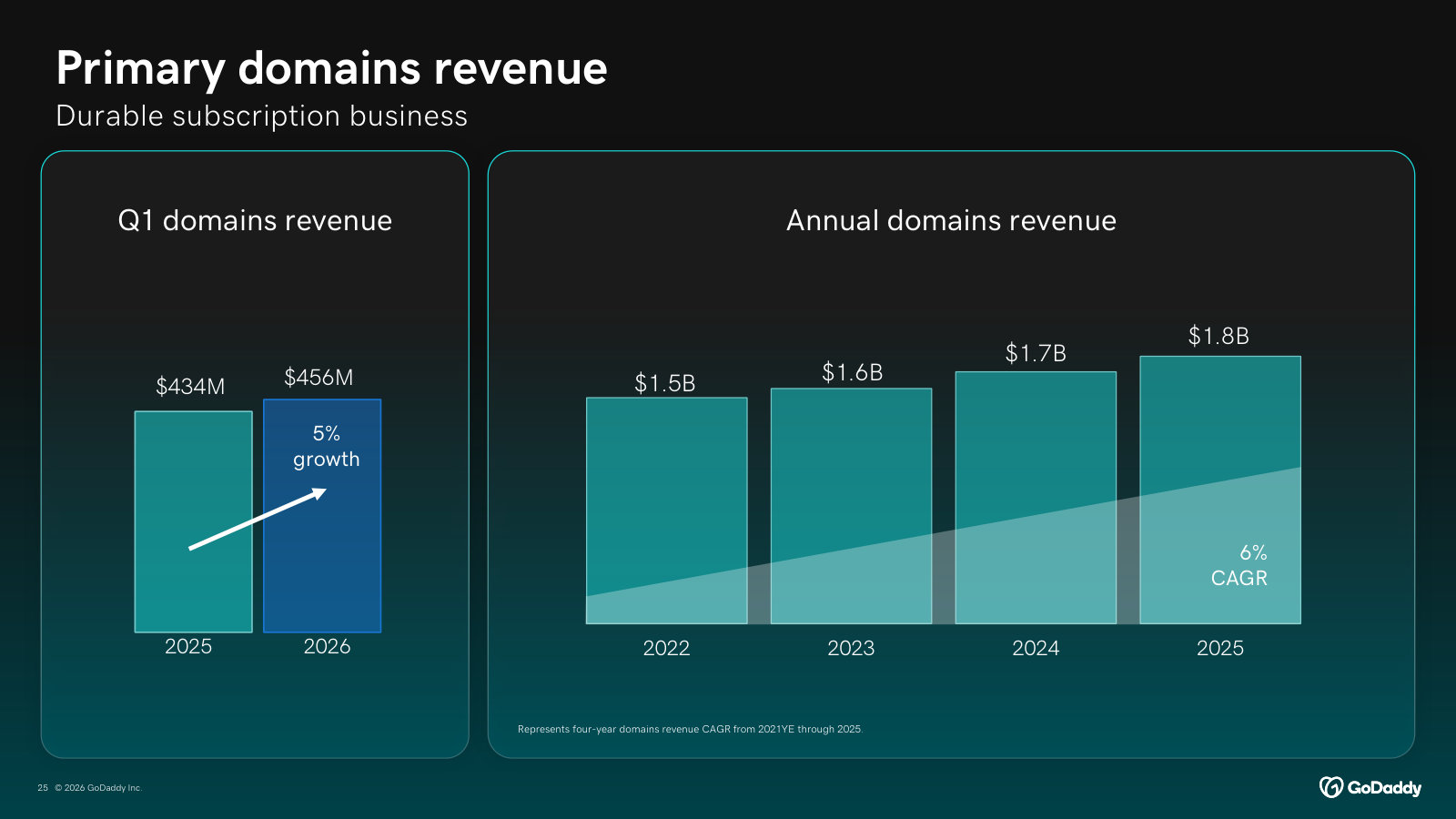
Q1 2026 Earnings Results — Q1 2026
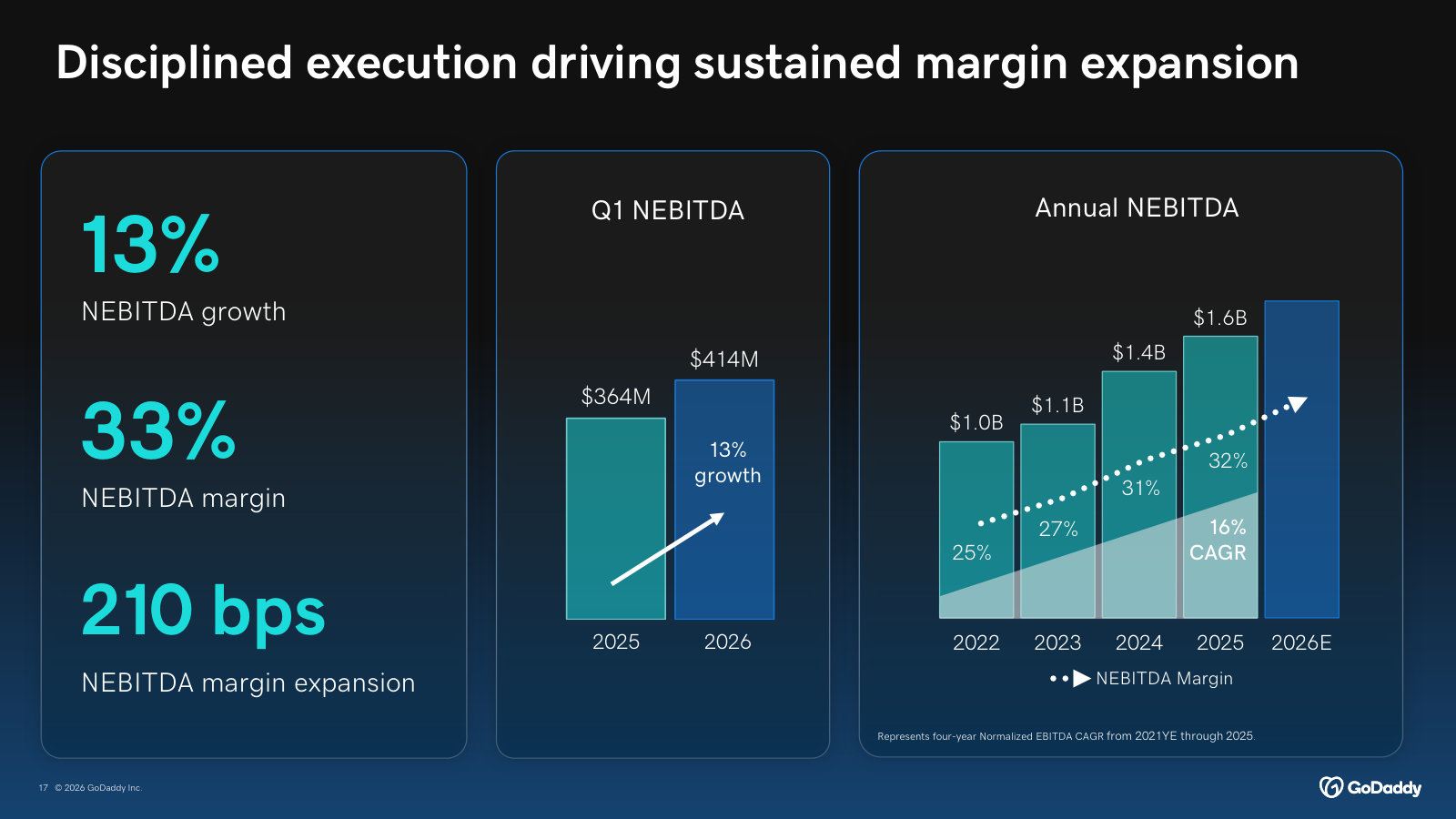
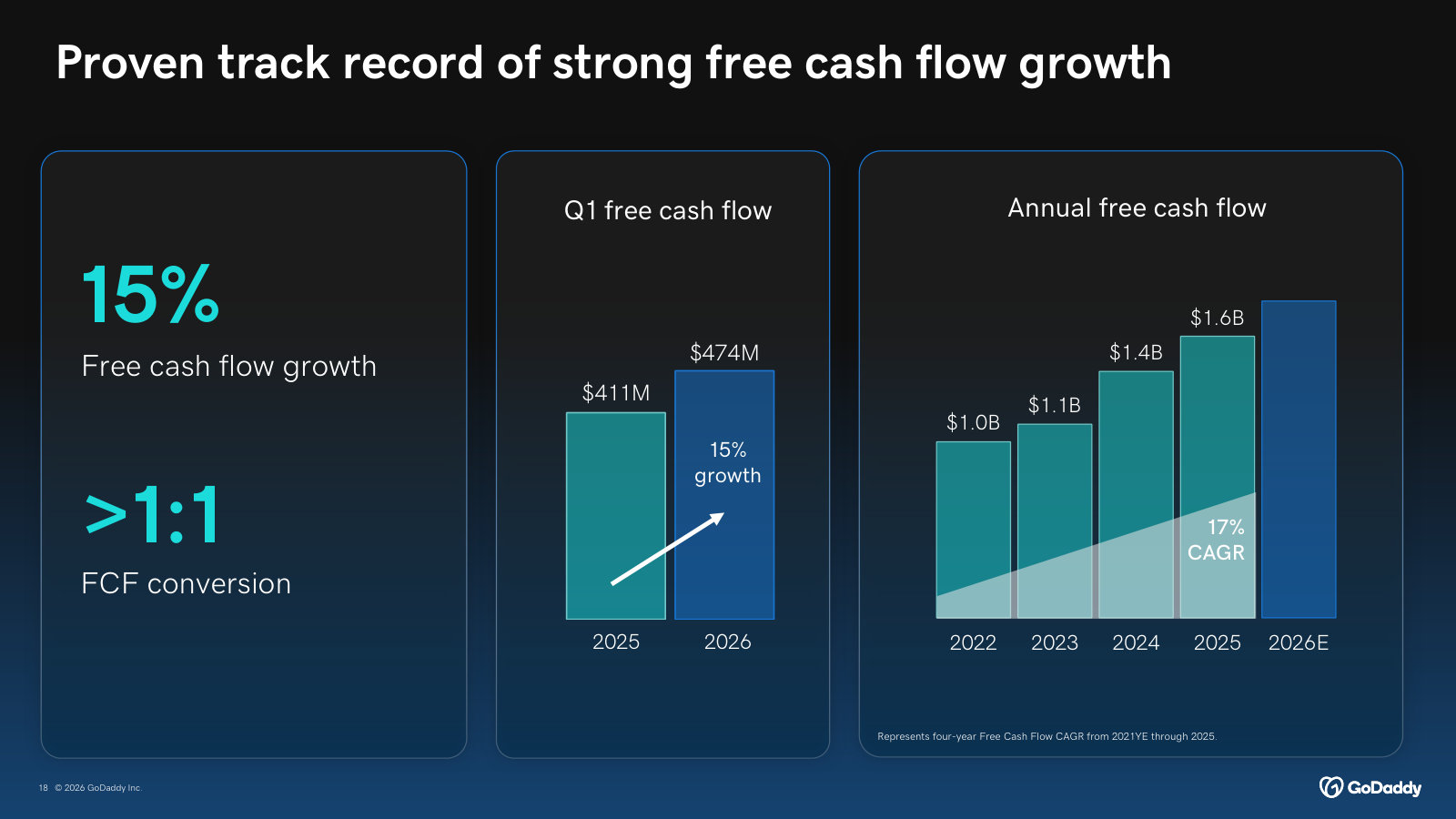
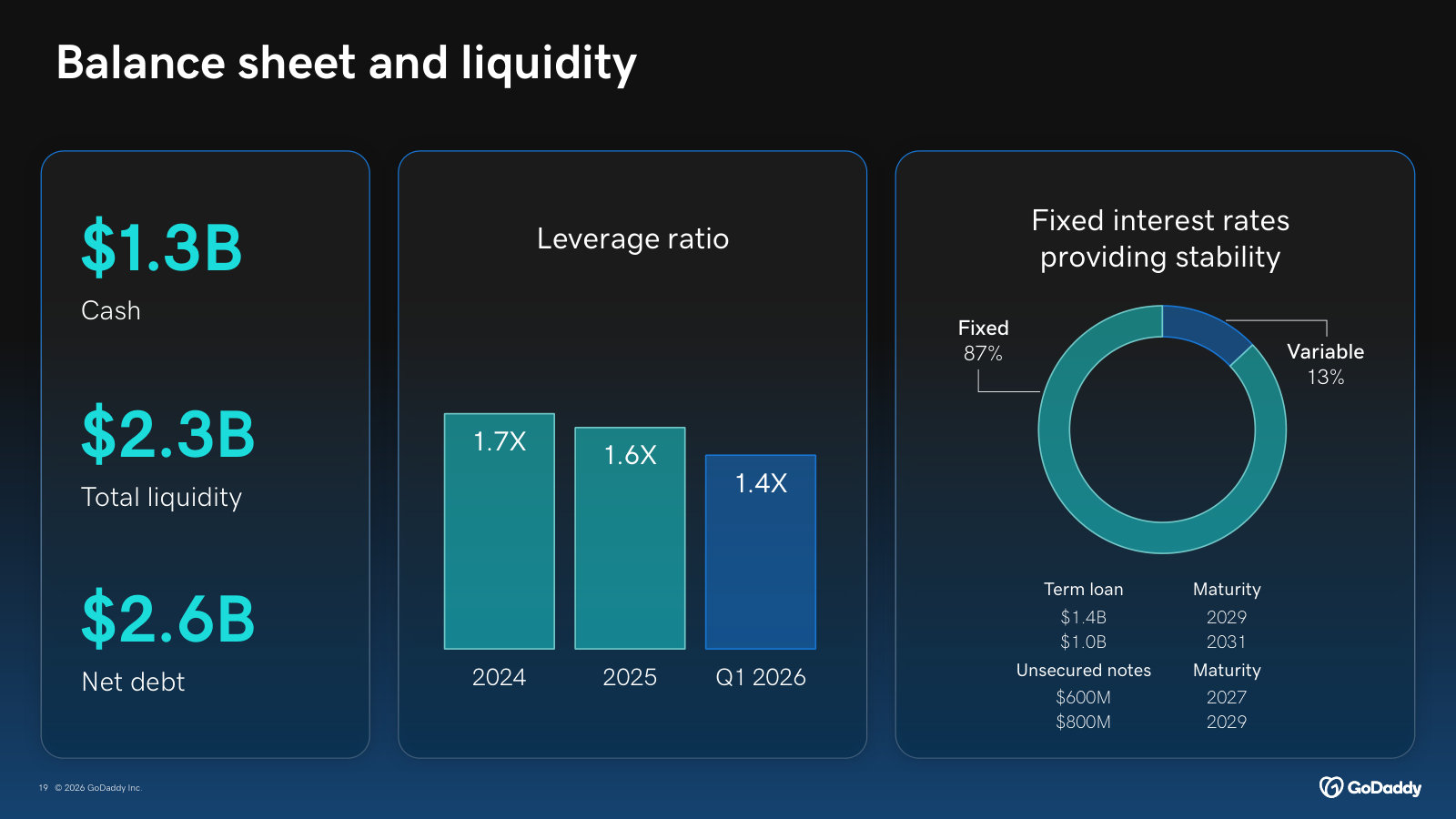
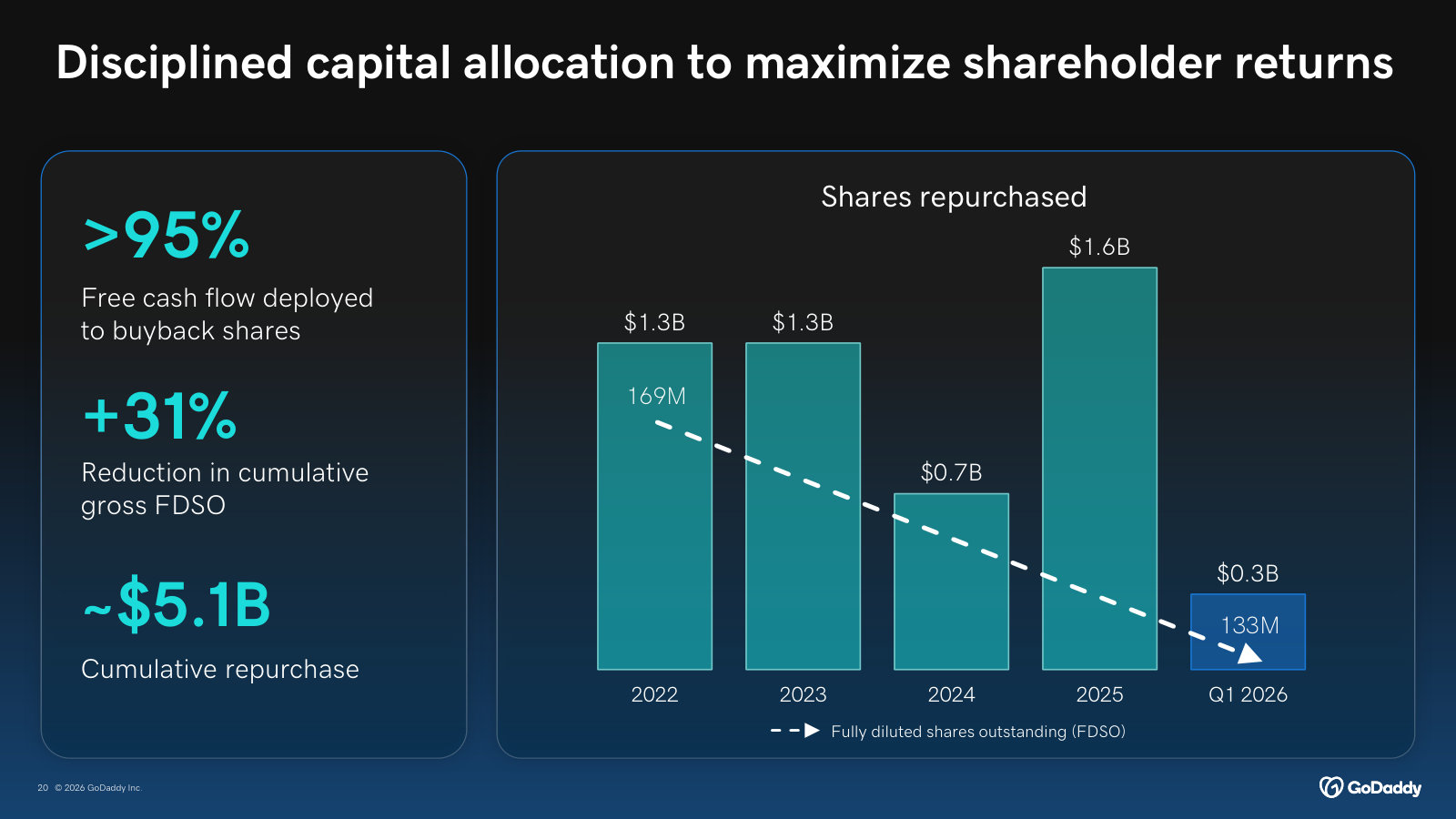
The current picture: how the AI/agentic transformation is being framed today, plus the latest segment mix, margins, cash flow and capital returns. · Open the full document →
More from management
Q3 2025 Earnings Results — Q3 2025 · 38 pages · The fullest articulation of the 'Agentic Open Internet' strategy — .ai domains, AI vibe-coding and the Agent Name Service registry. · Open →
Q4 2025 / Full-Year Earnings Results — Q4 2025 · 41 pages · Full-year 2025 results and the initial 2026 outlook and guidance that this year's quarters are measured against. · Open →
GoDaddy Inc.'s management answers for the business every quarter. These are the exchanges that explain it best — verbatim, from the call transcripts preserved in Sources. Each link opens the full transcript at that page in a new tab.
Q1 2026 Earnings Call — April 30, 2026
The most recent call: Airo AI Builder monetizing within weeks of beta, Agent Name Service pitched as a new domain-like identity layer for AI agents, and buybacks defended against a rising cash balance. · Open the full transcript →
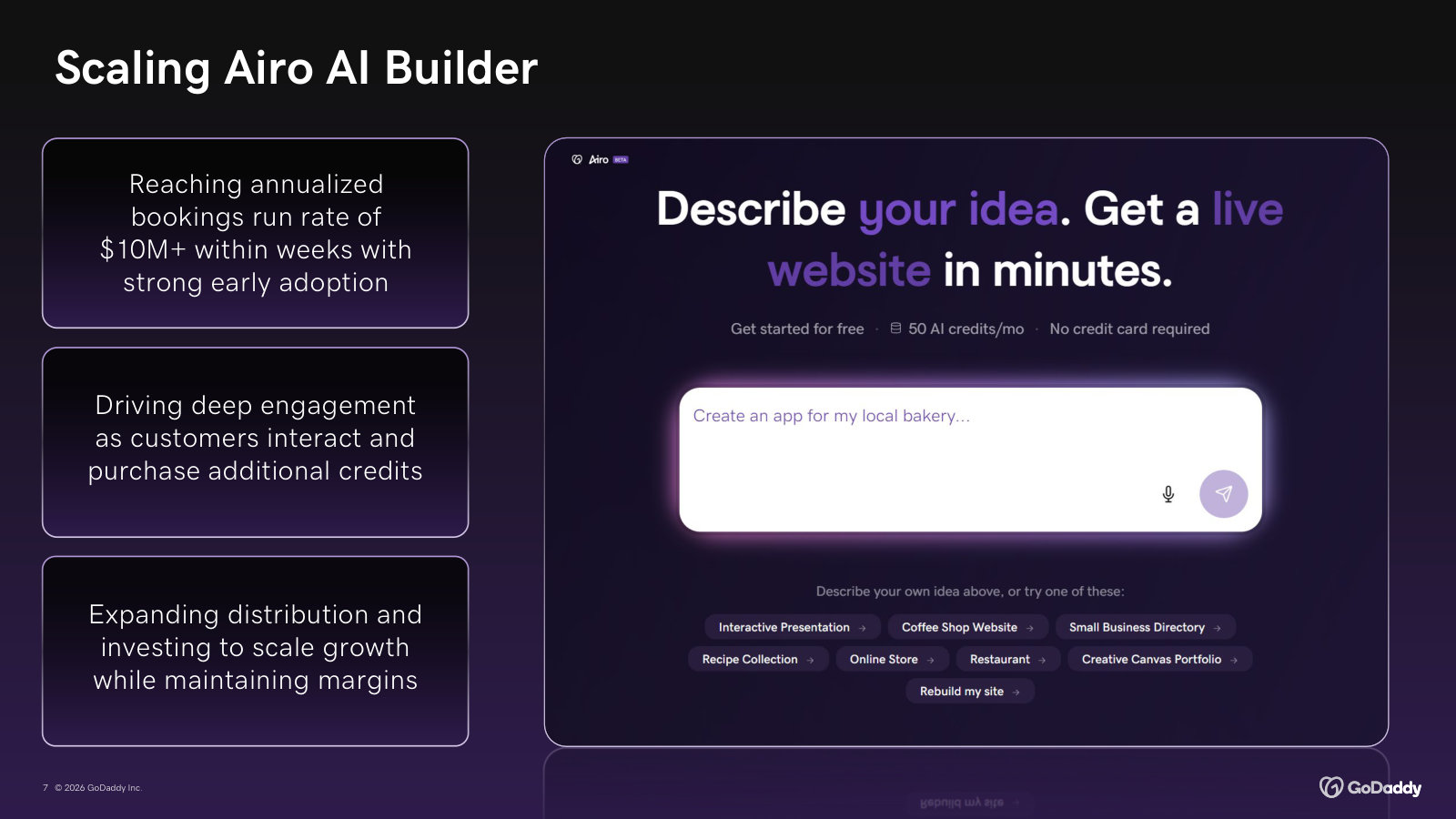
Airo AI Builder hit a $10M+ annualized bookings run rate within weeks of beta, monetizing through subscriptions plus usage credits.
Aman Bhutani, CEO: This new Airo AI Builder product offering has rapidly scaled to $10 million plus in annualized bookings run rate within weeks of its beta launch. While still early, the pace of adoption and quality of customer interaction is strong. Customers are building, publishing and purchasing incremental credits as they deepen their use of the product.
p. 2 · Read in context →
ANS a quarter on: partnerships signed and non-GoDaddy agents 'in the thousands' — early proof domains can extend into an agentic web.
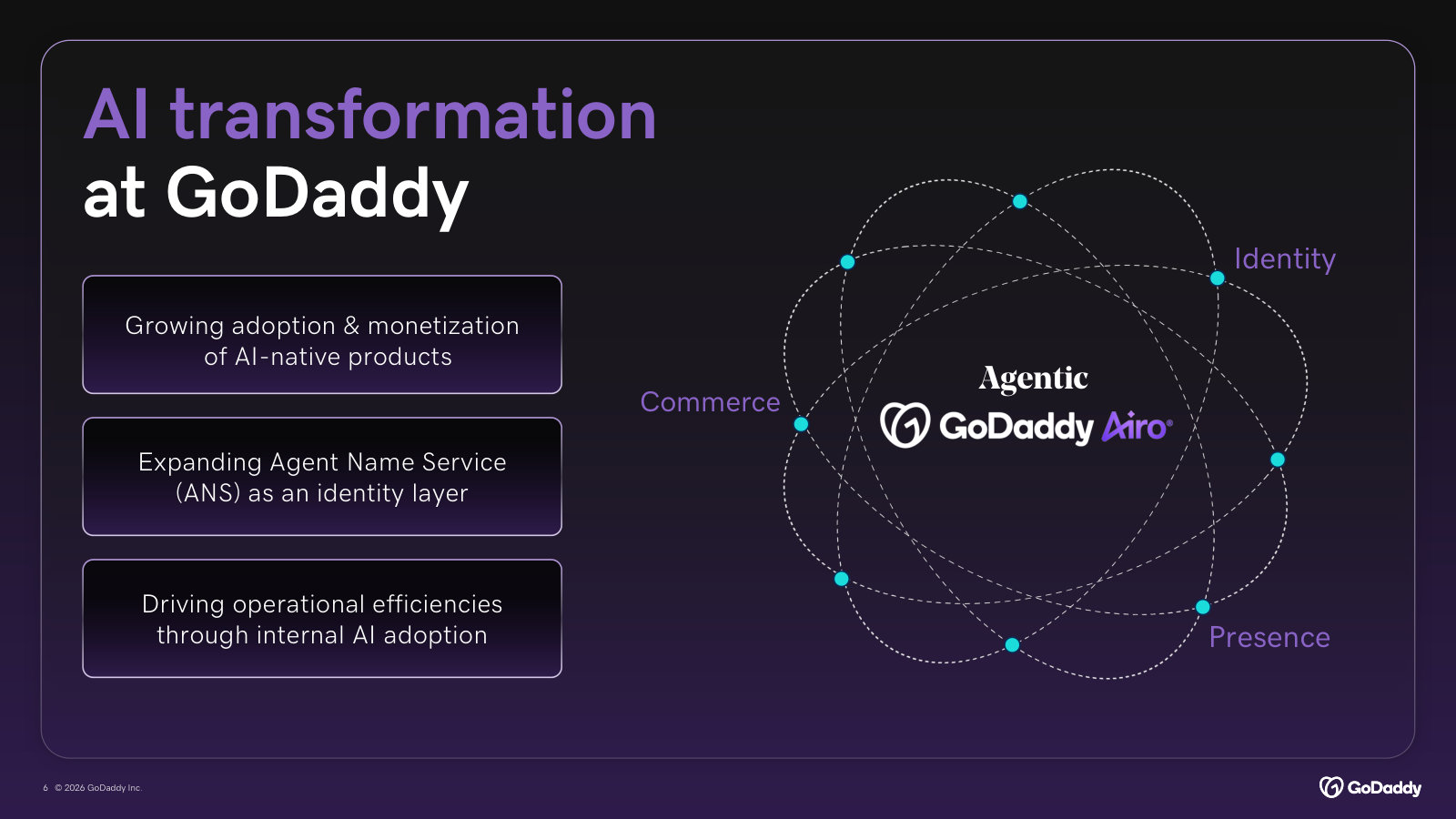
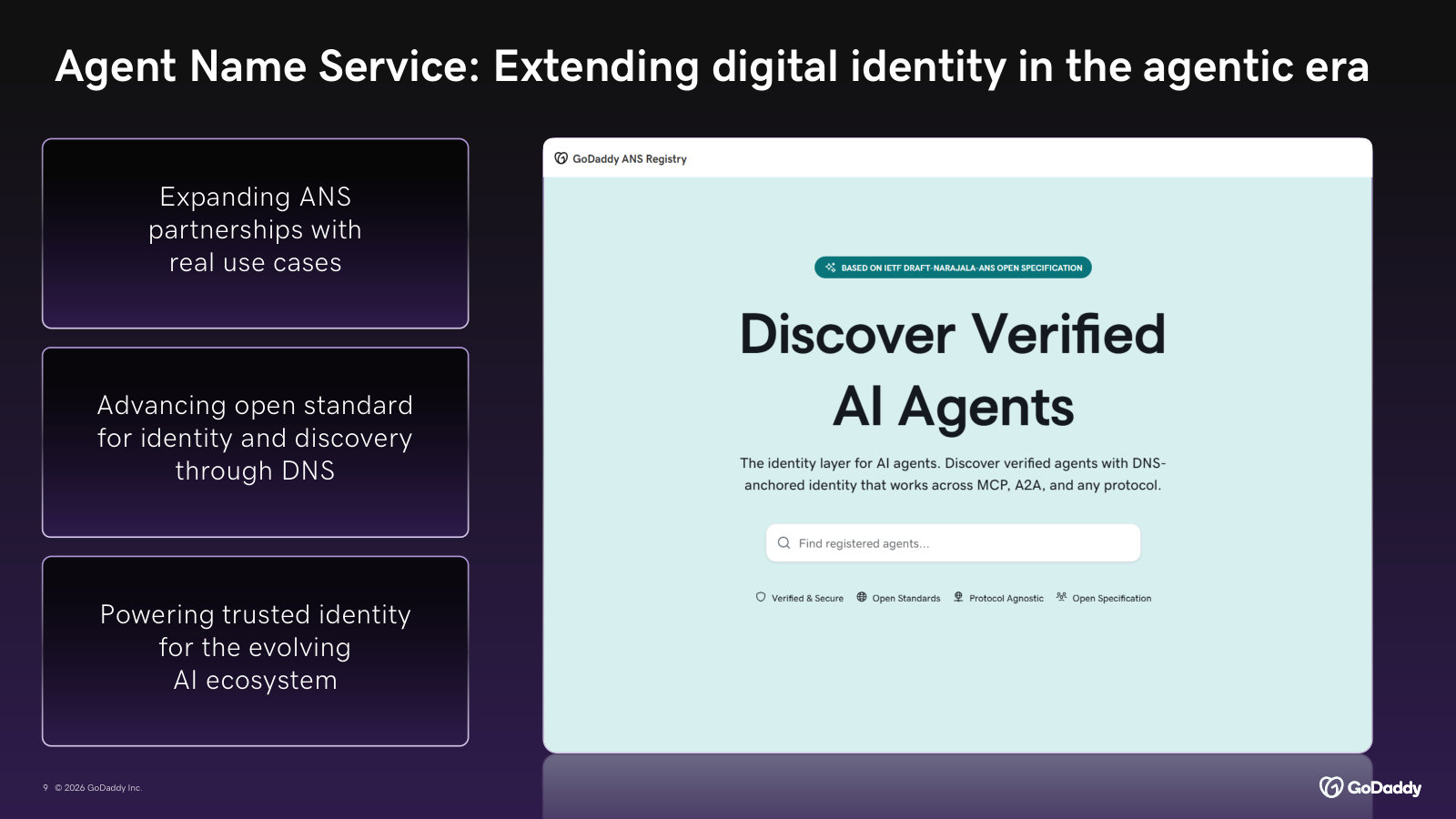
Aman Bhutani, CEO: The second component of our AI transformation is Agent Name Service or ANS. We are working with large players and seeing continued interest in this technology. ANS extends the role of domains as a digital identity provider in an Agentic Open Web. We signed a couple of partnerships over the last quarter with real-world use cases and are working hard on aligning key players on the open standard and the use of Domain Name Service or DNS for agent identity and discovery. Championing the open standard and partnerships are key to getting to critical mass of support of the open standard and we are encouraged by early results. Non-GoDaddy agents in GoDaddy's ANS implementation now number in the thousands.
p. 2 · Read in context →
The monetization engine: high-intent acquisition, pruning low-value products, and Airo cohorts attaching a second product 30% faster.
Mark McCaffrey, CFO: Our focus on attracting and growing high-intent customers combined with conversion improvements is driving durable growth and higher customer quality. We are driving increased conversion into primary domains and higher attach through Airo. At the same time, we continue to deliberately manage our product portfolio, exiting lower-value offerings and reallocating resources towards higher value opportunities. And our newer Airo cohorts are demonstrating that higher value with second product attach accelerating 30% faster relative to non-Airo cohorts.
p. 3 · Read in context →
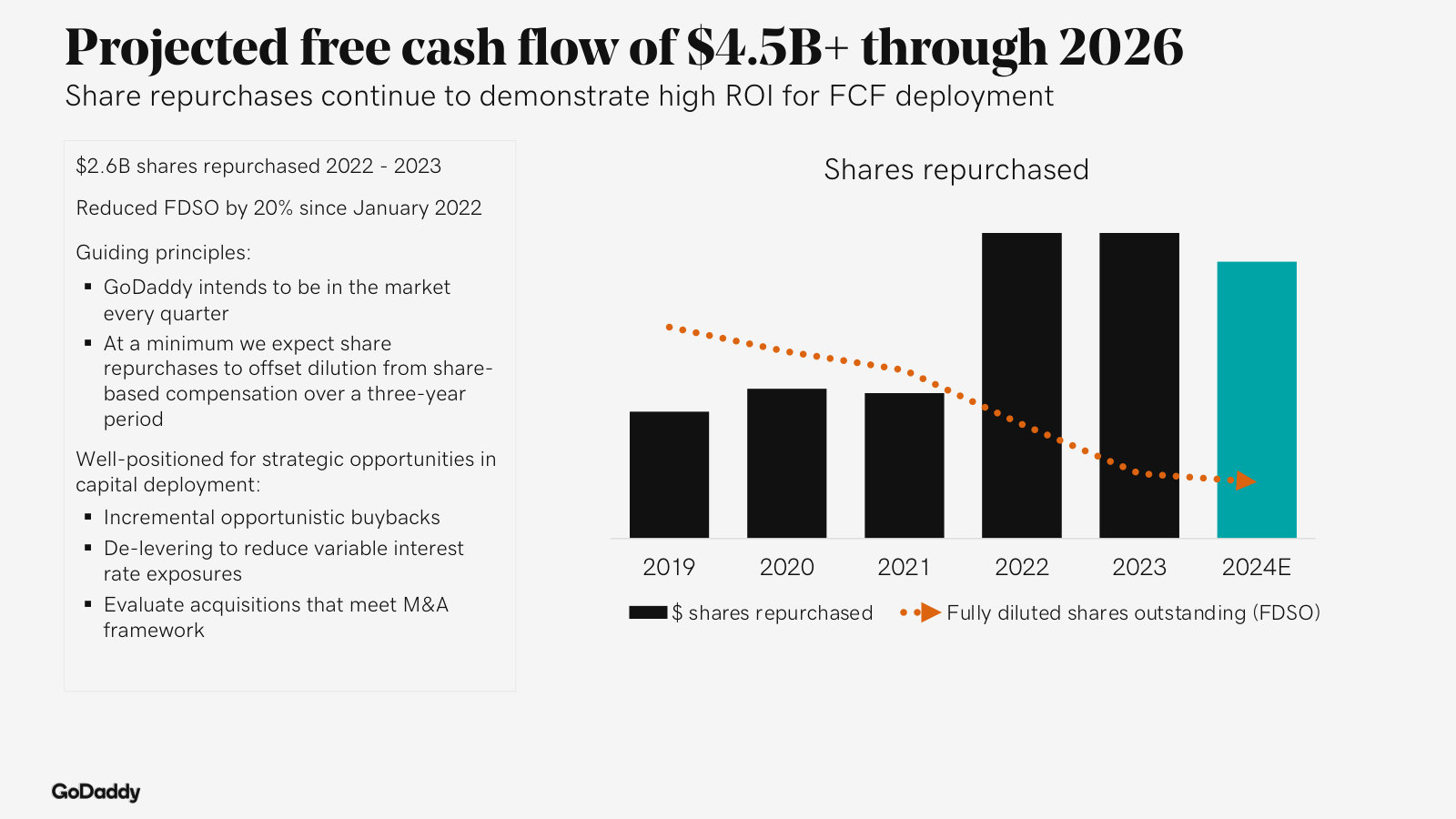
Capital-allocation policy, quantified: over 95% of free cash flow returned through buybacks across the last four years.
Mark McCaffrey, CFO: On capital allocation. We operate within a disciplined, return-based framework and have deployed greater than 95% of our free cash flow over the last four years towards share repurchases. Our continued commitment to returning capital is a clear expression of confidence and the strength of our cash flow and the long-term value we are creating.
p. 4 · Read in context →
Pressed on light Q1 buybacks with cash at a multi-year high — management says judge the track record, not any single quarter.
Trevor Young (Barclays); Mark McCaffrey, CFO: buybacks here in Q1 were well below free cash flow generation and the 95% payout stat that you've given. Meanwhile, cash at kind of the highest level since mid‑2021, if I'm not mistaken. Just any updated thoughts on capital allocation and buyback appetite with the stock at current levels? And in lieu of buybacks, any updated thoughts on M&A? […] On capital allocation, don't look at any particular quarter; look at our history — it's a good indicator of how we approach this. We look quarter by quarter, make determinations, and buybacks remain a strong lever to return value to shareholders. Our track record of returning capital shows how we approach this, and our philosophy hasn't changed.
p. 6 · Read in context →
Q4 2025 Earnings Call — February 24, 2026
The full-year 2025 call and the AI-strategy reset: a deliberate .com promo that dented near-term bookings to widen the funnel, the moat case for a 30-year data advantage, and the discipline holding margins as AI spend rises. · Open the full transcript →
The year's big bet and its bill: a .com promo to widen the funnel drew more demand than expected, cutting near-term bookings and revenue.
Aman Bhutani, CEO: We activated our marketing channels on the streamlined experience and introduced a promotional price for .com domains with a one-year term. The approach successfully increased new customer volume that purchased domain units with one-year terms. But the demand for this offer was greater than we expected. And the shift in term mix, combined with the promotional price, reduced upfront bookings and nearterm revenue.
p. 2 · Read in context →
The structural story in numbers: ~1,000 bps of margin expansion over five years converting better than 1:1 into 19% free-cash-flow growth.
Mark McCaffrey, CFO: Full year normalized EBITDA grew 14% to $1.6 billion and a margin of 32%, representing 150 basis points of expansion over the prior year. Over the past five years, cumulative margin expansion of 1,000 basis points reflects our ability to scale efficiently while continuing to invest in the business. This margin expansion flows through directly to cash generation. Free cash flow grew a robust 19% to $1.6 billion with a normalized EBITDA to free cash flow conversion of greater than 1:1.
p. 4 · Read in context →
How margins hold as AI spend rises: all AI costs run through one interface for visibility, and products built to a customer-viable cost.
Aman Bhutani, CEO: One, all the AI costs go through one interface so that we are able to stay on top of it very, very closely. It doesn't matter if that's a developer. It doesn't matter if it's one of the products that our customers are using. And two, we are very focused on solving for the objective function where we create products that are at a cost that works for our customers. So what you'll continually see in our products is an already optimized AI solution that then leads to lower costs than what you might see at some other companies.
p. 6 · Read in context →
The moat vs. AI-native entrants: brand, the domains funnel, and nearly 2 billion daily data points to tune agents to each customer.
Aman Bhutani, CEO: Our competitive advantages, of course, start with our brand. It starts with our domains funnel, the scale of our platform, and the data we have about interaction with our customers, whether it's like 1.7 billion, almost 2 billion data points selected on a daily basis, all the way from interaction on the site to customers calling and chat transcripts and all of that. And we have that data globally.
p. 9 · Read in context →
On 'vibe coding' rivals: they mostly chase enterprise users, not GoDaddy's micro-businesses — 'not immune,' but little funnel impact yet.
Arjun Bhatia (William Blair); Aman Bhutani, CEO: just as you looked at your old funnel, was there anything that sort of was indicating that the competitive intensity was increasing, especially from some of the Vibe coding players out there. And Aman, I think you touched on the moat there a little bit, but I'm curious how the new motion will maybe help you sort of defend against some of the competitors that are coming into the space? […] When I look at the competitors in the AI space, we still continue to see a lot of that focus being on enterprise employees, like product managers, people that work within enterprises or people that are a little bit sort of working for agencies or companies like that. We see less of that behavior with our direct customer, the person who is the roofer, the cleaner, some micro business owner. So we see less of that. Our expansion of go-to-market is really about being able to bring more high-intent customers into the domains funnel, which is our largest funnel and then attach to it very well. Like that is the primary motion at our company, and we want to continue to reinforce that more and more. I'm not suggesting that we are immune to what's happening in the world, we just have not seen a very large impact of that in our funnel yet or at this time.
p. 10 · Read in context →
Q3 2025 Earnings Call — October 30, 2025
The landmark agentic-pivot call: Agent Name Service launched as an identity layer for AI agents, Airo.ai and 'vibe coding' builders unveiled, and the clearest statement of the domain registrar's 'right to win.' · Open the full transcript →
Agent Name Service launched: verifiable identities for AI agents, built on DNS as an open standard — staking the agentic-identity claim.
Aman Bhutani, CEO: Working back from that vision, we launched GoDaddy's Agent Name Service or ANS. Built on DNS infrastructure and proposed as an open standard. GoDaddy's ANS provides verifiable identities for AI agents. By registering agents with ANS, value is immediately created for publishers by providing their agents with a verifiable identity. Value is also created for consumers of ANS since they can securely discover and validate agents across the open web. While many companies are beginning to explore this idea, we are excited to be leading the way.
p. 2 · Read in context →
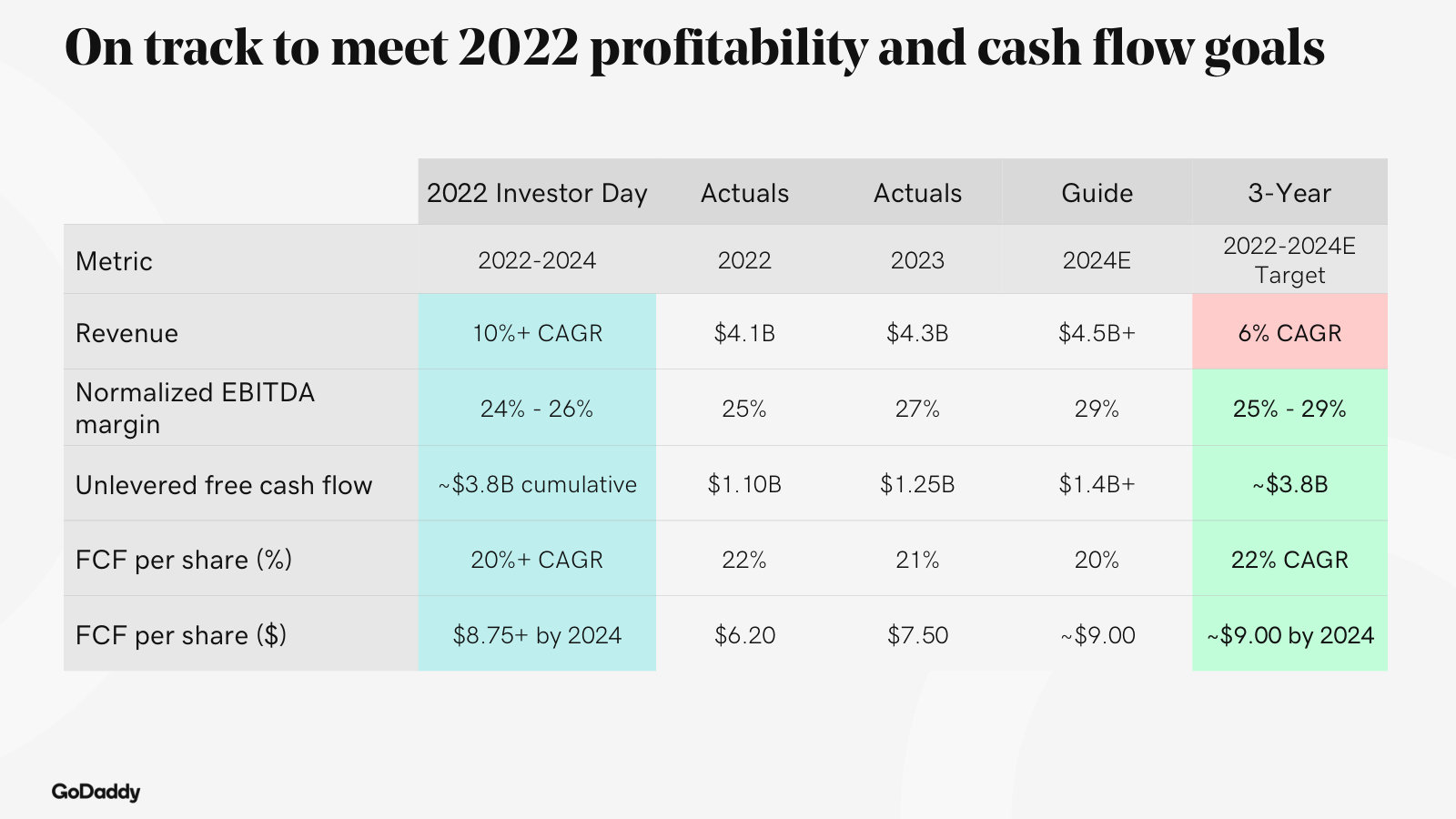
The North Star and its engine: on track to beat a 20% FCF CAGR, powered by a $500+ high-retention cohort now ~10% of the base, ARPU +10%.
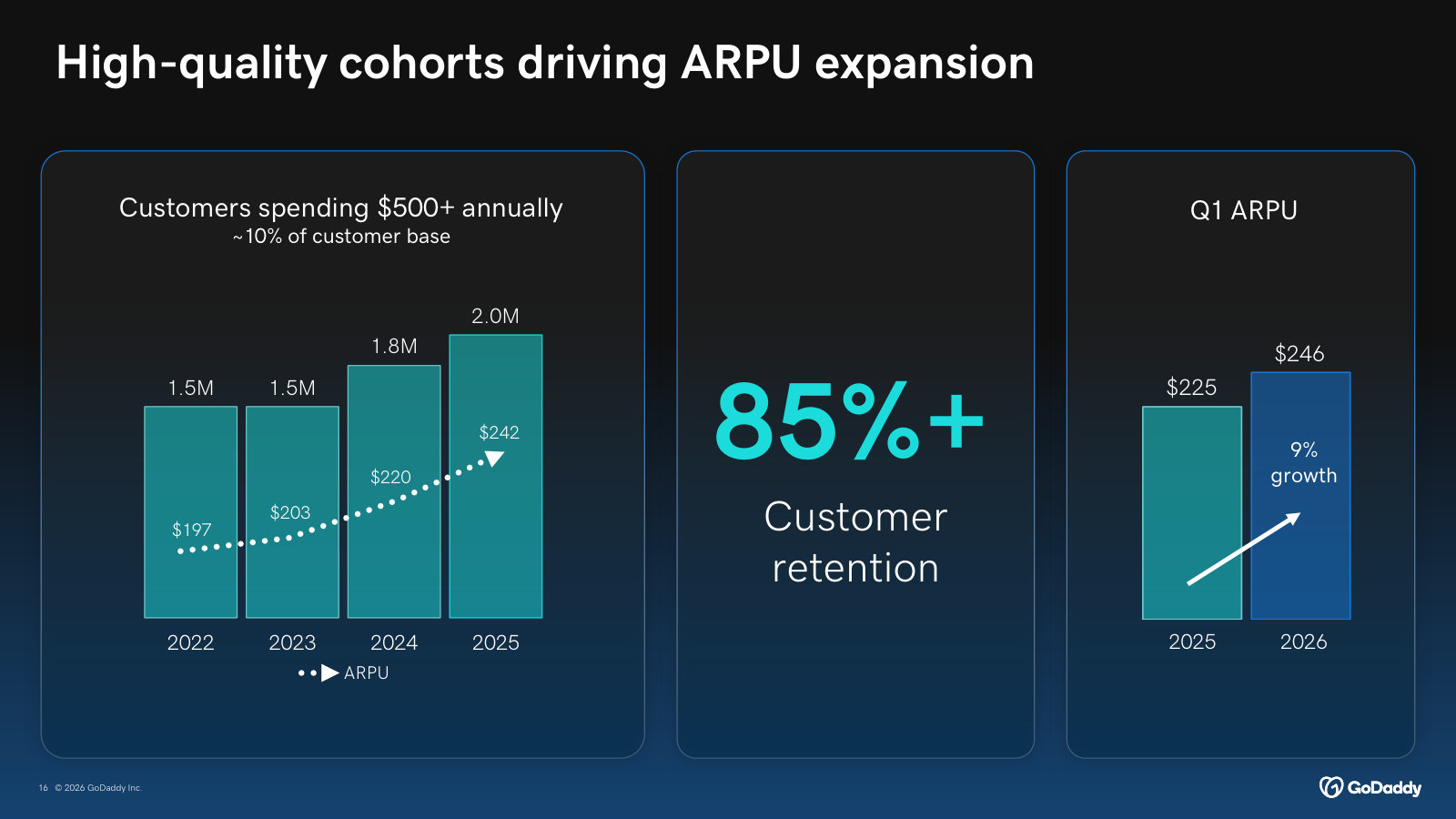
Mark McCaffrey, CFO: Taken together, we are on track to exceed our Investor Day North Star commitment of a 20% CAGR. How are we getting there? As Aman mentioned, our strategy that elevates GoDaddy Airo as our primary customer engagement engine is hitting its stride. High-intent customers are adopting more products, spending more and generating higher lifetime value. Our $500-plus customer cohort now represents approximately 10% of our base, and this cohort has higher attach and near perfect retention, boosting our ARPU up 10% to $237.
p. 3 · Read in context →
How work changes: 3–5-person teams ship with ~90% AI-written code — the bottleneck shifts from writing code to everything around it.
Aman Bhutani, CEO: Now what we're seeing is teams of 3 to 5 that are using AI in the new products, 90% of the code ultimately is being written by AI. So the inefficiencies are really less and less in writing the code part and it's everything else around it.
p. 6 · Read in context →
Its right to win, by analogy to SSL: the domain start-point plus certificate-authority role make DNS-anchored ANS its claim on agent trust.
Ken Wong (Oppenheimer); Aman Bhutani, CEO: We think back to the past, it was clear you guys had a right to win in SSL, given that the website journey starts with the domain, starts with GoDaddy. Help us understand what the rationale might be for why GoDaddy can serve a similar purpose in the Agentic Internet? […] If we look back to the advent of the Internet, the solution to the identity issue wasn't just websites; it was domains and DNS that initially addressed it. Agents need to be registered so that different companies, domains, or systems can trust and verify the claims made by these agents. This is the role of the Agent Name Service. By linking it to the DNS infrastructure, one of the fundamental building blocks of the Internet, we are leveraging the core principles of how the Internet functions. The Agent Name Service goes beyond just registration; it can embed certificates, and since GoDaddy is also a certificate authority, these certificates are integrated.
p. 7 · Read in context →
Q3 2024 Earnings Call — October 30, 2024
Airo moves from promise to proof — the paywall mechanic and 40% of new website subscriptions originating in Airo — plus the clearest explanation of how pricing-and-bundling actually works. · Open the full transcript →
Airo's first hard proof: ~3M customers reached, over half engaged, and 40%+ of new Websites + Marketing subscriptions now originate in Airo.
Aman Bhutani, CEO: Nearly 3 million customers have discovered Airo with over half of them engaging with the experience. We are pleased with the momentum in discovery and engagement, and just as exciting are the proof points we are driving in Airo monetization. With many months of data, we can clearly see that the largest engagement winner is website building. Over half of engaged users published a coming soon page, which is a customizable one-page website. Customers engaged with Airo are quickly becoming the largest funnel for websites plus marketing; with over 40% of websites plus marketing paid subscriptions in Q3 originating with the Airo experience.
p. 2 · Read in context →
How pricing works: test price points to map the elasticity curve, pick cohorts balancing churn vs. upside — now reaching Core Platform.
Aman Bhutani, CEO: The way we do this is by experimenting at different price points to find the price elasticity curve. What that curve helps us do is find the right cohorts where we can balance attrition for customers, right, or let's say, retention of customers with the pricing opportunity in front of us. […] So what I'm really talking about here is that we have identified other cohorts of customers that we will be applying this approach to. Some of those are going to have products that sit in the Core Platform, which is now going to take sort of the benefit of pricing and bundling across both segments.
p. 5 · Read in context →
The monetization mechanic: an in-context paywall at the moment of engagement pulls attach forward from months later — and drives that 40%.
Aman Bhutani, CEO: Over the last quarter or two, we started to put up paywalls where, along with that engagement, if, for example, a customer got a coming soon page and wanted to customize it a little bit, if they wanted to do more, a paywall would appear and say you need to buy a subscription or websites plus marketing. It's possible that a customer would have bought it anyway, two months or three months down the line, and we would have gotten that attachment. But what Airo offers is the ability for us to paywall right there, getting the customer to make that decision. That paywall is connected to the 40% that I talked about today.
p. 7 · Read in context →
Engagement, not discovery, is the quality metric — and Airo was deliberately kept out of the 3-year plan to build the funnel first.
Aman Bhutani, CEO: As we spend in marketing, discovery will definitely go up, but we don't want engagement as a percentage to drop. Engaged customers enter the monetization phase in a much more favorable manner than non-engaged customers. Metrics like attached conversion do much better for engaged users than they do for non-engaged users. That's if you will, the quality metric. […] we purposefully put Airo outside of the three-year planning because we wanted to build a very large mode of discovery and engagement. That very large mode will generate sort of recurrence for years to come.
p. 10 · Read in context →
On the WP Engine–Automattic WordPress feud: GoDaddy calls WordPress 'here to stay,' casting itself as a top contributor, not a bystander.
Clarke Jeffries (Piper Sandler); Aman Bhutani, CEO: there is a notable market event in the last quarter, a disagreement between a Managed WordPress vendor and the largest contributor to WordPress. Aman, do you see that as largely irrelevant to the long-term progress of WordPress? Have you seen any kind of conversations with your customers or partners that reacted to that? […] Our focus is really to build magical experiences on top of the WordPress platform, which is the largest content management system in the world. We believe that WordPress is here to stay. We are one of the top contributors and we're part of the WordPress community. We want to harness the power of WordPress and provide seamless experiences for our users, including enhanced functionalities.
p. 14 · Read in context →
Q4 2023 Earnings Call — February 13, 2024
The foundational call: the A&C / Core Platform model, the attach → retention → LTV engine, Airo's launch and first monetization proof, payments scaling, and the free-cash-flow-per-share North Star with its buyback engine. · Open the full transcript →
Airo's first controlled test: the test cohort out-monetized the control group at once — via attach and a shift to higher-margin products.
Aman Bhutani, CEO: I am happy to share that in a controlled experiment, customers that were part of the first test cohort for the Airo experience monetized at rates higher than those customers in the control group that were not exposed to the Airo experience. The increased monetization was due to attach and shifting the mix towards higher price and higher margin products.
This is particularly encouraging because significant customer experience changes like Airo typically take many months of iterative improvement to outperform the control group.
p. 2 · Read in context →
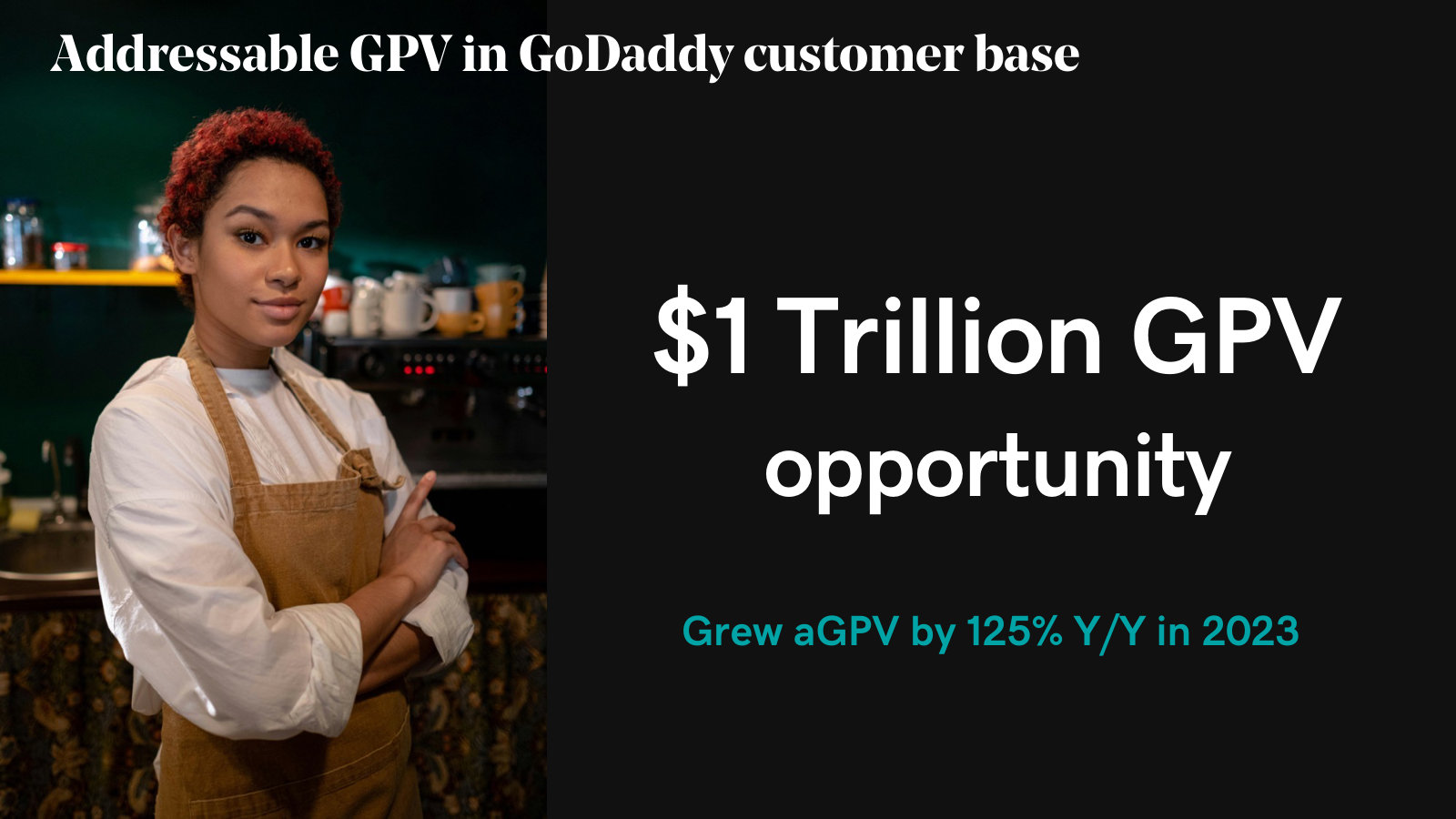
The commerce proof: GoDaddy can sell payments into its own base — 2023 annualized GPV grew 125%, its largest driver of payments growth.
Aman Bhutani, CEO: On Commerce, over the last year we proved that we can sell our payments solutions into our customer base, and it was the largest driver of GPV growth last year. In fact, annualized GPV for 2023 exceeded our expectations and grew a 125% year-over-year.
p. 2 · Read in context →
The capital-return engine: $2.6B / 34.2M shares retired cut the diluted count over 20% — the three-year target hit ahead of schedule.
Mark McCaffrey, CFO: Additionally, the cumulative shares repurchased under our current authorizations totaled $2.6 billion, representing 34.2 million shares retired. This reduced our fully diluted shares outstanding since the inception of these authorizations by over 20%, achieving our three-year targeted reduction ahead of schedule.
Our buybacks over the last two years have driven impressive ROI for this capital outlay, demonstrating our disciplined capital allocation framework and dedication to driving long-term shareholder value.
p. 3 · Read in context →
The core economic engine: second- and third-product attach powers high-margin A&C; retention rises from 85% to 'almost a customer for life.'
Mark McCaffrey, CFO: we’re seeing the demand move to that second product much faster than we had ever seen. And then now we’re seeing it to the third product much faster than we’ve ever seen. So that shows up in our A&C growth. That’s our higher profitability segment as well. […] We’ve talked about once we get to the second product, our average retention is 85%, but it goes up from there. If we get customers to a third product, it goes up significantly.
It’s almost a customer for life.
p. 7 · Read in context →
More calls
Q2 2025 Earnings Call — August 7, 2025 · 11 pages · The first hard quantification of the $500+ 'near-perfect-retention' cohort (~9% of the base) and the most direct rebuttal to AI 'vibe coding' competition; the .co registry walk-away as a discipline signal. · Open →
Q1 2025 Earnings Call — May 1, 2025 · 10 pages · The new $3B buyback authorization and sub-3x leverage target, plus the clearest walk-through of the free-Airo → Airo Plus upsell mechanic. · Open →
Q4 2024 Earnings Call — February 13, 2025 · 16 pages · Full-year 2024 results against the March-2024 Investor Day targets — the margin and free-cash-flow print that reset the bar for 2025. · Open →
Q2 2024 Earnings Call — August 1, 2024 · 13 pages · Capital-allocation priorities ranked against the FCF North Star, and the three structural EBITDA-margin tailwinds spelled out. · Open →
Q1 2024 Earnings Call — May 2, 2024 · 13 pages · The first call after the March 2024 Investor Day, testing the newly framed North Star and long-term margin targets. · Open →
Q3 2023 Earnings Call — November 2, 2023 · 12 pages · The pre-Airo integration era: margin expansion from unifying the software platform and rationalizing non-core hosting. · Open →
Q2 2023 Earnings Call — August 3, 2023 · 12 pages · Early evidence that the platform unification was lifting attach and A&C margin, ahead of the Airo launch. · Open →
Q1 2022 Earnings Call — May 5, 2022 · 29 pages · Where GoDaddy reframed reporting into two segments (Applications & Commerce and Core Platform) and laid out the three-year plan and $6+ FCF-per-share goal. · Open →
GoDaddy Inc.'s annual reports contain management's most considered account of the business. These are the sections, passages and visual pages worth opening in the originals preserved in Sources.
GoDaddy Inc. — FY2025 Annual Report (Form 10-K) — FY2025
The latest 10-K: how GoDaddy frames its business, its two segments, the drivers behind 2025 results, and the risks most specific to a domains-and-hosting model. · Open the full document →
Item 1. Business — Overview — p. 7 · Read the full section →
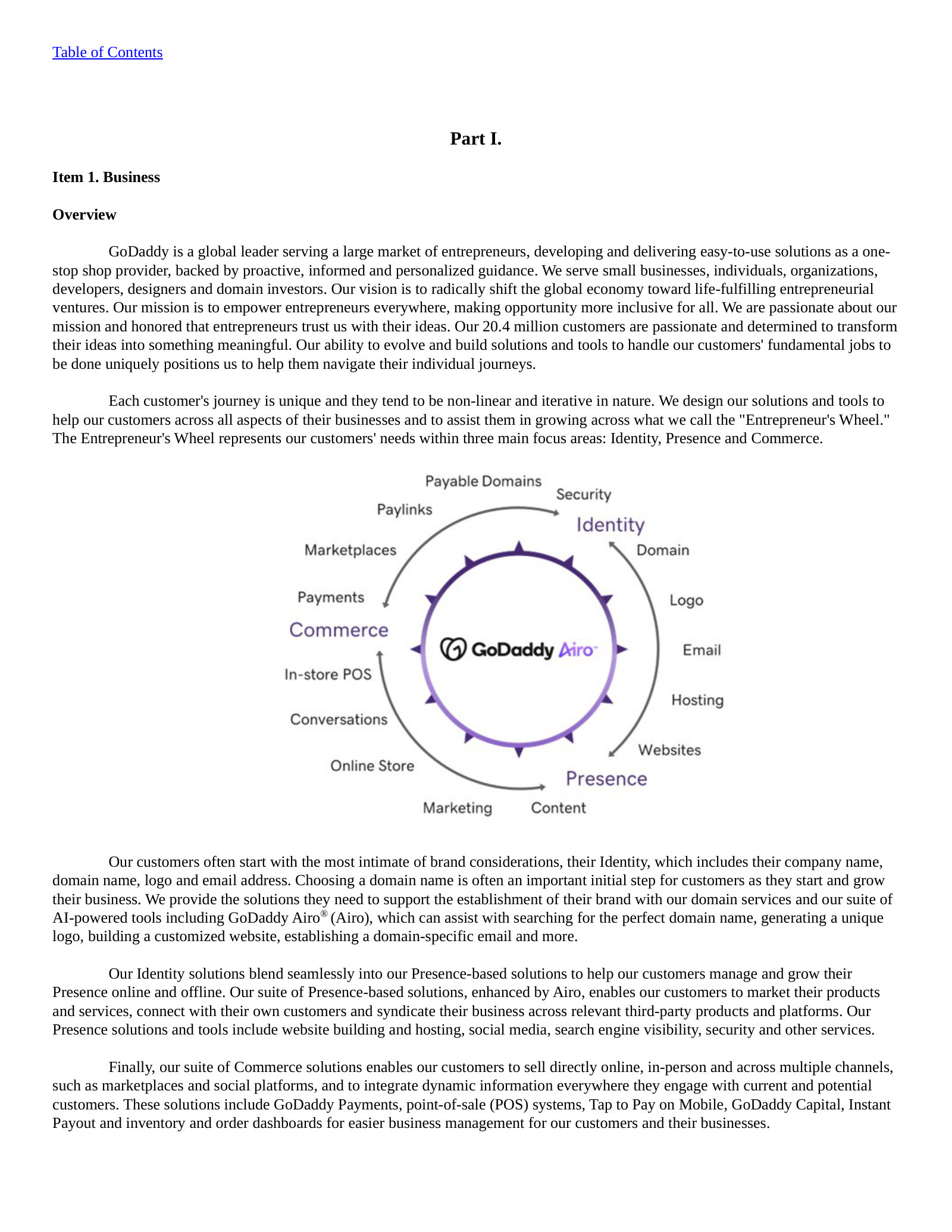
Management's own one-paragraph statement of what GoDaddy is, who it serves, and the scale of its customer base.
The business in management's words — a one-stop shop for 20.4 million entrepreneurs.
GoDaddy is a global leader serving a large market of entrepreneurs, developing and delivering easy-to-use solutions as a onestop shop provider, backed by proactive, informed and personalized guidance. […] Our 20.4 million customers are passionate and determined to transform their ideas into something meaningful.
p. 7 · Read in context →
Item 1. Business — Our Solutions and Experiences: Applications & Commerce and Core Platform — p. 11 · Read the full section →
Defines the two reporting segments and what each sells — the Core Platform (domains, hosting) still ~62% of revenue, A&C the growth engine.
Applications & Commerce — website building, e-commerce, marketing, email and productivity.
Bringing an idea to life online, establishing and maintaining a presence and continuing to grow requires the right tools and products. Website building solutions, e-commerce tools, digital marketing capabilities, email and other productivity solutions within the A&C segment are designed to help our customers start, grow and scale their presence and their businesses.
p. 11 · Read in context →
Core Platform — domains, aftermarket, hosting and security; ~62% of total revenue.
Our Core Platform products meet customers at a common starting place, establishing an exclusive, uniquely branded identity through domain registrations and renewals and an aftermarket domain platform. We also provide adjacent offerings to assist customers in building and maintaining a presence online, including website hosting and website security. During the years ended December 31, 2025, 2024 and 2023, we derived approximately 62%, 64% and 66% of our total revenue, respectively, from sales of our Core Platform products.
p. 15 · Read in context →
Item 1A. Risk Factors — Evolving technologies (AI) and changes in customer behavior may impact demand for and value of our products — p. 48 · Read the full section →
The most existential risk for a domains-and-websites business: AI and alternative systems could erode the need to register a domain at all.
As AI and social channels rise, domains and websites "may become less prominent, and their value may decline."
As reliance on social media channels, applications and AI-powered tools increases, domain names, websites and online stores and marketplaces may become less prominent, and their value may decline. […] The widespread acceptance of any alternative system, such as mobile applications, AI-powered products and tools or closed networks, could eliminate the need to register a domain name or to establish an online presence and could materially and adversely affect our business.
p. 50 · Read in context →
Item 1A. Risk Factors — We face significant competition, which we expect will continue to intensify — p. 50 · Read the full section →
GoDaddy competes across every layer of its portfolio — registrars, hosts, website builders, payments — and now against AI-native entrants.
A broad portfolio means competition on every front, from point solutions to full-stack rivals.
The market for our products and services is highly competitive, and we expect this competition to continue in the future as existing and new competitors introduce new solutions or enhance existing solutions. […] Our competitors include providers of domain registration services, web-hosting solutions, website creation and management solutions, e-commerce enablement providers, payment facilitation providers, cloud computing service and online security providers, alternative web presence and marketing solutions providers and providers of productivity tools such as business-class email.
p. 50 · Read in context →
Item 1A. Risk Factors — A delay in access to new TLDs (ICANN) could adversely impact our business — p. 79 · Read the full section →
The registrar model depends on ICANN policy; the 2026 "Next Round" of new gTLDs is a structural dependency unique to this industry.
Domain access hinges on ICANN — participation in the upcoming Next Round is a competitive necessity.
ICANN has periodically authorized the introduction of new TLDs and made domain names related to them available for registration. […] Our competitive position depends in part on our ability to gain access to and meaningfully participate in new TLDs opportunities, including the Next Round.
p. 79 · Read in context →
Item 7. Management's Discussion and Analysis — Results of Operations — p. 113 · Read the full section →
Where management explains what actually drove 2025: revenue to $4.95bn and operating margin to 22.8%, plus the initiatives behind it.
The four levers management credits for growth: seamless tech/Airo, cost optimization, pricing & bundling, commerce.
The primary factors driving growth in our business are our seamless technology experience, cost optimization and retention of high intent customers, pricing and bundling, and commerce.
p. 114 · Read in context →
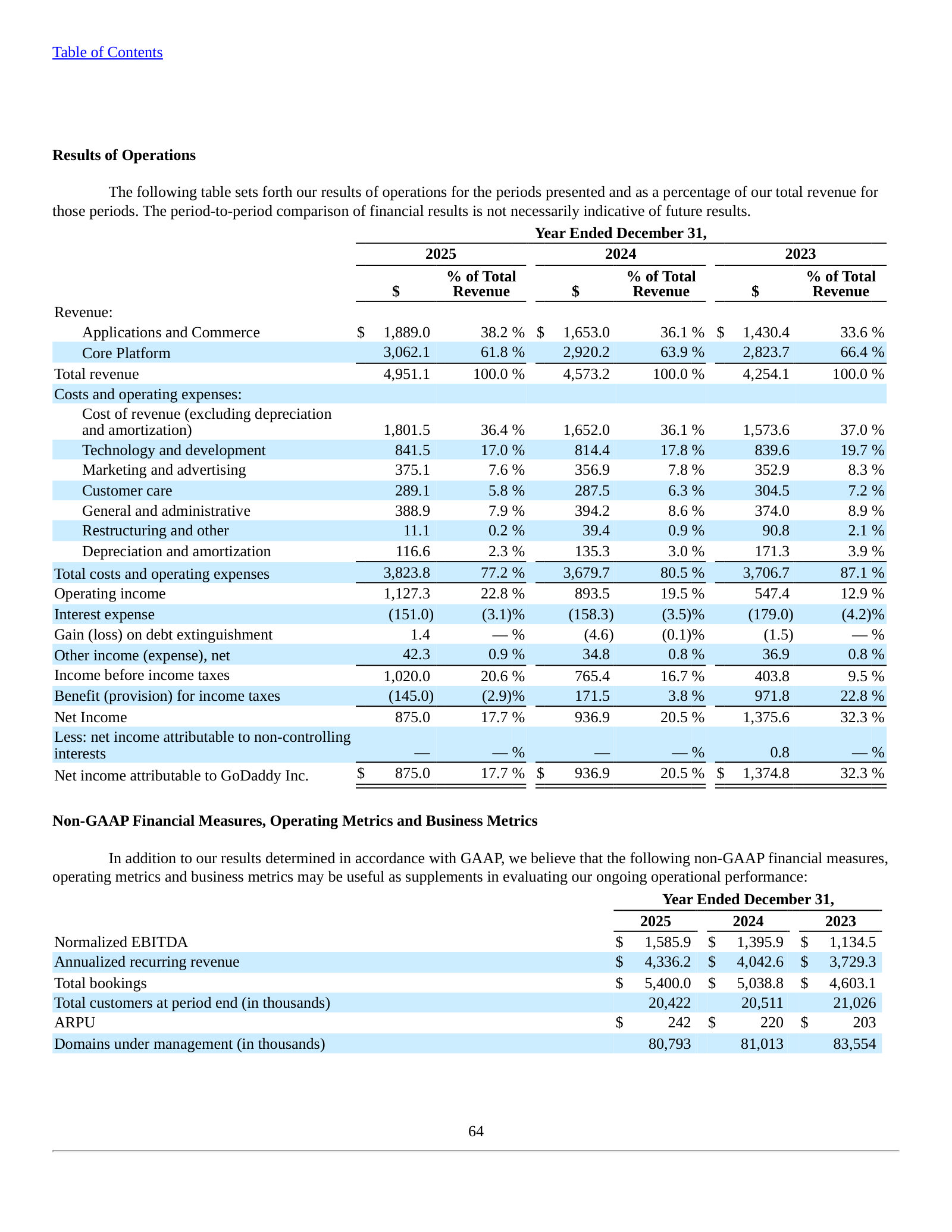
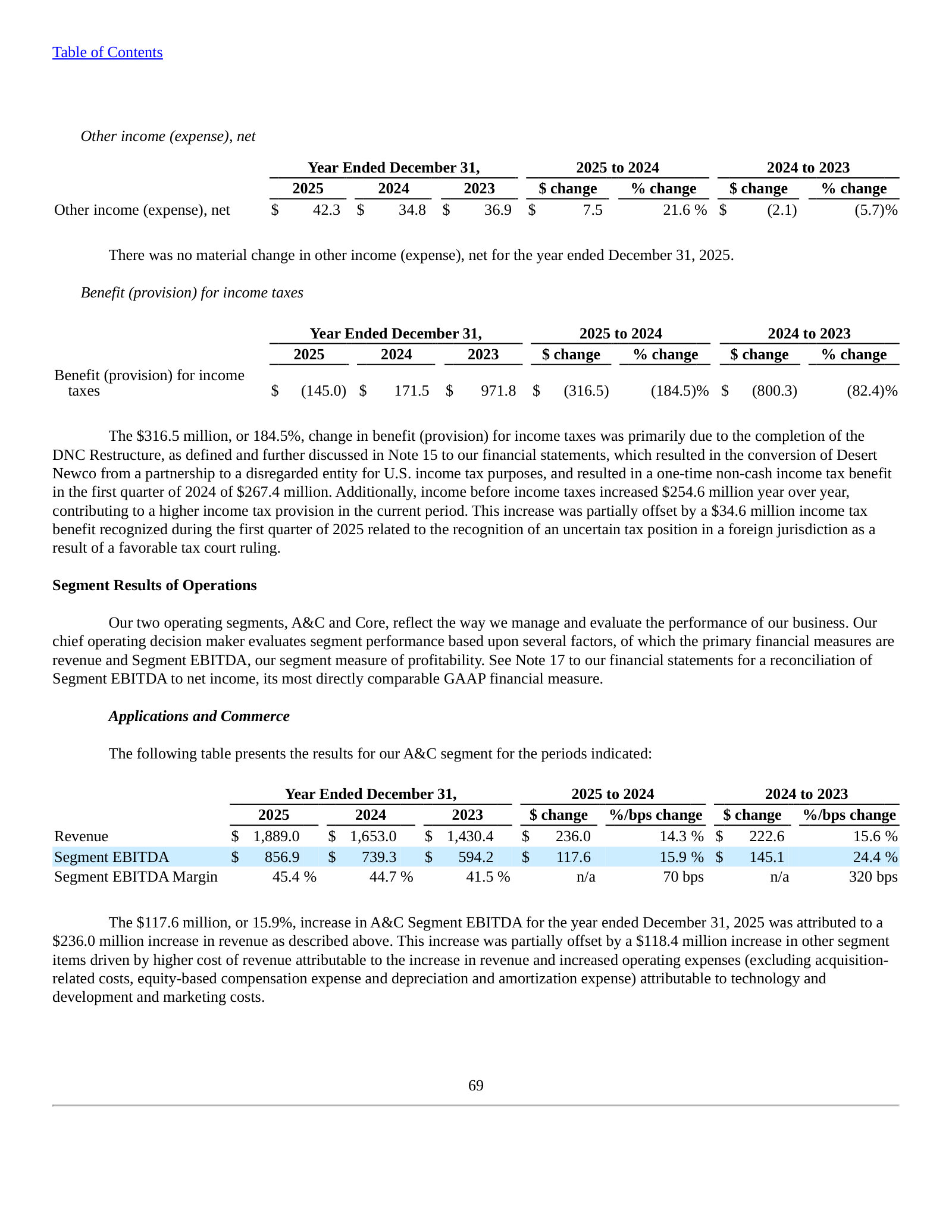
Item 7. Management's Discussion and Analysis — Segment Results of Operations — p. 125 · Read the full section →
Segment EBITDA reveals where profit is made: A&C carries a ~45% margin versus Core's ~33% — the mix story behind the P&L.
How management measures the two segments — revenue and Segment EBITDA.
Our two operating segments, A&C and Core, reflect the way we manage and evaluate the performance of our business. Our chief operating decision maker evaluates segment performance based upon several factors, of which the primary financial measures are revenue and Segment EBITDA, our segment measure of profitability.
p. 125 · Read in context →
Item 7. Critical Accounting Policies and Estimates — Revenue Recognition — p. 130 · Read the full section →
The policy that defines the subscription model — domain and renewal revenue recognized ratably, feeding deferred revenue and bookings.
GoDaddy Inc. — FY2021 Annual Report (Form 10-K) — FY2021
Included to show a real structural evolution: in FY2021 GoDaddy reported as a single segment; by FY2022 it split into Applications & Commerce and Core Platform. · Open the full document →
Item 1. Business — Overview — p. 7 · Read the full section →
The earlier self-description — 21.2 million customers and a different framing before the Airo/agentic-AI and commerce emphasis of today.
GoDaddy in 2021 — "everyday entrepreneurs" and 21.2 million customers.
GoDaddy is a global leader in serving a large market of everyday entrepreneurs, delivering simple, easy-to-use products, and outcome-driven, personalized guidance to small businesses, individuals, organizations, developers, designers and domain investors. […] Our 21.2 million customers are passionate, everyday entrepreneurs with vibrant ideas, who are determined to make their way in the world and to transform their ideas into something meaningful.
p. 7 · Read in context →
Notes to Consolidated Financial Statements — Segment — p. 137 · Read the full section →
The "before" of the segment redefinition: in 2021 the CEO reviewed the company on a consolidated basis — a single reportable segment.
One segment in 2021 — the structure later split into A&C and Core.
As of December 31, 2021, our chief operating decision maker was our Chief Executive Officer who reviews financial information presented on a consolidated basis for purposes of allocating resources and evaluating financial performance for the entire company. Accordingly, we have a single operating and reportable segment.
p. 137 · Read in context →
More annual reports
GoDaddy Inc. — FY2024 Annual Report (Form 10-K) — FY2024 · 197 pages · Prior-year 10-K with the same two-segment structure — useful for year-over-year comparison of segment revenue and margins. · Open →
GoDaddy Inc. — FY2023 Annual Report (Form 10-K) — FY2023 · 224 pages · The year restructuring charges and cost actions began driving margin expansion; useful baseline for the profitability turn. · Open →
GoDaddy Inc. — FY2022 Annual Report (Form 10-K) — FY2022 · 211 pages · The first 10-K under the two-segment (Applications & Commerce / Core Platform) structure that GoDaddy still uses today. · Open →
Competitors describe GoDaddy Inc.'s market in their own filings and calls. These verified passages and visual pages show where their strategies meet, using source documents preserved in Sources.
Wix.com (WIX)
The most direct competitor to GoDaddy's website-builder and web-presence business — a SaaS platform selling website creation, domains and commerce tools to the same small businesses and entrepreneurs. It is the one peer that names GoDaddy in its filings.
Wix's 20-F competition section names GoDaddy by name — as a large domain-registration and hosting company that also lets a business owner build a website — and flags generative-AI website builders as an emerging overlap.
several large service companies that primarily offer domain registration and hosting services, such as GoDaddy, provide the ability for a business owner to build a website using their tools or have one built by their workforce. Moreover, newly emerging technologies that utilize AI may also offer services that overlap with certain solutions we offer, including the emergence of generative AI website builders.
p. 106 · Read in context →
Wix's characterization of the shared market for website design-and-management software as 'highly fragmented,' with no incumbent offering a fully integrated solution — the space GoDaddy's Websites + Marketing also targets.
The market for providing web-based website design and management software is evolving and highly fragmented today. We believe no provider currently offers a comprehensive, customizable, fully integrated workflow solution to create and manage a professional digital presence comparable to ours.
p. 106 · Read in context →
IONOS Group (IOS)
A European web-hosting, domains and cloud provider for SMEs whose 'Web Presence & Productivity' line — domain registration, hosting, AI website builders, email and commerce — maps almost one-for-one onto GoDaddy's core offering, and which competes with GoDaddy in North America as well as Europe.
IONOS's Web Presence & Productivity portfolio — domain registration, web hosting, AI-powered website builders, e-commerce, email, marketing and SEO — maps closely onto GoDaddy's own product stack for small businesses.
In the Web Presence & Productivity division, IONOS offers professional solutions for online presence, such as domain registration, web hosting, website builders powered by artificial intelligence, and dedicated servers. This is complemented by additional productivity tools (e.g., e-commerce, email, and marketing applications) as well as supplementary services such as search engine optimization, business applications, and storage and security solutions.
p. 5 · Read in context →
IONOS's stated scale and positioning — a base of over six million customers and a claim to be a leading SME digitalization partner — a reference point against GoDaddy's own customer and share narrative.
As one of the leading providers and preferred digitalization partners for small and medium-sized enterprises (SMEs), IONOS is exceptionally well-positioned to benefit sustainably from this structural market growth. […] A central pillar and a decisive competitive advantage is its loyal customer base of over six million customers worldwide.
p. 53 · Read in context →
IONOS positions itself as a 'one-stop shop' for SMEs, citing strong positions in Germany, Spain, the UK and Austria — the European strongholds it defends against GoDaddy's US base.
IONOS clearly positions itself as a “one-stop shop” for digital transformation. The company operates in a structurally growing market driven by megatrends such as cloud migration and, increasingly, by agentic A (AI agents). […] With strong market positions in key markets such as Germany, Spain, the United Kingdom, and Austria, the Group is exceptionally well-positioned.
p. 8 · Read in context →
Tucows (TCX)
A top global domain registrar and GoDaddy's clearest rival in the domains business — its OpenSRS, Enom and Ascio wholesale registrars and Hover retail brand compete directly for domain registrations. Its Ting fiber and Wavelo telecom units do not overlap with GoDaddy and are excluded here.
Tucows' claim to a strong position in the wholesale domain-registration and email markets behind its OpenSRS, Ascio and Enom brands — the reseller-friendly channel where it competes with GoDaddy rather than in retail website-building.
We believe that we are well positioned in the wholesale domain registration and email markets due in part to our highly-recognized “Tucows”, “OpenSRS”, “Ascio” and “Enom” brands and the respect they confer on us as a defender of end-user rights and reseller-friendly approaches to doing business. We were among the first group of 34 registrars to be accredited by ICANN in 1999
p. 8 · Read in context →
Tucows quantifies its wholesale distribution moat: a network of more than 34,000 resellers across 200 countries selling white-label domains — a channel-led model distinct from GoDaddy's retail-direct approach.
Tucows Domains generates revenues primarily from the registration fees charged to resellers in connection with new, renewed and transferred domain name registrations. […] Our primary distribution channel is a global network of more than 34,000 resellers that operate in 200 countries […] providing the broadest portfolio of gTLD and the country code top-level domain options and related services, a white-label platform that facilitates the provisioning and management of domain names
p. 7 · Read in context →
Tucows' domain brand stack — OpenSRS, Enom, Ascio, EPAG and Hover, spanning wholesale and retail registration — the direct product collision with GoDaddy's registrar business.
Tucows Domains includes wholesale and retail domain name registration services, as well as value-added services derived through our OpenSRS, Enom, Ascio, EPAG and Hover brands.
p. 6 · Read in context →
GMO Internet Group (9449)
Japan's leading domain registrar and web-hosting group — the GoDaddy-analog in its home market, selling domain registration (Onamae.com), hosting and servers to the same small-business customers. Its footprint is concentrated in Japan and its payment, security and crypto arms fall outside GoDaddy's business.
GMO frames its domains-hosting-servers stack — the same registrar-plus-hosting bundle GoDaddy sells — as the number-one service in each layer of the Japanese market.
GMO Internet Group management, Q2 FY2025 results presentation: We have developed a wide range of services from infrastructure areas such as Internet access, domain names, cloud computing, and rental servers to value-added areas such as payment settlement and online store support. Each is the number one service, and by generating synergies with each other, we have achieved sustainable growth.
p. 17 · Read in context →
GMO reframes the registrar/hosting battleground around AI-agent traffic, positioning MCP and API support as a new competitive front GoDaddy must also contest.
GMO Internet Group management, Q1 FY2026 results presentation: The main users of the Internet are rapidly shifting from humans to Al […] what is required of our group is to become a company that AI will choose. To this end, we are working on MCP support and API support.
p. 12 · Read in context →
Shopify (SHOP)
The leading commerce platform for entrepreneurs and small businesses — adjacent to GoDaddy's domains/web-presence core but a direct competitor to GoDaddy's growing Applications & Commerce segment (online-store creation, payments) and to its 'help entrepreneurs start a business' positioning.
Shopify's self-description as commerce infrastructure that makes it easier to 'start, run and grow a business' for merchants from aspirational entrepreneurs upward — the same start-a-business pitch GoDaddy makes to its small-business base.
Shopify provides essential internet infrastructure for commerce. Shopify's all-in-one platform makes it easier to start, run and grow a business, powering sales online, in store, and everywhere in between. […] We believe we can help merchants of all verticals and sizes, from aspirational entrepreneurs to companies with large-scale, direct-to-consumer or business to business ("B2B") operations, or both, realize their potential at all stages of their business life cycle.
p. 7 · Read in context →
Shopify's merchant-solutions stack — integrated payments, working capital and shipping layered on subscriptions, monetized through Shopify Payments — mirrors the payments-and-commerce attach strategy GoDaddy is pursuing.
We offer a variety of merchant solutions to augment those provided through our subscriptions and to address the broad array of functionality merchants commonly require, including accepting payments, securing working capital and shipping. […] We principally generate merchant solutions revenues from payment processing fees and currency conversion fees from Shopify Payments, our fully integrated payment solution.
p. 9 · Read in context →
Shopify facilitated $378.4 billion of merchant GMV in 2025 (up 29% year over year) and ties its merchant-solutions revenue to that volume — the commerce flow GoDaddy's Applications & Commerce segment aims to capture a slice of.
Our merchant solutions revenues are also directionally correlated with the level of GMV facilitated through our platform.
p. 48 · Read in context →
BigCommerce (BIGC)
An open-SaaS e-commerce platform that overlaps GoDaddy's online-store and commerce offering, but which is increasingly enterprise/mid-market focused and is de-emphasizing the small-business segment where GoDaddy concentrates — useful as evidence of the limited, not head-on, overlap.
BigCommerce's account mix — 5,825 enterprise accounts alongside 'tens of thousands' of small-business accounts (on ~$351m ARR growing 3%) — shows an enterprise-weighted platform whose SMB tail is small relative to GoDaddy's mass-SMB base.
Daniel Lentz, Chief Financial Officer: BigCommerce serves 5,825 enterprise accounts, alongside tens of thousands of small business accounts.
p. 3 · Read in context →
BigCommerce states its priority is moving up-market to enterprise while its small-business base stays roughly flat — signaling it is de-emphasizing, not aggressively contesting, GoDaddy's core small-business commerce turf.
Daniel Lentz, Chief Financial Officer: The priority for us remains moving up market and focusing on enterprise accounts. […] We have tens of thousands of small business customers and we really want to find ways to expand that further.
p. 6 · Read in context →
More peer documents
WIX_annual_report_FY2023 — 324 pages · Prior-year 20-F carries the same competition section naming GoDaddy among large domain/hosting companies moving into website-building — evidence the framing is persistent, not new. · Open →
Q1_FY2026 — 26 pages · Wix management's latest call on AI-era web creation and taking share of the SMB web-presence market; the index page is partly garbled by a cookie-consent overlay, so it is shelved rather than quoted. · Open →
IOS_annual_report_FY2024 — 173 pages · IONOS's prior-year report with the same Web Presence & Productivity segment detail and customer-contract metrics for a two-year read on scale and ARPU. · Open →
9449_annual_report_FY2025 — 244 pages · GMO's annual report with the Internet Infrastructure segment's Japanese domain/hosting brands (Onamae.com, ConoHa, LOLIPOP!) and share data — mostly Japanese text and image slides, so unquotable but useful for context. · Open →
SHOP_annual_report_FY2024 — 198 pages · Shopify's prior-year 10-K for a two-year GMV and merchant-solutions trend against which to size GoDaddy's smaller commerce segment. · Open →
Q4_FY2025 — 34 pages · Shopify management's full-year call detailing merchant growth, payments penetration and the entrepreneur/SMB opportunity that frames the commerce overlap. · Open →
Source: S&P Capital IQ consensus via Xpressfeed · Generated 2026-07-19.
Street snapshot
The 15 price targets are widely spread, from $83 to $190, with a mean of $111.93 well above the $100 median (USD).
Currency: USD · Scale: money in millions, absolute (per share) · Analyst counts shown explicitly; recommendation respondents: 17.
| Street view | Reading | Analysts |
|---|---|---|
| Recommendation mix | Buy 7, Outperform 2, Hold 8, Underperform 0, Sell 0 | 17 |
| Consensus score | 2.06 | 17 |
| Target price | mean 111.9; high 190.0; low 83.00 | 15 |
Forward table
Consensus has revenue compounding in the mid-single digits, from $4,951m actual in FY2025 to $5,242m (FY2026) and $5,549m (FY2027), with gross margin holding near 63–64% and free cash flow climbing from $1,673m to $1,955m. The company pays no dividend across the horizon, and net debt is modelled to fall steadily from $2,587m in FY2025 toward a small net cash position by FY2028.
Currency: USD · Scale: money in millions, absolute (per share) · Analyst count is the estimate count for each period and metric.
| Period | Metric | Mean | YoY | Analysts | Low / high |
|---|---|---|---|---|---|
| FY0E | Revenue | 5,242 | 5.9% | 17 | 5,200 / 5,259 |
| FY0E | EBITDA | 1,750 | 10.3% | 14 | 1,725 / 1,769 |
| FY0E | EBIT | 1,317 | 17.9% | — | — / — |
| FY0E | Net income (GAAP) | 932.9 | 6.6% | 11 | 865.8 / 1,009 |
| FY0E | Net income (normalized) | 1,241 | 6.1% | — | — / — |
| FY0E | EPS (GAAP) | 7.12 | 14.5% | 13 | 6.63 / 7.69 |
| FY0E | EPS (normalized) | 9.39 | 17.0% | 3 | 9.20 / 9.49 |
| FY0E | Free cash flow | 1,805 | 7.8% | — | — / — |
| FY0E | Dividend per share | 0.00 | — | — | — / — |
| FY0E | Gross margin | 64.0% | 0.7% | — | — / — |
| FY0E | Capital expenditure | -26.82 | -3.9% | — | — / — |
| FY0E | Net debt | 1,685 | -34.8% | — | — / — |
| FY0E | ROE | 255.3% | 44.7% | — | — / — |
| FY0E | Cash from operations | 1,808 | 13.4% | — | — / — |
| FY+1E | Revenue | 5,549 | 5.8% | 17 | 5,499 / 5,612 |
| FY+1E | EBITDA | 1,891 | 8.1% | 14 | 1,836 / 1,957 |
| FY+1E | EBIT | 1,457 | 10.6% | — | — / — |
| FY+1E | Net income (GAAP) | 1,095 | 17.3% | 11 | 951.2 / 1,278 |
| FY+1E | Net income (normalized) | 1,314 | 5.9% | — | — / — |
| FY+1E | EPS (GAAP) | 8.98 | 26.0% | 13 | 7.49 / 10.75 |
| FY+1E | EPS (normalized) | 10.77 | 14.8% | 3 | 10.01 / 11.45 |
| FY+1E | Free cash flow | 1,955 | 8.4% | — | — / — |
| FY+1E | Dividend per share | 0.00 | — | — | — / — |
| FY+1E | Gross margin | 63.9% | -0.0% | — | — / — |
| FY+1E | Capital expenditure | -32.36 | 20.7% | — | — / — |
| FY+1E | Net debt | 855.8 | -49.2% | — | — / — |
| FY+1E | Cash from operations | 1,943 | 7.5% | — | — / — |
| FY+1E | ROE | 125.3% | -50.9% | — | — / — |
| FY+2E | Revenue | 5,874 | 5.9% | 10 | 5,745 / 5,968 |
| FY+2E | EBITDA | 2,093 | 10.7% | 7 | 2,040 / 2,166 |
| FY+2E | EBIT | 1,655 | 13.5% | — | — / — |
| FY+2E | Net income (GAAP) | 1,279 | 16.9% | 7 | 1,188 / 1,423 |
| FY+2E | Net income (normalized) | 1,389 | 5.7% | — | — / — |
| FY+2E | EPS (GAAP) | 10.93 | 21.8% | 8 | 9.02 / 13.28 |
| FY+2E | EPS (normalized) | 11.22 | 4.1% | 2 | 10.41 / 12.03 |
| FY+2E | Free cash flow | 2,153 | 10.1% | — | — / — |
| FY+2E | Dividend per share | 0.00 | — | — | — / — |
| FY+2E | Gross margin | 64.5% | 0.8% | — | — / — |
| FY+2E | Capital expenditure | -29.99 | -7.3% | — | — / — |
| FY+2E | Net debt | -58.87 | -106.9% | — | — / — |
| FY+2E | Cash from operations | 2,018 | 3.9% | — | — / — |
| FY+2E | ROE | 68.9% | -45.0% | — | — / — |
| Q2 FY2026 | Revenue | 1,295 | 6.3% | 16 | 1,286 / 1,300 |
| Q2 FY2026 | EBITDA | 426.5 | 11.7% | 13 | 421.7 / 431.6 |
| Q2 FY2026 | EBIT | 317.0 | 20.0% | — | — / — |
| Q2 FY2026 | Net income (GAAP) | 225.8 | 12.9% | 10 | 203.0 / 248.3 |
| Q2 FY2026 | Net income (normalized) | 299.8 | 18.1% | — | — / — |
| Q2 FY2026 | EPS (GAAP) | 1.69 | 20.2% | 12 | 1.53 / 1.88 |
| Q2 FY2026 | EPS (normalized) | 2.24 | 18.0% | 3 | 2.17 / 2.29 |
| Q2 FY2026 | Free cash flow | 473.2 | 29.9% | — | — / — |
| Q2 FY2026 | Dividend per share | 0.00 | — | — | — / — |
| Q2 FY2026 | Gross margin | 63.9% | 0.2% | — | — / — |
| Q2 FY2026 | Capital expenditure | -6.83 | -8.4% | — | — / — |
| Q2 FY2026 | Net debt | 2,300 | -21.0% | — | — / — |
| Q2 FY2026 | ROE | 298.1% | -7.7% | — | — / — |
| Q2 FY2026 | Cash from operations | 450.2 | 38.5% | — | — / — |
| Q3 FY2026 | Revenue | 1,326 | 4.8% | 16 | 1,300 / 1,344 |
| Q3 FY2026 | EBITDA | 444.4 | 8.8% | 13 | 431.7 / 458.5 |
| Q3 FY2026 | EBIT | 333.5 | 17.5% | — | — / — |
| Q3 FY2026 | Net income (GAAP) | 237.7 | 12.9% | 10 | 210.7 / 271.1 |
| Q3 FY2026 | Net income (normalized) | 317.4 | 12.8% | — | — / — |
| Q3 FY2026 | EPS (GAAP) | 1.82 | 20.4% | 12 | 1.57 / 2.08 |
| Q3 FY2026 | EPS (normalized) | 2.41 | 20.9% | 3 | 2.39 / 2.44 |
| Q3 FY2026 | Free cash flow | 443.3 | 10.1% | — | — / — |
| Q3 FY2026 | Dividend per share | 0.00 | — | — | — / — |
| Q3 FY2026 | Gross margin | 63.6% | -0.9% | — | — / — |
| Q3 FY2026 | Capital expenditure | -7.14 | -21.5% | — | — / — |
| Q3 FY2026 | Net debt | 2,111 | -14.2% | — | — / — |
| Q3 FY2026 | Cash from operations | 457.6 | 22.5% | — | — / — |
| Q3 FY2026 | ROE | 347.6% | 97.1% | — | — / — |
| Q4 FY2026 | Revenue | 1,359 | 6.7% | 16 | 1,342 / 1,400 |
| Q4 FY2026 | EBITDA | 465.9 | 8.1% | 13 | 449.3 / 479.7 |
| Q4 FY2026 | EBIT | 356.0 | 16.0% | — | — / — |
| Q4 FY2026 | Net income (GAAP) | 257.5 | 5.0% | 10 | 228.4 / 276.9 |
| Q4 FY2026 | Net income (normalized) | 332.4 | 11.2% | — | — / — |
| Q4 FY2026 | EPS (GAAP) | 2.00 | 11.4% | 12 | 1.75 / 2.18 |
| Q4 FY2026 | EPS (normalized) | 2.57 | 11.8% | 3 | 2.47 / 2.63 |
| Q4 FY2026 | Free cash flow | 421.5 | 12.2% | — | — / — |
| Q4 FY2026 | Dividend per share | 0.00 | — | — | — / — |
| Q4 FY2026 | Gross margin | 64.4% | 0.5% | — | — / — |
| Q4 FY2026 | Capital expenditure | -7.11 | -31.3% | — | — / — |
| Q4 FY2026 | Net debt | 1,908 | -28.3% | — | — / — |
| Q4 FY2026 | ROE | 283.2% | -19.8% | — | — / — |
| Q4 FY2026 | Cash from operations | 427.3 | 25.4% | — | — / — |
| Q1 FY2027 | Revenue | 1,341 | 5.8% | 8 | 1,335 / 1,350 |
| Q1 FY2027 | EBITDA | 444.7 | 7.6% | 5 | 439.9 / 452.5 |
| Q1 FY2027 | EBIT | 339.2 | 15.7% | — | — / — |
| Q1 FY2027 | Net income (GAAP) | 251.2 | 17.0% | 5 | 223.8 / 262.3 |
| Q1 FY2027 | Net income (normalized) | 313.5 | 14.7% | — | — / — |
| Q1 FY2027 | EPS (GAAP) | 1.95 | 22.1% | 7 | 1.73 / 2.12 |
| Q1 FY2027 | EPS (normalized) | 2.34 | 14.3% | 1 | 2.34 / 2.34 |
| Q1 FY2027 | Free cash flow | 492.2 | 5.9% | — | — / — |
| Q1 FY2027 | Dividend per share | 0.00 | — | — | — / — |
| Q1 FY2027 | Gross margin | 63.8% | 0.7% | — | — / — |
| Q1 FY2027 | Capital expenditure | -8.29 | 15.6% | — | — / — |
| Q1 FY2027 | Net debt | 1,652 | -31.4% | — | — / — |
| Q1 FY2027 | Cash from operations | 502.8 | 15.5% | — | — / — |
| Q1 FY2027 | ROE | 225.7% | -24.8% | — | — / — |
Estimate momentum
Normalized-EPS estimates have edged higher lately — FY2028 to $11.22 from $10.52 ninety days ago — though only three analysts contribute, so the move rests on a thin base.
Currency: USD · Scale: money in millions, absolute (per share) · Point-in-time consensus; analyst count is shown where supplied.
| Period | Metric | Lookback | Then | Now | Direction / magnitude | Analysts |
|---|---|---|---|---|---|---|
| 2028 | Revenue | 30d | 5,877 | 5,874 | down 0.1% | — |
| 2028 | Revenue | 90d | 5,870 | 5,874 | up 0.1% | — |
| 2028 | Revenue | 180d | 6,066 | 5,874 | down 3.2% | — |
| 2027 | Revenue | 30d | 5,549 | 5,549 | down 0.0% | — |
| 2027 | Revenue | 90d | 5,547 | 5,549 | up 0.0% | — |
| 2027 | Revenue | 180d | 5,663 | 5,549 | down 2.0% | — |
| 2027 | EPS (normalized) | 30d | 10.77 | 10.77 | flat 0.0% | — |
| 2027 | EPS (normalized) | 90d | 10.59 | 10.77 | up 1.8% | — |
| 2027 | EPS (normalized) | 180d | 11.03 | 10.77 | down 2.3% | — |
| 2028 | EPS (normalized) | 30d | 11.22 | 11.22 | flat 0.0% | — |
| 2028 | EPS (normalized) | 90d | 10.52 | 11.22 | up 6.7% | — |
Beat / miss record
Normalized-EPS surprises are choppier: large beats through 2024 (up to +27.9% in Q3) gave way to misses of -5.2% and -7.1% in FY2025 Q1 and Q3.
Current sequences by metric: Revenue: 8 consecutive beats; EPS (normalized): 2 consecutive beats.
Currency: USD · Scale: money in millions, absolute (per share) · Consensus is captured before each actual first became effective; analyst count shown per observation.
| Quarter | Metric | Consensus as of | Actual | Surprise | Outcome | Analysts |
|---|---|---|---|---|---|---|
| Q1 FY2026 | Revenue | 1,263 | 1,267 | 0.3% | Beat | — |
| Q1 FY2026 | EPS (normalized) | 1.99 | 2.05 | 2.7% | Beat | — |
| Q4 FY2025 | Revenue | 1,272 | 1,274 | 0.1% | Beat | — |
| Q4 FY2025 | EPS (normalized) | 2.22 | 2.30 | 3.7% | Beat | — |
| Q3 FY2025 | Revenue | 1,233 | 1,265 | 2.6% | Beat | — |
| Q3 FY2025 | EPS (normalized) | 2.15 | 1.99 | -7.1% | Miss | — |
| Q2 FY2025 | Revenue | 1,207 | 1,218 | 0.9% | Beat | — |
| Q2 FY2025 | EPS (normalized) | 1.89 | 1.90 | 0.4% | Beat | — |
| Q1 FY2025 | Revenue | 1,189 | 1,194 | 0.4% | Beat | — |
| Q1 FY2025 | EPS (normalized) | 1.97 | 1.86 | -5.2% | Miss | — |
| Q4 FY2024 | Revenue | 1,179 | 1,193 | 1.1% | Beat | — |
| Q4 FY2024 | EPS (normalized) | 1.73 | 1.97 | 13.8% | Beat | — |
| Q3 FY2024 | Revenue | 1,144 | 1,148 | 0.3% | Beat | — |
| Q3 FY2024 | EPS (normalized) | 1.40 | 1.80 | 27.9% | Beat | — |
| Q2 FY2024 | Revenue | 1,114 | 1,124 | 0.9% | Beat | — |
| Q2 FY2024 | EPS (normalized) | 1.28 | 1.43 | 11.4% | Beat | — |
Where the street disagrees
Revenue and EBITDA, by contrast, are tightly clustered (FY2026 revenue standard deviation of about $14m on a $5,242m mean).
Currency: USD · Scale: money in millions, absolute (per share) · Dispersion is high-low divided by absolute mean; analyst count shown per item.
| Period | Metric | Mean | Low | High | Spread / mean | Analysts |
|---|---|---|---|---|---|---|
| Q1 FY2025 | EPS (normalized) | 1.97 | 1.30 | 2.97 | 85.1% | 4 |
| Q2 FY2025 | EPS (normalized) | 1.89 | 1.37 | 2.38 | 53.2% | 4 |
| Q4 FY2024 | EPS (normalized) | 1.73 | 1.33 | 2.15 | 47.6% | 7 |
| Q3 FY2024 | EPS (normalized) | 1.40 | 1.09 | 1.75 | 46.8% | 5 |
| 2028 | EPS (GAAP) | 10.93 | 9.02 | 13.28 | 38.9% | 8 |
Source: Visible Alpha consensus via S&P Xpressfeed · Consensus as of 2026-07-16 · generated 2026-07-19.
Model trust
Base currency: USD · VA scales normalized from Abs, M; item currencies and units retained · Coverage depth and vintage; broker count is the maximum represented.
| Brokers | Line items | Last revision |
|---|---|---|
| 13 | 378 | 2026-07-16 |
Operating KPIs
Base currency: USD · VA scales normalized from Abs, M; item currencies and units retained · FY-1A / FY0E / FY+1E; broker count shown per KPI.
| Operating KPI | Source | FY-1A | FY0E | FY+1E | Brokers |
|---|---|---|---|---|---|
| Accounts and other receivables | CD | 102,377.12bn Amount | 80,077.04bn Amount | 78,420.17bn Amount | 13 |
| Accounts payable | CD | 111,599.17bn Amount | 91,402.30bn Amount | 109,854.10bn Amount | 13 |
| Capital expenditure | CD | 27,737.13bn Amount | 26,910.45bn Amount | 30,996.45bn Amount | 13 |
| Changes in Deferred revenue | CD | 252,531.44bn Amount | 237,852.39bn Amount | 245,314.16bn Amount | 13 |
| Changes in Other operating assets and liabilities | CD | -86,899.46bn Amount | 26,151.56bn Amount | 48,545.09bn Amount | 13 |
| Changes in Prepaid domain name registry fees | CD | -44,009.68bn Amount | -23,484.43bn Amount | -12,718.62bn Amount | 13 |
| Changes in working capital | CD | 126,894.82bn Amount | 305,364.06bn Amount | 337,167.44bn Amount | 13 |
| Cost of revenue (excluding depreciation and amortization) | CD | 1,803,454.00bn Amount | 1,893,686.94bn Amount | 2,006,724.16bn Amount | 13 |
| Current portion of long term debt | CD | 15,609.33bn Amount | 15,163.49bn Amount | 15,214.45bn Amount | 13 |
| Deferred revenue | CD | 2,414,232.46bn Amount | 2,547,828.91bn Amount | 2,732,982.75bn Amount | 13 |
| Deferred revenue, net of current portion | CD | 950,146.48bn Amount | 988,355.07bn Amount | 1,041,664.93bn Amount | 13 |
| Depreciation and amortization | CD | 120,699.89bn Amount | 102,397.30bn Amount | 102,208.15bn Amount | 13 |
P&L bridge
Base currency: USD · VA scales normalized from Abs, M; item currencies and units retained · Margins are derived against revenue; YoY compares adjacent fiscal columns; broker count shown per line.
| P&L line | FY-1A | FY0E | FY+1E | Brokers |
|---|---|---|---|---|
| Revenue | 4,946,623.00bn Amount | 5,245,232.86bn Amount (6.0% YoY) | 5,543,862.01bn Amount (5.7% YoY) | 13 |
| Gross Profit | 3,144,045.58bn Amount (63.6% margin) | 3,352,541.58bn Amount (63.9% margin; 6.6% YoY) | 3,538,142.39bn Amount (63.8% margin; 5.5% YoY) | 13 |
| Ebitda | 1,573,835.09bn Amount (31.8% margin) | 1,751,095.62bn Amount (33.4% margin; 11.3% YoY) | 1,891,982.67bn Amount (34.1% margin; 8.0% YoY) | 13 |
| Operating Income | 1,119,516.99bn Amount (22.6% margin) | 1,321,440.04bn Amount (25.2% margin; 18.0% YoY) | 1,458,062.56bn Amount (26.3% margin; 10.3% YoY) | 12 |
| Net Income | 848,211.69bn Amount (17.1% margin) | 929,876.49bn Amount (17.7% margin; 9.6% YoY) | 1,069,467.15bn Amount (19.3% margin; 15.0% YoY) | 13 |
| Eps | 6.03 Amount | 7.05 Amount (16.9% YoY) | 8.57 Amount (21.5% YoY) | 13 |
Consensus dispersion
The disagreement sits in margin and per-share conversion rather than the top line, so the open question is how much operating leverage the revenue mix actually delivers.
Base currency: USD · VA scales normalized from Abs, M; item currencies and units retained · Top high-low spreads relative to absolute mean; requires at least 3 brokers.
| Line item | Period | Mean | Min | Q1 | Q3 | Max | Spread / mean | Brokers |
|---|---|---|---|---|---|---|---|---|
| Changes in Other operating assets and liabilities | FY-2028 | -30.83bn Amount | -79,707.21bn Amount | -27,747.47bn Amount | 29,054.82bn Amount | 90,000.00bn Amount | 550505.9% | 8 |
| Changes in Deferred revenue | 4QFY-2025 | 1,231.44bn Amount | -95,310.37bn Amount | -39,559.90bn Amount | 22,908.81bn Amount | 160,522.40bn Amount | 20775.0% | 11 |
| Changes in Prepaid domain name registry fees | 3QFY-2025 | -1,328.41bn Amount | -21,294.51bn Amount | -9,876.33bn Amount | -145.89bn Amount | 41,612.07bn Amount | 4735.5% | 8 |
| Changes in Prepaid domain name registry fees | 4QFY-2025 | -1,938.31bn Amount | -45,316.30bn Amount | -16,409.83bn Amount | 9,093.76bn Amount | 42,624.36bn Amount | 4537.0% | 8 |
| Changes in working capital | 4QFY-2025 | 5,822.10bn Amount | -172,336.95bn Amount | -1,312.31bn Amount | 40,672.79bn Amount | 45,617.76bn Amount | 3743.6% | 11 |
| Changes in Deferred revenue | 4QFY-2026 | -5,219.01bn Amount | -69,220.94bn Amount | -35,084.08bn Amount | 5,272.30bn Amount | 115,000.00bn Amount | 3529.8% | 13 |
Quarterly path
Base currency: USD · VA scales normalized from Abs, M; item currencies and units retained · Next four supplied quarters; final column is maximum broker coverage in the row.
| Quarter | Accounts and other receivables | Accounts payable | Capital expenditure | Changes in Deferred revenue | Changes in Other operating assets and liabilities | Total revenue | EPS Diluted, Applicable to common stockholders($) | Broker coverage |
|---|---|---|---|---|---|---|---|---|
| 3QFY-2026 | 88,231.77bn Amount | 92,687.29bn Amount | 7,992.61bn Amount | 32,297.28bn Amount | 11,217.06bn Amount | 1,328,804.10bn Amount | 1.80 Amount | 13 |
| 4QFY-2026 | 80,077.04bn Amount | 91,402.30bn Amount | 7,591.23bn Amount | -5,219.01bn Amount | 22,036.89bn Amount | 1,355,232.49bn Amount | 1.98 Amount | 13 |
| 1QFY-2027 | 85,499.90bn Amount | 107,533.84bn Amount | 7,460.95bn Amount | 126,870.46bn Amount | 22,281.13bn Amount | 1,339,890.91bn Amount | 1.92 Amount | 9 |
| 2QFY-2027 | 86,458.19bn Amount | 107,932.04bn Amount | 7,923.99bn Amount | 81,113.23bn Amount | 13,679.51bn Amount | 1,366,574.87bn Amount | 2.01 Amount | 9 |
100 stale period values omitted; 7 line items fully removed.
Source: S&P Capital IQ transcripts via Xpressfeed · latest indexed call 2026-04-30 · generated 2026-07-19.
Latest call digest
GoDaddy Inc., Q1 2026 Earnings Call, Apr 30, 2026 · 2026-04-30T21:00:00
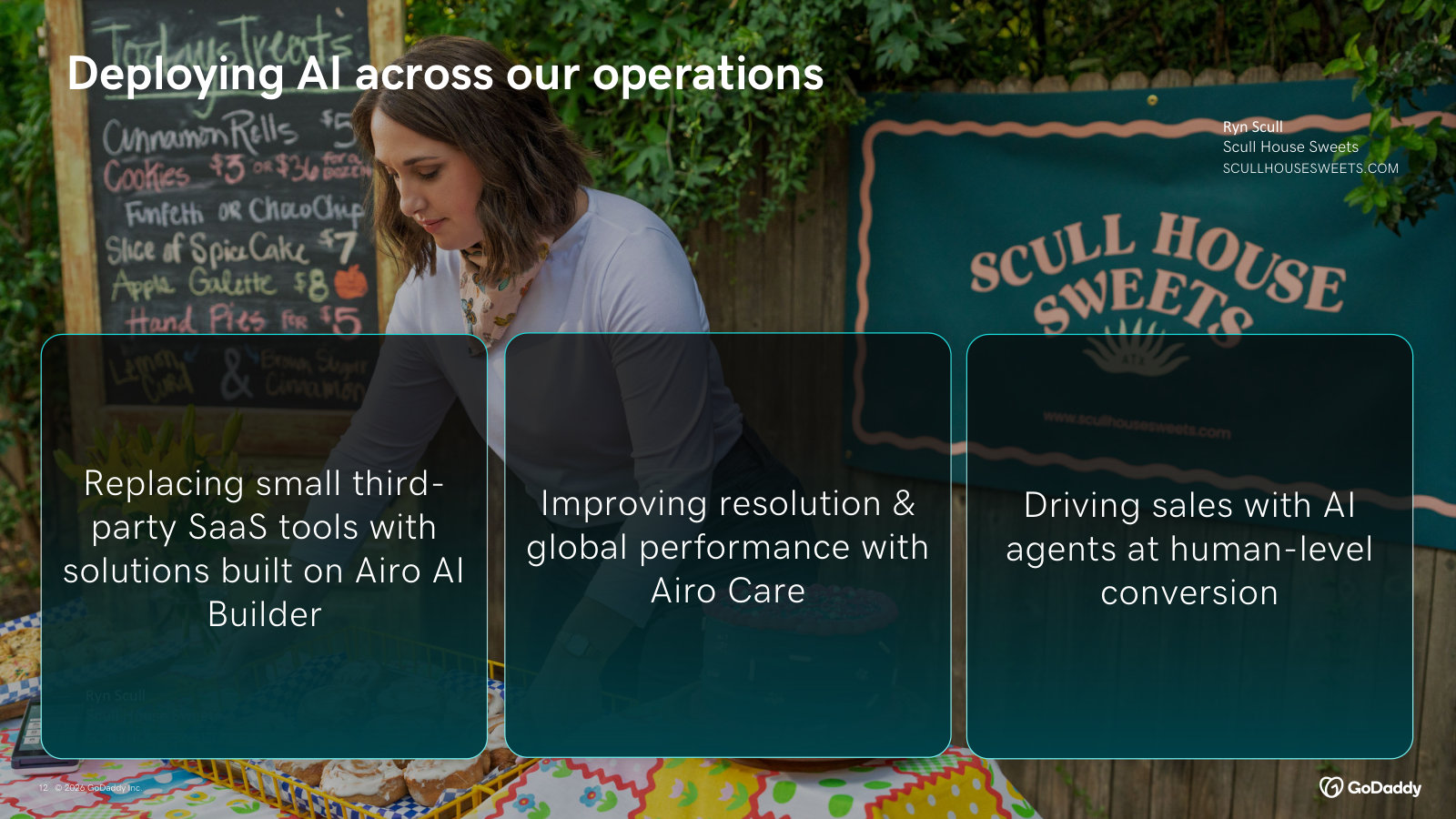
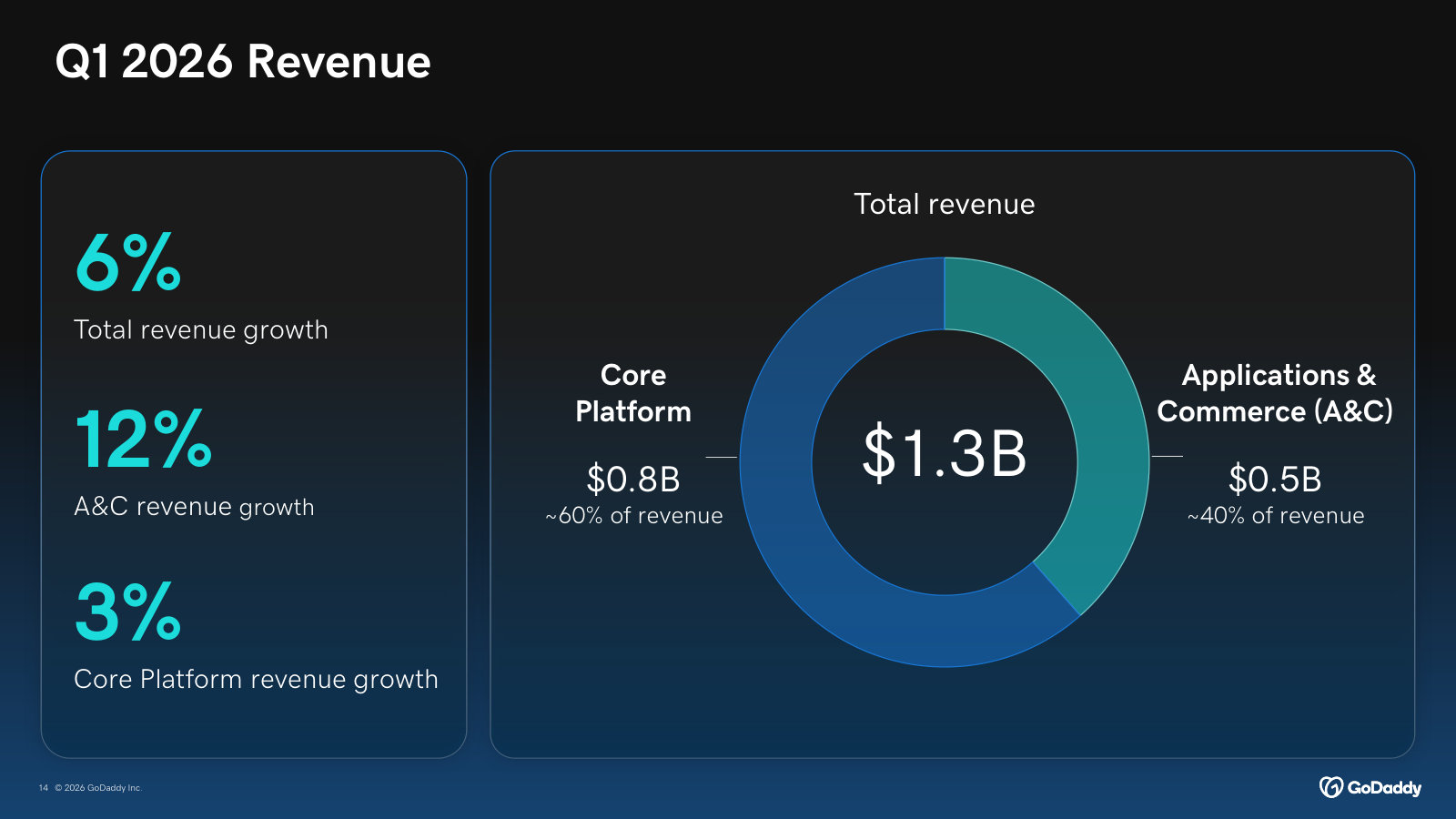
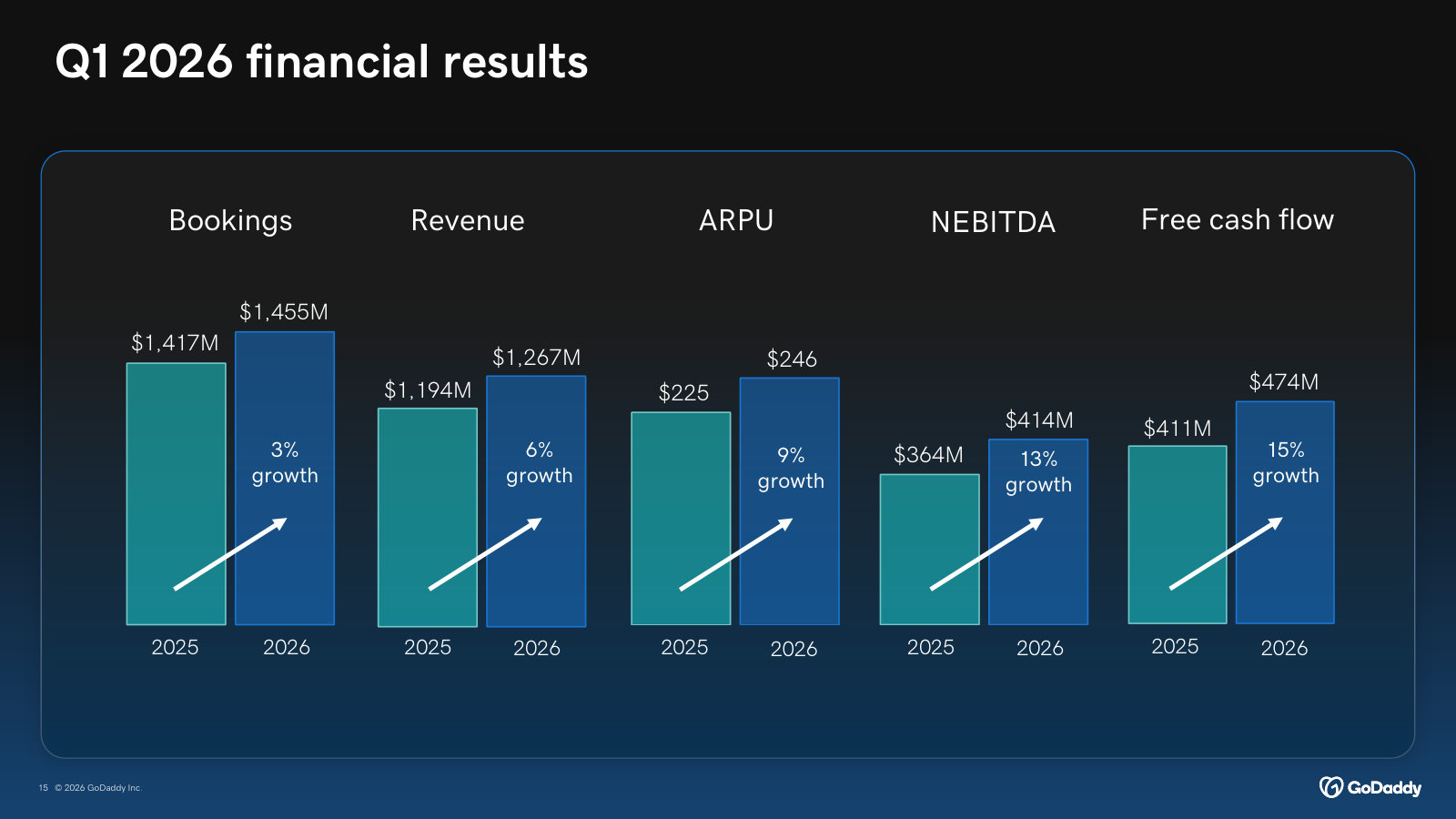
Q1 2026 call — April 30, 2026. Prepared remarks were an AI-transformation pitch: revenue grew 6%, normalized EBITDA margin expanded over 200 bps to 33%, and free cash flow grew 15% to $474 million. Management led with three AI proof points — Airo AI Builder reaching "$10 million plus in annualized bookings run rate within weeks of its beta launch," Agent Name Service (ANS) partnerships, and AI-driven internal efficiency (Airo Care lifting resolution rates, an autonomous sales agent). Mark McCaffrey reaffirmed the full-year 2026 guide ($5.195B–$5.275B revenue, normalized EBITDA margin over 33%, ~$1.8B free cash flow) and guided Q2 revenue to $1.285B–$1.305B.
The Q&A reality was more guarded. Analysts pressed for the size and unit economics of Airo AI Builder (transaction size, credit-vs-subscription mix, margin vs. Websites + Marketing); management declined repeatedly, calling it "super early" and "too early to talk about… the more detailed pieces." Bookings grew only 3% versus 6% revenue, reflecting the promotional offer, the .CO registry contract expiration and tougher aftermarket compares; management framed Q1 as the peak impact and guided bookings back to "at or above parity" for the rest of the year. Other pressure points: whether the Websites + Marketing upgrade would trigger a price change (only after reaching customer-experience parity), and domain share strategy (willing to "let low LTV customers go"). Net: an upbeat prepared narrative on AI optionality, paired with deliberate refusal to quantify it and a self-inflicted near-term bookings drag.
Participant coverage from the latest call.
| Group | Participants | Count |
|---|---|---|
| Management | Christie Masoner — Vice President & Head of Investor Relations, GoDaddy Inc.; Amanpal Bhutani — CEO & Director, GoDaddy Inc.; Mark McCaffrey — Chief Financial Officer, GoDaddy Inc. | 3 |
| Analysts | Vikram Kesavabhotla — Senior Research Analyst, Robert W. Baird & Co. Incorporated, Research Division; Hoi-Fung Wong — MD & Senior Analyst, Oppenheimer & Co. Inc., Research Division; Trevor Young — Former Vice President, Barclays Bank PLC, Research Division; Mark Zgutowicz — Senior Equity Analyst, The Benchmark Company, LLC, Research Division; Willow Miller — Research Analyst, William Blair & Company L.L.C., Research Division; Sang-Jin Byun — Equity Analyst, Jefferies LLC, Research Division; Eleanor Smith — Analyst, JPMorgan Chase & Co, Research Division; Naved Khan — Managing Director of Internet Equity Research, B. Riley Securities, Inc., Research Division; John Halpert — Research Analyst, Cantor Fitzgerald & Co., Research Division; Kishan Patel — Senior Research Associate, Raymond James & Associates, Inc., Research Division; Kathleen Alexis Keyser — Research Associate, Morgan Stanley, Research Division | 11 |
Curated latest-call exchanges; one row per analyst topic.
| Analyst | Firm | Topic | What changed in Q&A |
|---|---|---|---|
| Vikram Kesavabhotla | Robert W. Baird & Co. | Customer quality & AI efficiency flow-through | Asked how GoDaddy measures customer quality and whether internal AI savings flow to EBITDA/FCF or get reinvested. Management defined quality via product activation/attach and said AI-marketing returns are immaterial in 2026 but justify reinvestment. |
| Hoi-Fung Wong | Oppenheimer & Co. | Airo AI Builder scale ceiling & AI hosting | Pushed on how large the $10M run-rate product could become and whether GoDaddy could monetize hosting scarcity. Management declined to size it, stressing it is very early, and confirmed Airo AI Builder runs on GoDaddy hosting but it will not chase enterprise workloads. |
| Mark Zgutowicz | The Benchmark Company | Airo AI Builder unit economics | Asked for average transaction size, credit-top-up vs. plan mix, and margin vs. legacy Websites + Marketing. Management declined the breakdown as too early, reiterating the product is gross-margin positive. |
| Willow Miller | William Blair & Company | A&C bookings deceleration | Probed the A&C bookings slowdown. Management attributed it to promo-offer discount allocation and the Websites + Marketing pricing pause rather than demand, and expected it to pass through the year. |
| Eleanor Smith | JPMorgan Chase & Co | ANS right-to-win & domain share strategy | Asked GoDaddy's advantage in ANS versus larger competitors and whether it would cede domain share. Management leaned on its registrar/DNS position and said it would let low-LTV domain customers go to focus on high-intent customers. |
Theme tracker
Themes are curator-classified across supplied calls.
| Theme | Status | Quarters mentioned | Read-through |
|---|---|---|---|
| Airo / AI product evolution (generative to agentic) | persisted | Q2 2023, Q4 2023, Q1 2024, Q4 2024, Q2 2025, Q3 2025, Q4 2025, Q1 2026 | The central growth narrative every call, from Digital Guide (2023) to Airo, then Airo Plus, then Airo.ai / Airo AI Builder in 2025-2026. Framing shifted from generative to agentic, but the theme is continuous. |
| Agent Name Service (ANS) / Agentic Open Internet | emerged | Q3 2025, Q4 2025, Q1 2026 | New in Q3 2025 and carried forward with a MuleSoft/Salesforce integration (Q4 2025) and further partnerships (Q1 2026). Positioned as a domain-identity extension; monetization remains speculative and is not in guidance. |
| Free cash flow North Star and share buybacks | persisted | Q2 2023, Q1 2024, Q4 2024, Q2 2025, Q3 2025, Q4 2025, Q1 2026 | Reaffirmed as the financial North Star each quarter, with the vast majority of free cash flow returned via buybacks (100% of FCF in 2025; >95% over the last four years). |
| Aftermarket (secondary domain) volatility | persisted | Q2 2023, Q4 2023, Q1 2024, Q4 2024, Q3 2025, Q4 2025, Q1 2026 | A recurring swing factor tied to lumpy high-value transactions. Strong (up 28%) in Q3 2025, still up 8% in Q4 2025, then a tougher compare weighing on Q1 2026. |
| Pricing and bundling | persisted | Q3 2023, Q1 2024, Q4 2024, Q2 2025, Q3 2025, Q4 2025 | A multiyear initiative discussed most calls and cited as an ARPU driver across both segments. In early 2026 the Websites + Marketing pricing action was deliberately paused for the AI rebuild, but the theme itself persists. |
| Commerce / GPV milestone disclosures | dropped | Q4 2023, Q1 2024, Q4 2024, Q2 2025 | Annualized GPV milestones ($1.7B, $2B, $2.6B, $3B) and GMV were headlined through mid-2025, then faded from prepared-remarks prominence by Q4 2025 and Q1 2026 as the story pivoted to Airo and ANS. Reduced emphasis, not a stated exit. |
Guidance ledger
Quotes, calls, and speakers are source-verified; outcomes are curator-classified.
| Verbatim guidance | Call | Speaker | Curator outcome | Outcome note |
|---|---|---|---|---|
| “we are raising our full year 2025 revenue guidance to 8% growth, the top end of our 3-year range of 6% to 8%” | GoDaddy Inc., Q3 2025 Earnings Call, Oct 30, 2025 · 2025-10-30T21:00:00 | Amanpal Bhutani | kept | On the Q4 2025 call management reported ~$5 billion in full-year revenue, growth of 8%, matching the raised guide. |
| “we are raising our full year free cash flow target to approximately $1.6 billion, representing growth of over 18%” | GoDaddy Inc., Q2 2025 Earnings Call, Aug 07, 2025 · 2025-08-07T21:00:00 | Mark McCaffrey | kept | Q4 2025 results showed full-year free cash flow of $1.6 billion, up 19%, in line with the raised target. |
| “reaffirming our full year margin expansion target of 100 basis points with continued sequential expansion each quarter this year, exiting 2025 at 33%” | GoDaddy Inc., Q2 2025 Earnings Call, Aug 07, 2025 · 2025-08-07T21:00:00 | Mark McCaffrey | kept | Q4 2025 normalized EBITDA margin reached 34% (full-year 32%, up 150 bps), meeting the 33% exit target. |
| “we expect total revenue to be within a range of $5.195 billion to $5.275 billion, representing growth of approximately 6% at the midpoint” | GoDaddy Inc., Q4 2025 Earnings Call, Feb 24, 2026 · 2026-02-24T22:00:00 | Mark McCaffrey | pending | 2026 full-year guide; reaffirmed on the Q1 2026 call with Q1 revenue at the high end of its range. |
| “We expect to drive free cash flow of approximately $1.8 billion maintaining greater than a 1:1 conversion for the full year.” | GoDaddy Inc., Q4 2025 Earnings Call, Feb 24, 2026 · 2026-02-24T22:00:00 | Mark McCaffrey | pending | 2026 target; reaffirmed on the Q1 2026 call, which reported Q1 free cash flow of $474 million. |
| “We expect normalized EBITDA margin to exceed our Investor Day target of approximately 33%.” | GoDaddy Inc., Q4 2025 Earnings Call, Feb 24, 2026 · 2026-02-24T22:00:00 | Mark McCaffrey | pending | 2026 target; Q1 2026 came in at 33% margin, up over 200 bps, with the full-year target reaffirmed. |
| “For Q2, we are targeting total revenue of $1.285 billion to $1.305 billion, representing 6% growth at the midpoint of the range.” | GoDaddy Inc., Q1 2026 Earnings Call, Apr 30, 2026 · 2026-04-30T21:00:00 | Mark McCaffrey | pending | Q2 2026 guide issued on the Q1 2026 call; the supplied history does not include the Q2 2026 result. |
Q&A pressure map
Question counts and firms are curator tallies; analyst coverage shown above.
| Topic | Questions | Firms | Pressure / response |
|---|---|---|---|
| Airo / Airo.ai monetization, KPIs and entry into guidance | 5 | Oppenheimer & Co., The Benchmark Company, Jefferies, B. Riley Securities, William Blair & Company | The most persistent line of questioning from Q3 2025 through Q1 2026: analysts repeatedly asked for run-rate durability, unit economics and when Airo/Airo.ai would be baked into the guide. Management consistently said it is early and deliberately excluded it from guidance, leaving the questions largely unanswered on specifics. |
| 1-year domain promo / go-to-market impact on bookings | 5 | Robert W. Baird & Co., Oppenheimer & Co., B. Riley Securities, Barclays, The Benchmark Company | Dominated the Q4 2025 call and carried into Q1 2026. Analysts probed whether the bookings drag is one-time; management framed it as peaking near-term, with bookings returning to parity or above later in the year and no change to the high-intent strategy. |
| AI cost and margin sustainability | 3 | Robert W. Baird & Co., William Blair & Company, The Benchmark Company | Recurring concern that AI/compute and token costs could pressure gross and EBITDA margins. Management pointed to internal efficiency offsets, a single AI-cost interface and self-hosted model options as the reason margin guidance holds. |
| Competitive threat from AI / vibe-coding entrants | 3 | William Blair & Company, Oppenheimer & Co., Raymond James | Analysts asked about share loss to app-builder and vibe-coding tools. Management said it has not seen a large impact in its micro-business funnel yet, while acknowledging it is not immune. |
| ANS right-to-win and monetization path | 3 | Oppenheimer & Co., JPMorgan Chase & Co, Citigroup | Pressed on GoDaddy's advantage versus larger players and how ANS would monetize. Answers were qualitative — DNS/registrar positioning and an open standard — with monetization described only as analogous to domain registration. |
| Total customer count return to growth | 3 | Robert W. Baird & Co., Barclays, Oppenheimer & Co. | Repeated pressure on when headline customer count turns positive. Management redirected to the high-intent, $500-plus cohort and near-perfect retention rather than committing to a timing for total-count growth. |
Language shifts
Only language evidence verified against the referenced component is shown.
| Observation | Verbatim evidence | Call ID | Component |
|---|---|---|---|
| Introduced a new self-inflicted bookings-headwind narrative — the first time management flagged that its own promotional offer outran expectations and pressured up-front bookings and revenue. | “But the demand for this offer was greater than we expected. And the shift in term mix, combined with the promotional price reduced up-front bookings and near-term revenue.” | 1982561971 | 1 |
| New strategic vocabulary ('Agentic Open Internet', ANS) that had no presence in the 2023-2024 calls, marking a reframing of the domain business around agent identity. | “The next leap forward is the Agentic Open Internet, where AI-powered agents collaborate and complete end-to-end tasks with speed and precision.” | 1964532490 | 1 |
| Confidence language on the Investor Day North Star firmed from 'on track' in prior calls to 'on track to exceed,' consistent with running ahead of the 20% free-cash-flow CAGR. | “Taken together, we are on track to exceed our Investor Day North Star commitment of a 20% CAGR.” | 1964532490 | 2 |
| More explicit acknowledgment of external competitive/macro pressure than in earlier calls, paired with a claim of limited funnel impact so far. | “I'm not suggesting that we are immune to what's happening in the world, we just have not seen very large impact of that in our funnel yet or at this time.” | 1982561971 | 49 |
The call history shows a business that keeps compounding free cash flow and margin reliably while re-basing its growth story on AI — Airo.ai, Airo AI Builder and ANS — whose monetization is still unproven and deliberately kept out of guidance. Near-term bookings were dented by a self-inflicted promo and go-to-market change management calls transitory. The debate for investors is whether AI-native products can add growth before the reported bookings and A&C deceleration hardens into a trend.
What GoDaddy Is, and Why the Question Is Interesting Now
GoDaddy sells the plumbing of a small business's online presence — domain names, websites, email, and payments — to 20.4 million paying customers, and it does so profitably enough to convert nearly a third of revenue into free cash. In the year to December 31, 2025 it earned $4.95 billion of revenue and $1.58 billion of free cash flow, and returned all of that cash to shareholders through buybacks. It is also a stock that fell roughly 59% from a January 2025 peak of $214 to about $89, back to where it traded in early 2024. This chapter establishes what the business is, how it earns money, and the question the rest of this report examines.
Revenue (FY2025)
Free Cash Flow (FY2025)
Normalized EBITDA Margin
Net Leverage (TTM)
Sources: FY2025 Annual Report (Form 10-K), Results of Operations and Cash Flows [1]; Q4 FY2025 earnings call [2].
Growth is now monetization, not more customers
The most important thing to understand about GoDaddy's recent growth is where it comes from, and it is not more customers. Between FY2023 and FY2025 GoDaddy's revenue grew only because ARPU rose from $203 to $242 while paying customers fell from 21.0 million to 20.4 million and domains under management fell from 83.6 million to 80.8 million, even as the global domain market grew about 7.5% (roughly 360 million to 387 million names); GoDaddy's share of registered names slid from 24% to 21%, back to its 2015 IPO level, in a base where 94% of customers first buy a domain. [3][4][5][6][7][8] Consolidated revenue still rose 16.4% over those two years, but on a customer and domain base about 3% smaller, so essentially all of GoDaddy's growth is now ARPU and attach on a static-to-shrinking funnel; a stalled ARPU against that flat base would remove the main source of growth.
The same figures carry a benign reading. Applications and Commerce revenue still grew 14.3% and Core revenue grew 4.9%, the latter driven by higher domain and aftermarket revenue rather than decline [9], and management's stated strategy is to concentrate on higher-value, high-intent customers and let lower-value ones go [10] — which would make the shrinking unit count a deliberate prune of low-LTV registrations, not an eroding funnel. In the filings the deliberate-prune and funnel-erosion readings are observationally identical.
Source: FY2025 Annual Report (Form 10-K), Operating Metrics, with prior 10-Ks for FY2020–FY2023; indexed to 2020 = 100 [11].
GoDaddy's valuation is most sensitive to which of these readings holds. On the pricing-power reading, a sticky base that renews above 85% keeps paying more each year as GoDaddy attaches higher-value products — website builders, commerce, and now AI tools branded Airo. On the maturation reading, a flat-to-shrinking base of customers and domains leaves growth dependent on charging the same people more, a lever with a ceiling. Both fit the same numbers, and at about $89 a buyer pays roughly 12.5 times FY2026 earnings whichever proves out, so the return depends on which reading is closer to right.
The business: domains first, then everything attached to them
GoDaddy is the world's largest domain registrar, with roughly 81 million domains under management at the end of 2025 — about 21% of the 387 million domains registered worldwide — and a customer base of which around 94% has bought a domain from the company [12][13]. The domain is the wedge. Around it GoDaddy sells websites and website builders, hosting and security, professional email and productivity tools (largely resold Microsoft 365), and, increasingly, commerce and payments. Retention runs above 85%, and just under half the customer base — roughly a third of revenue — sits outside the United States [14].
The company reports in two segments. Core Platform ($3.06 billion, 62% of revenue) is the mature engine: domains, plus a shrinking tail of legacy hosting and security. Applications and Commerce ($1.89 billion, 38%) is the growth engine: the higher-value website, email, and commerce subscriptions that carry a ~45% segment margin [15]. In FY2025, Applications and Commerce revenue grew 14.3% and Core grew 4.9%, for total growth of 8.3% [16].
Source: FY2025 Annual Report (Form 10-K), Year-Over-Year Revenue [17]; prior-year 10-Ks for FY2020–FY2023 segment history.
The business is overwhelmingly recurring and paid in advance. Annualized recurring revenue was $4.34 billion — about 88% of total revenue — and total bookings reached $5.4 billion, ahead of revenue because customers pay at contract inception and GoDaddy recognizes the revenue over the term [18]. That prepayment leaves $3.3 billion of deferred revenue on the balance sheet — a genuine source of float, and a reason the model throws off more cash than its accounting profit alone would suggest [19].
The cash engine and what management does with it
GoDaddy is asset-light to an unusual degree. Capital expenditure was $23.9 million in FY2025 — under half a percent of revenue — so operating cash flow of $1.60 billion dropped almost entirely to free cash flow of $1.58 billion, up 19% on the year [20]. Operating margin has climbed steadily, from 12.9% in FY2023 to 22.8% in FY2025 [21], and normalized EBITDA margin reached 32%, roughly 1,000 basis points higher than five years earlier [22].
Management returns essentially all of that cash through buybacks and pays no dividend. In FY2025 it repurchased 10.2 million shares for $1.6 billion — 100% of free cash flow — and over the past four years has directed more than 95% of free cash flow to repurchases [23]. The effect on the share count is real, not cosmetic: fully diluted shares have fallen roughly 33% since 2021, to 136 million at the end of 2025 and 133 million by the first quarter of 2026 [24]. That reduction more than offsets the roughly $318 million of annual equity-based compensation, which is a genuine cost the reader should net against free cash flow when judging the yield [25].
Source: FY2025 Annual Report (Form 10-K) and prior-year 10-Ks, Consolidated Statements of Cash Flows [26].
The balance sheet reflects the cost of that policy. GoDaddy carries $3.78 billion of long-term debt against $1.08 billion of cash, and years of buybacks have left total stockholders' equity at just $215 million and an accumulated deficit of $2.79 billion — with $3.63 billion of goodwill on the books, tangible equity is deeply negative [27]. That looks alarming in isolation. Set against the cash engine, it is more manageable than it appears: net leverage was 1.6x trailing EBITDA at year-end and 1.4x by the first quarter of 2026, interest expense of $151 million is covered about ten times by operating cash flow, and the company had $999 million available under its revolver and was in compliance with all covenants [28]. The negative book equity is a legacy of the buyback policy and the 2011 leveraged buyout, not a sign of distress — but it does mean the equity has no accounting cushion, and the model depends on cash flow staying strong.
The share-price arc
GoDaddy came public in April 2015 at $20.00 a share, the exit vehicle for a 2011 leveraged buyout led by KKR and Silver Lake [29]. Founder Bob Parsons had already handed operating control to the sponsors; today the company is run by a professional management team under CEO Aman Bhutani, with none of the founder ownership the term "GoDaddy" might imply [30]. The stock compounded quietly for years, then ran hard through 2024 on enthusiasm for margin expansion and AI-driven small-business tools, peaking at $214 in late January 2025. It has since given back most of that move.
Source: NYSE daily price history; 2026 point is the July 10, 2026 close. Intra-year peak of $214.35 reached January 28, 2025 (market data, as reported).
What the fall did to the valuation matters more than the fall itself. At about $89, and on consensus estimates, GoDaddy trades at roughly 12.5 times expected FY2026 earnings of $7.11 and under 10 times the FY2027 estimate of $8.97; against guided FY2026 free cash flow of about $1.8 billion, the enterprise is valued at roughly 8 times [31]. The sell-side has cooled to match: of sixteen analysts, none rate the stock a sell, but eight now sit at hold, and the median price target of $100 implies only modest upside. This is no longer a high-flyer's multiple; at roughly 12.5 times forward earnings it is priced for slow growth.
Whether slowly is the right word is the open question. Management guides FY2026 to about 6% revenue growth — Applications and Commerce in the low double digits, Core in the low single digits — while reaffirming a free-cash-flow "North Star" of a 20%-plus compound growth rate, a gap it expects to bridge with margin expansion and a shrinking share count rather than faster sales [32]. Part of the 2026 deceleration is self-inflicted and arguably temporary — a shift to shorter contract terms, the loss of a .CO registry contract, and the exclusion of lumpy aftermarket sales together cost about two points of growth — but part of it is the underlying reality of a maturing core [33].
The question this report answers
GoDaddy is a highly cash-generative, asset-light franchise that has fallen roughly 60% from its peak to a mid-single-digit-growth valuation, run by professional managers who return all of their cash to shareholders and shrink the share count aggressively. The question the rest of this report exists to answer is whether that is a durable compounder handed to patient buyers at a value price because growth merely cooled to the mid-single digits — or a maturing domains-and-hosting business whose growth increasingly depends on charging a flat-to-shrinking base of customers more each year, on a balance sheet that carries $3.8 billion of debt and almost no book equity. Every chapter that follows tests one side of that question: how durable the pricing-and-attach engine really is, what the last three years of financials and the forward estimates actually show, who owns and runs the company and how they are paid, how much of the fall reflects real deterioration versus sentiment, and where the margin of safety is — or is not.
Financials and Estimates
Over FY2023–FY2025 GoDaddy's operating income roughly doubled and free cash flow rose 57%, yet reported net income fell — a divergence created almost entirely by income-tax accounting, not by any deterioration in the business [1]. The forward view is a business consensus expects to grow revenue around 6% while compounding earnings per share in the mid-teens to mid-twenties, on trivial cash taxes [2].
FY2025 Revenue ($M)
Operating Income ($M)
Free Cash Flow ($M)
Cash Taxes Paid ($M)
Source: FY2025 Annual Report (Form 10-K) — Statements of Operations [3], Cash Flows [4], Income Taxes [5].
The three-year income statement
Revenue rose from $4,254.1M in FY2023 to $4,951.1M in FY2025, an 8.3% gain in the most recent year and a 7.9% annualized pace over the two years [6]. What stands out is not the top line but what happened below it: operating income climbed from $547.4M to $1,127.3M, and the operating margin expanded from 12.9% to 22.8% [7].
Source: FY2025 Annual Report (Form 10-K), MD&A — Results of Operations [8].
The margin gain is a story of fixed-cost leverage rather than cost-cutting. Total costs and operating expenses rose only 3.2% over the two years — from $3,706.7M to $3,823.8M — while revenue rose 16.4% [9]. Put differently, about 83 cents of every incremental revenue dollar fell through to operating income. Part of that is a genuine wind-down of past-cycle charges: restructuring dropped from $90.8M to $11.1M and depreciation and amortization fell from $171.3M to $116.6M as acquired intangibles ran off [10]. The rest is scale: technology, marketing and customer-care lines were roughly flat in dollars against a revenue base that grew by nearly $700M.
Reported earnings fell while pretax profit grew
Below operating income, the picture inverts. Reported net income attributable to GoDaddy declined from $1,374.8M in FY2023 to $936.9M in FY2024 to $875.0M in FY2025; basic earnings per share fell from $9.27 to $6.34 [11]. That EPS decline is an artifact of tax accounting rather than any deterioration in the business. Income before income taxes moved the other way — from $403.8M to $1,020.0M, a 2.5-fold increase [12].
Source: FY2025 Annual Report (Form 10-K), Consolidated Statements of Operations [13].
The entire divergence sits on the tax line. FY2023 carried an income-tax benefit of $971.8M and FY2024 a further benefit of $171.5M, while FY2025 recorded a normal tax provision of $145.0M at a 14.2% effective rate [14]. Those prior-year benefits came from recognizing deferred tax assets — GoDaddy stopped maintaining a valuation allowance against most of its U.S. federal and state deferred tax assets, and a legal-entity restructuring added more — which flattered FY2023–FY2024 net income by hundreds of millions of non-recurring, non-operating dollars [15]. Measured on pretax profit, FY2025 is by far the strongest of the three years; measured on reported EPS, it looks the weakest.
The three-year decline in GoDaddy's reported net income and EPS is an artifact of income-tax accounting. Pretax income rose from $403.8M to $1,020.0M while prior-year tax benefits of roughly $1.1 billion combined unwound to a normal 14.2% tax rate. Operating and cash performance improved every year.
Cash taxes and the NOL shield
The tax swing that depressed reported earnings has a mirror image in cash: GoDaddy pays almost nothing in cash tax. Cash paid for income taxes was $16.5M in FY2025, $19.1M in FY2024 and $10.6M in FY2023 — against pretax income that reached $1,020.0M [16]. The FY2025 book provision of $145.0M is therefore largely deferred, not paid: the cash-flow statement adds back $157.4M of deferred taxes, having subtracted a $993.2M deferred benefit back in FY2023 [17]. The shield is durable: at year-end FY2025 GoDaddy held $5,332.3M of gross net operating losses and tax credits, of which only about $2.1 billion sits behind a valuation allowance, with the balance available to offset future taxable income [18].
That is why free cash flow runs ahead of net income. Operating cash flow rose from $1,047.6M to $1,599.4M, and with capital spending of just $23.9M — under 0.5% of revenue — free cash flow reached $1,575.5M, 1.8 times reported net income [19].
Source: FY2025 Annual Report (Form 10-K), MD&A — Cash Flows [20] and Consolidated Statements of Cash Flows [21].
One honest offset belongs here. Free cash flow is struck after adding back $317.8M of equity-based compensation, up from $296.3M in FY2023 — a real cost borne by shareholders through dilution rather than cash [22]. Charging that compensation against FCF would cut FY2025 free cash flow to roughly $1.26 billion. The buyback program that consumed 100% of reported FCF in FY2025 is, in part, spending cash to hold the share count against that ongoing issuance.
Where the growth comes from
The two reporting segments are moving at different speeds, and the mix is shifting toward the higher-margin one. Applications & Commerce — website building, commerce and payments, and third-party productivity such as Microsoft 365 — grew revenue 14.3% in FY2025 to $1,889.0M and carries a 45% segment-EBITDA margin [23]. Core Platform grew 4.9% to $3,062.1M, but that number hides a split: domains revenue rose from $2,018.5M to $2,310.5M over two years while the remaining "other" Core line — legacy hosting and add-ons — fell from $805.2M to $751.6M as GoDaddy migrated customers off end-of-life products [24].
Source: FY2025 Annual Report (Form 10-K), Disaggregated Revenue [25].
Segment profitability improved on both sides. A&C segment EBITDA rose from $594.2M to $856.9M and Core from $816.4M to $1,010.3M; total segment EBITDA reached $1,867.2M against roughly $281M of unallocated corporate overhead [26]. The growth mix matters for the durable-versus-maturing question: the fast, high-margin part of the business (A&C, plus domains) is compounding at low-teens rates, while the slow-growth drag is a shrinking legacy tail — not the core franchise.
The forward view
Consensus frames the next two years as steady revenue with faster earnings. Analysts model revenue of about $5,242M in FY2026 and $5,549M in FY2027 — growth near 5.9% in each year — while consensus EPS rises from $6.22 in FY2025 to $7.11 in FY2026 and $8.97 in FY2027, gains of roughly 14% and 26%.
Source: consensus estimates (16 analysts for revenue, 12 for EPS); FY2025 actual per FY2025 Annual Report (Form 10-K) [27].
Management's own FY2026 guidance is consistent with that: revenue of $5.195–5.275 billion, about 6% growth at the midpoint, a normalized EBITDA margin above 33%, and free cash flow of roughly $1.8 billion at greater than 1:1 conversion, with a reaffirmed 20%-plus free-cash-flow-per-share compounding target [28]. The guide also absorbs just over 200 basis points of self-inflicted and one-off revenue drag in FY2026 — the loss of the .CO registry contract and the exclusion of high-value aftermarket transactions account for about two-thirds, and a go-to-market shift toward shorter initial contract terms the remaining third [29].
The forward case is most sensitive to continued margin expansion and the shrinking share count: those two drivers open the gap between ~6% revenue growth and mid-teens-to-mid-twenties EPS growth, with the share count already down about 33% since 2021 and management continuing to reduce it. It rests on two assumptions worth watching. First, that the effective tax rate stays low — the 14.2% booked in FY2025 is helped by research credits and stock-compensation benefits, and a drift toward the low-20s statutory zone would trim GAAP EPS growth even as cash taxes stay shielded by NOLs into the back half of the decade [30]. Second, that revenue does not decelerate further — the ~6% pace is guided, not achieved, and the recent revision trend is modestly negative, with FY2026 and FY2027 EPS estimates edged down over the past month.
Source: consensus analyst recommendations, as reported.
The sell-side sits split, not bullish: 8 buy or strong-buy ratings against 8 holds and no sells, with a median price target of $100 and a mean near $112 against a share price of about $89 — a spread of high-$83 lows to a $190 high. The distribution reads as a market that accepts the cash-generation case but is unwilling to pay up for a mid-single-digit grower until the revenue line reaccelerates or the buyback-driven EPS math proves itself. For a business whose operating profit and cash flow have compounded through a period when its own reported earnings said otherwise, the clean cash and rising pretax profit set against a cooling top line and a normalizing tax rate are what the following chapters weigh.
The Long View
A three-years-back, two-years-forward window is the disciplined default for reading a company's financials. Applied mechanically to GoDaddy it misframes the name at both ends. The window opens in FY2023 — mid-transformation and inside a one-off tax distortion — and closes at FY2027, one year before the current growth drags are set to lapse. Over the decade since its 2015 IPO, operating income went from a $31.0 million loss to $1.13 billion, and free cash flow compounded roughly 19% a year — the wider window shows a transformation the short one cannot.
What a three-year window opens onto
GoDaddy came public in April 2015 at $20.00 per share [1] as the exit vehicle for its private-equity owners — KKR, Silver Lake and TCV, alongside founder Bob Parsons, who together held substantially all of the pre-IPO stock [2]. It was a levered, unprofitable business: FY2015 revenue of $1,607.3 million produced a $31.0 million operating loss and $69.2 million of interest expense [3]. Ten years on, that same business earns a 22.8% operating margin on $4,951.1 million of revenue, with interest expense of $151.0 million [4].
That transformation is the story the three-year window flattens. Opened at FY2023, it starts with the operating margin already at 12.9% and running up — so a reader sees the final third of a climb and no baseline. The full series shows the margin rising in almost every year of the decade [5] — from a 2.7% operating margin in FY2016 ($50.1 million on $1,847.9 million of revenue) [6] to 22.8% in FY2025 [7]. The recent jump the short window frames as sudden is the maturation of a decade-long operating-leverage machine, not a discrete event.
Sources: FY2015–FY2017 per the 2018 prospectus supplement [8]; FY2019–FY2021 per the FY2021 10-K [9]; FY2023–FY2025 per the FY2025 10-K [10]; FY2018 and FY2022 as reported in company financials.
The gap between the two bars widens across the decade: revenue roughly tripled while operating income went from negative to $1.13 billion. The margin line makes the continuity explicit.
Sources: FY2015–FY2017 [11], FY2019–FY2021 [12] and FY2023–FY2025 [13] as cited; margins derived from reported revenue and operating income.
The cash line tells the same story more cleanly, because it never carried the tax noise that distorts the reported-earnings series (Financials and Estimates). Free cash flow rose from $325.0 million in FY2016 to $1,575.5 million in FY2025 — a compound rate near 19% a year, on operating cash flow of $1,599.4 million against capital expenditure of just $23.9 million [14]. A window that begins in FY2023 captures the last three years of that curve; it cannot show that the curve is a decade old.
Debt tripled while leverage fell
The longer window also reframes the balance sheet, which matters most to a reader who wants the chance of bankruptcy near zero. Total debt grew from $2,482.3 million at the end of FY2017 [15] to roughly $3.8 billion today — it rose, not fell, as the company funded acquisitions. What changed is not the debt load but what stands behind it. In FY2015, interest expense of $69.2 million exceeded the operating result outright [16]; in FY2025, $151.0 million of interest is covered more than seven times by $1,127.3 million of operating income [17]. GoDaddy grew into a debt load it once strained under — the deleveraging is in the denominator, not the numerator (Debt and Solvency).
Sources: FY2015 per the 2018 prospectus supplement [18]; FY2025 per the FY2025 10-K [19].
There is a reported-earnings echo of this same widen-the-window point. Across the decade the bottom line lurched — net income of $138 million in FY2019, a $494 million net loss in FY2020, $243 million of net income in FY2021 [20] — driven by tax-receivable-agreement adjustments, deferred-tax swings and impairments rather than by the operating trend. The three-year window inherits the tail of that pattern: reported EPS falls from FY2023 to FY2025 only because FY2023–24 booked roughly $1.1 billion of one-off tax benefits (Financials and Estimates). Operating income and cash flow, read across ten years, carry none of that noise.
Where two years of estimates end
The forward end of the window has the opposite problem: it closes at FY2027, one year before the FY2026 growth drags — chiefly the .CO registry-contract expiration and the exclusion of high-value aftermarket transactions — lapse. That leaves the two-year view unable to show whether FY2027 revenue re-accelerates as the drags roll off or settles into a slower structural rate. The temporary-versus-structural decomposition of that drag, and the gap between flat ~6% forward revenue and double-digit forward EPS growth, are worked through in What to Watch; the tax swing behind the falling FY2023–FY2025 EPS is detailed in Financials and Estimates.
The short window is a discipline, and the long arc cuts both ways
The evidence points one way on the framing: for GoDaddy specifically, the wider lens is the truer one — it separates a decade-long operating and cash transformation from the tax and mix noise that the FY2023–FY2025 slice happens to contain, and it dates the growth-drag question a year past where the estimate window stops.
The strongest fact against leaning too hard on that read is that the reader's short window is not a mistake — it is a guard against exactly the seduction a ten-year compounding story invites. And the long arc does not settle the case; it sharpens both sides of it. The same decade that shows free cash flow compounding near 19% also shows total debt rising to roughly $3.8 billion, book equity oscillating around zero throughout (Debt and Solvency), and a share price that ran to $214.35 in January 2025 and has since fallen about 58% to near $89 (Franchise at a Discount). The bull's decade of margin build and the bear's decade of financial engineering and round-tripped value are the same ten years.
What would move the read is near at hand and measurable. If FY2027 revenue re-accelerates above the ~6% consensus carries as the .CO and aftermarket drags lapse, the two-year window will have mistaken a self-inflicted trough for the structural rate. If FY2027 lands at or below 6% with the drags gone, the mechanical consensus read was right, and the widened window buys context but not a better number.
Competitive Moat
GoDaddy's moat is real but narrow. It rests on domain scale — the world's largest registrar, roughly a fifth of all names, over 85% retention — which buys durable pricing power, now expressed as a deliberate choice to shed low-value customers and monetize a flat base harder. The same AI wave GoDaddy is monetizing through Airo could also, in the company's own risk language, reduce the need to register a domain at all — the premise the moat is built on. The near-term advantage is defensible; its durability is contingent on that transition.
What the advantage actually is
Three things carry the moat, and each shows up in a number. First, scale and brand: GoDaddy manages roughly 81 million domains, about 21% of the ~387 million registered worldwide, and describes itself as the world's largest registrar "by far" [1] [2]. Second, switching costs: the domain is, in management's words, "the front door to our platform," and the identity, email, website and commerce products a customer attaches all hang off it — leaving means moving a registrar, migrating email, and rebuilding a site [3]. Third, a recurring, prepaid revenue base: 20.4 million customers renewing at over 85% retention [4].
Domains Under Mgmt (M)
Share of Global Names
Paying Customers (M)
Customer Retention
Source: FY2025 Annual Report (Form 10-K), Item 1 Business [5]; retention above 85% for FY2025.
None of this is execution dressed up as a moat. Scale in domains is structural — it is the accumulated inventory of a 30-year head start, and GoDaddy notes it has already survived "low-priced registrars, loss-leader strategies, free domains and disruptive technologies" over that span while remaining the leader [6]. The company itself names retention, pricing and bundling, and attach — not new-customer volume — as the primary drivers of growth [7].
Pricing power, exercised as a strategy
The clearest proof of pricing power is that GoDaddy is now choosing to run a smaller base on purpose. Management has said plainly it "will let lower-LTV customers go because our focus is on high-intent customers," and in Q1 2026 it removed a lower-value product line to tilt the mix toward customers who attach and renew [8] [9]. This is the mechanism behind the pattern established in the orientation chapter: customers and domains under management are roughly 3% lower than two years ago while ARPU has climbed from $203 to $242, up 10% in FY2025 alone [10]. A firm without pricing power cannot shrink its customer count and grow revenue at the same time.
The economics concentrate at the top of the base. Customers spending more than $500 a year grew 11%, now represent about 10% of the total base, carry higher second- and third-product attach, and — in management's phrase — have "near-perfect retention" [11].
The counter-fact sits in the same data, and it matters: this is not purely price on a captive base. A new one-year domain offer drove new registrations up 6% for independent and partner customers, and A&C revenue grew 12% on genuine attach adoption [12]. So the pricing engine is not simply squeezing renewals; some of the ARPU lift is customers buying more. The limitation is different, and structural: monetizing a flat-to-shrinking base is inherently self-capping, because each pruned unit is one fewer to price against.
A crowded field, and where GoDaddy sits in it
The market is, by GoDaddy's own description, "highly fragmented and competitive," and its FY2025 10-K names more than thirty rivals across its segments [13].
Source: FY2025 Annual Report (Form 10-K), Item 1 Competition [14].
The list is long, but no single rival matches GoDaddy on both scale and profitability in its core lane. The nearest listed pure-play DIY-website builder, Wix, earns roughly a 6% operating margin on about a third of GoDaddy's revenue; GoDaddy earns close to 23% (see the financials chapter) [15]. The full-stack analogues — IONOS in Europe, GMO in Asia — are profitable but a fraction of GoDaddy's size, and the commerce specialists (Shopify, BigCommerce) compete in a different, transaction-led lane. The point is not that GoDaddy is unassailable; it is that the competitive threat is fragmentation and price pressure at the margin, not displacement by a larger incumbent.
Sources: GoDaddy FY2025 10-K, MD&A [16]; Wix FY2024 results, per peer financial data (revenue $1,760.7M, operating income $100.1M). Peer set is auto-selected; Wix is the cleanest direct DIY-builder comparison.
One wrinkle in that field is worth naming: Microsoft appears on GoDaddy's own competitor list across both segments, yet GoDaddy also resells Microsoft 365 email as a core productivity product [17] [18]. Part of the attach economics runs on a product supplied by a company that also competes with it — a dependency rather than an owned advantage.
The AI edge cuts both ways
GoDaddy's answer to the durability question is AI, and it is genuinely two-sided. On offense, the domain funnel feeds an AI layer that rivals cannot easily replicate: management cites close to 2 billion customer data points collected daily, used to tune agents "down to the customer grain" [19]. The early cohort evidence is real if small — customers routed through Airo show cumulative annual spend up in the high teens and second-product attach roughly 30% faster than non-Airo cohorts [20]. GoDaddy has also launched ANS, an open "trust layer" that registers AI agents under the domain system — an attempt to make domains the identity anchor for autonomous agents, extending the franchise into an agentic internet [21].
The threat is the mirror image, and GoDaddy states it in its own risk factors: the "widespread acceptance of any alternative system, such as mobile applications, AI-powered products and tools or closed networks, could eliminate the need to register a domain name or to establish an online presence" [22]. If customers increasingly reach the internet through AI platforms and closed ecosystems, demand for the builders, hosting and domains at the base of the moat could fall. The front door of the franchise is precisely what an agent-mediated internet could route around. ANS is GoDaddy's wager that domains remain the trust layer even then; it is a plausible bet, not yet a proven one — agents have only been registrable since late 2025 [23].
The read, and what would change it
On the moat playbook's scale, this is a narrow moat: durable and cash-generative today, defended by scale, brand and switching costs that show up in retention and pricing, but bounded on two sides — a base it is choosing to shrink, and a technology shift it does not control. It is not a wide moat, because the advantage defends and monetizes rather than compounds units; it is not absent, because the pricing evidence is unambiguous.
Three things would move the read. If domain units — primary registrations and total domains under management — stop declining and turn up as the high-intent pruning finishes, the "self-capping" concern weakens and the moat looks wider. If ARPU growth outruns the value delivered and retention slips below the mid-80s, the pricing engine is nearer its ceiling than it looks. And the decisive one over the next few years is whether Airo.ai and ANS add customers and attach rather than merely defend them — the difference between the AI transition extending the franchise and eroding the domain demand that sits at its base. The moat's competitive durability is the load-bearing assumption behind the growth and margin trajectory the earlier chapters mapped; it is real, but it is contingent.
Industry Tailwinds
The demand behind GoDaddy is real but modest, and it moves at two speeds. The domain-name market it was built on kept growing — the global base rose from roughly 350 million registrations in 2022 to about 387 million by the end of 2025 — yet GoDaddy's own domains under management slipped from about 85 million to about 81 million and its share fell from roughly 24% to 21%. Beneath that sits a broad, slow, decade-old current: small businesses moving online. Neither tailwind is strong enough to carry double-digit growth on its own.
A growing market, a smaller share
GoDaddy's foundational market is the world's registered domain names, and that pond has kept filling. Measured against VeriSign's Domain Name Industry Brief, the global base was about 350 million names in September 2022, about 360 million at the end of 2023, about 362 million at the end of 2024, and about 387 million by December 2025 [1]. The industry did not stall.
GoDaddy's own base shrank in units, partly by choice. Its domains under management peaked near 85 million at the end of 2023 [2], then eased to about 81 million at the end of 2024 [3] and held there through 2025 [4]. Because the global base grew while GoDaddy's base did not, its share of registered domains slid from about 24% in 2023 to 22% in 2024 to 21% in 2025 — back to where it stood at the 2015 IPO, when 59 million domains represented roughly 21% of the world's names [5].
Sources: FY2021–FY2025 10-Ks, Item 1 Business — Domains / Global Brand Awareness. Global-base and share figures are VeriSign Domain Name Industry Brief data as cited by GoDaddy; the 2021–2022 industry marks are as of September 30 [6], [7], [8], [9], [10].
Between FY2023 and FY2025 GoDaddy's revenue grew only because ARPU rose from $203 to $242 while paying customers fell from 21.0 million to 20.4 million and domains under management fell from 83.6 million to 80.8 million, even as the global domain market grew about 7.5% (roughly 360 million to 387 million names); GoDaddy's share of registered names slid from 24% to 21%, back to its 2015 IPO level, in a base where 94% of customers first buy a domain. [11]
Two readings of that divergence coexist, and both matter. The generous one is that GoDaddy is declining to chase the low-value tail of the market — the burst of cheap, promotional, and speculative registrations that swells the global count without producing customers who renew or attach. That is consistent with the high-intent, "let lower-LTV customers go" strategy documented in Competitive Moat: a 21% share of a larger, lower-quality pond can be worth more than 24% of a smaller one. The less generous reading is that domains are GoDaddy's top-of-funnel — 94% of its customers arrive by first buying one [12] — so ceding registration share, even at the cheap end, gradually narrows the mouth of the funnel that feeds the high-value conversions the whole model depends on. The corpus does not decompose the 387 million by TLD or price band, so which reading dominates cannot be settled from the filings; the trend in GoDaddy's registration share is one signal to watch on the demand side.
One near-term supply event bears on this. ICANN's next round of new generic top-level domains — the first major expansion since 2012 — is expected to open in the second quarter of 2026, adding to the more than 460 gTLDs GoDaddy already offers [13]. More names to sell is a modest tailwind for registrations and for GoDaddy Registry's back-end services, but history from the 2012–2013 round suggests new-gTLD volume is incremental, not transformational.
Small-business digitization
Beneath the domain market runs the demand story GoDaddy has told since it went public: the world's small businesses are still moving online, and most of them need help. The company frames its opportunity around the roughly 36.2 million U.S. small businesses that make up 99.9% of all firms and about 43.5% of U.S. GDP, and describes a market it believes is "fundamentally underserved" [14].
The tell is how little the pitch has changed. At the 2015 IPO the framing was roughly 28 million U.S. small businesses, more than 200 million self-employed people outside the United States, and a Beall Research finding that over half of U.S. small businesses still had no website as of early 2013 [15]. Eleven years on, the same "many remain offline" opportunity is being described to a new set of investors. The underlying unit growth is genuine but slow: the U.S. small-business count rose from about 28 million (2012 data) to about 36.2 million (2022 data), roughly 29% over a decade, or about 2.6% a year [16] [17]. That is close to the mid-single-digit revenue growth the company now guides to — which is the point. This is a tailwind that supports a durable, compounding franchise, not one that reaccelerates a mature business on its own.
The faster-growing piece of that demand is abroad. About 48% of GoDaddy's customers and roughly a third of its revenue are already international, spread across more than 200 markets [18]. Digitization is less complete outside the United States, and country-code domains — GoDaddy offers 59 of them — are how a lot of that demand expresses itself [19]. A newer, unquantified swing factor sits alongside it: U.S. business formation has run well above its pre-pandemic pace since 2020, and each new venture is a potential domain-plus-attach customer. GoDaddy does not size that effect in its filings, and this analysis does not attach a figure to it; it is a reason the demand backdrop is arguably better now than the slow decade-average implies, not a proven lift.
U.S. small businesses (M)
Share of U.S. GDP
Customers international
Markets served
Source: FY2025 Annual Report (Form 10-K), Item 1 Business — Our Opportunity and Global Brand Awareness [20] [21]. Markets figure is "over 200."
Where the next leg comes from
If units are flat by design and the digitization current is slow, the growth that matters comes from selling more to each customer — and the industry is handing GoDaddy two vectors to do it. The first is commerce. The 10-K frames an entrepreneur's needs as identity, presence, and commerce, with commerce covering payments, point-of-sale, scheduling, and transactions — categories GoDaddy monetizes through its Applications and Commerce segment, the faster-growing half of the business detailed in Financials and Estimates [22]. As small merchants take payments online and in person, the attach opportunity per customer widens even if the customer count does not.
The second is the go-to-market and product shift management is leaning on. Asked whether customer growth would turn positive, the CEO called the "expanded go-to-market approach" a tailwind while stressing it is being "optimizing it for that high-intent customer" to capture attach and lifetime value rather than raw unit count [23]. That is the same choice visible in the domain-share data: GoDaddy is treating the industry's tailwind as a source of higher-value customers to convert, not a race for market share. The AI layer that could accelerate or undercut that attach engine is the subject of Competitive Moat and is not re-argued here.
How strong the tailwind is
The honest size of the tailwind behind GoDaddy is mid-single-digit. The domain market grows, but slowly and with volume GoDaddy chooses not to chase; small-business digitization is a real, multi-decade current that has reliably produced modest, not rapid, demand; commerce and international are genuine but incremental accelerants. For the through-line, that cuts a specific way. A value case at roughly 8x EV/FCF (Margin of Safety) does not need a powerful tailwind — it needs this one not to reverse. The evidence says the tailwind is intact and modest. The main risk to that read is the share slide: if ceding registration share is narrowing the top of the funnel rather than pruning its low-value tail, the demand backdrop is quietly eroding rather than being optimized. Three things would decide it, all disclosed each year: the direction of GoDaddy's domains under management, its share of the global base, and whether international and commerce keep outgrowing the core.
Watch items on the demand side: GoDaddy's domains under management and its share of the global registered base (a rising share confirms the "pruning low-value volume" read; a falling one points to funnel erosion); the international and Applications-and-Commerce growth premium over the core; and whether the Q2 2026 new-gTLD round and elevated business formation convert into net new high-intent customers.
Debt and Solvency
GoDaddy carries $3.83 billion of debt against $215 million of book equity and roughly $4.4 billion of negative tangible equity — figures that read like distress and are not. The negative equity is the residue of returning $3.55 billion to shareholders in three years, not eroded capital; solvency rests on cash. Net leverage is 1.6x, interest is covered about ten times, maturities are back-end-loaded, and no maintenance covenant binds; but there is no asset cushion behind the debt, so solvency is most sensitive to the durability of the cash flow rather than to any single one of those terms.
The figures that look alarming
Gross Debt ($M)
Book Equity ($M)
Tangible Equity ($M)
Net Debt / NEBITDA
Sources: FY2025 Annual Report (Form 10-K), Consolidated Balance Sheets [1] and Long-Term Debt note [2]; net leverage per the Q4 FY2025 earnings call [3].
Three numbers on the face of GoDaddy's balance sheet would stop a solvency-minded reader cold. Total stockholders' equity is $215.1 million against $8.03 billion of assets — a 2.7% sliver [4]. Strip the $3.63 billion of goodwill and $0.99 billion of intangibles and tangible book equity is about negative $4.4 billion [5]. And current liabilities of $2.99 billion exceed current assets of $1.84 billion, so working capital is negative by $1.15 billion [6]. Taken at face value, this is the balance sheet of a company with no cushion. The rest of this chapter is about why each of those figures means something other than what it appears to.
Why book equity is near zero
The negative equity is not a loss account. It is a distribution account. Since the KKR/Silver Lake leveraged buyout that ended at the 2015 IPO, GoDaddy has run a thin-equity, cash-return capital structure, and the accounting for its buybacks writes the result straight into the accumulated deficit rather than paid-in capital.
Source: GoDaddy consolidated balance sheets, FY2020–FY2025, as reported.
Book equity has oscillated around zero for six years — negative in 2020 and 2022, barely positive in most others — while the business grew and generated more cash each year. That pattern is the tell: an operating company that was destroying capital would show equity trending down through losses, not sitting near zero and bouncing with the pace of repurchases. The mechanism is visible in the equity statement. In FY2025 GoDaddy repurchased $1,612.0 million of stock and booked it as an increase in accumulated deficit; it did the same with $668.6 million in FY2024 and $1,272.9 million in FY2023 — $3.55 billion charged to the deficit over three years [4]. Additional paid-in capital, meanwhile, stands intact at $2,975.2 million [7]. Accelerated share-repurchase programs run the same way: the FY2025 upfront payments were "accounted for as an increase in accumulated deficit" [5].
Put another way, GoDaddy has returned more cash to shareholders, cumulatively, than it has ever reported in profit, and the balance sheet records that gap as negative retained earnings. That removes the accounting cushion, but it does not create a claim anyone can call. Book equity, for this company, is not a solvency signal.
The debt itself
What is a claim someone can call is the $3.83 billion of borrowings. The stack is four instruments plus an undrawn revolver, and it is neither exotic nor front-loaded.
Source: FY2025 Annual Report (Form 10-K), Note 9 Long-Term Debt [8]; Senior Notes coupons [9].
About $2.43 billion — the two term-loan tranches, or 63% of the stack — floats against SOFR; the $1.4 billion of senior notes is fixed at low coupons (the 2029 notes at just 3.5%, issued in the near-zero-rate window of early 2021) [10][11]. The floating exposure is the standard worry, but it cut the other way in 2025: as SOFR eased, the effective rate on the 2029 term loans fell from 7.6% to 6.6% and on the 2031 loans from 7.2% to 6.2%, and a portion is hedged with interest-rate swaps [12]. Total interest expense actually declined, from $158.3 million to $151.0 million [13]. The company states that a hypothetical 10% move in rates on its unhedged debt "would not have had a material impact" [14].
Notably, the debt has barely moved in absolute size for five years — it has hovered at $3.8–3.9 billion of gross principal while GoDaddy continuously refinanced and pushed maturities out. In 2024 alone the company issued $4.21 billion of new term loans and repaid $4.24 billion of old ones, extending the 2027 term-loan tranche to 2031 [15]. This is a company that has operated on leverage for a decade and has treated its debt as a permanent, rolled feature of the capital structure rather than a balance to pay down.
The maturity wall
Refinancing risk is real only where maturities cluster. GoDaddy's do — but in 2029, not soon.
Source: FY2025 Annual Report (Form 10-K), Note 9 Long-Term Debt — Future Debt Maturities [16]. The reference line marks approximate annual free cash flow (~$1.6B FY2025, guided ~$1.8B FY2026).
Only mandatory amortization — about $25 million a year — comes due before December 2027, when the $600 million of 2027 Senior Notes mature [17]. The wall arrives in 2029: $2.21 billion, the 2029 term loans and 2029 senior notes together [18]. Against free cash flow that was $1.58 billion in FY2025 and is guided to roughly $1.8 billion in FY2026 [19], the 2027 maturity is a rounding item and the 2029 wall is a little over a year of cash generation — coverable from internal cash if the credit markets were shut, and, on GoDaddy's refinancing record, far more likely to be rolled well before it lands.
Coverage, liquidity, and the covenant that isn't binding
The reason the debt sits so lightly is that operating cash dwarfs the cost of carrying it.
NEBITDA / Interest (x)
Total Liquidity ($M)
Revolver Available ($M)
Deferred-Revenue Float ($M)
Sources: NEBITDA $1,585.9M and interest $151.0M, FY2025 10-K [20][21]; liquidity and revolver [22][23]; deferred revenue [24].
Normalized EBITDA of $1,585.9 million covers $151.0 million of interest 10.5 times; operating cash flow of $1,599.4 million covers it 10.6 times [25][26]. Net debt of $2.7 billion is 1.6 times trailing NEBITDA — inside management's target range [27] — and had fallen to 1.4x by the first quarter of 2026 [28]. Liquidity is about $2.1 billion: $1.08 billion of cash plus $998.6 million available on the undrawn revolver [29][30].
Two structural features matter more than the ratios. First, there is effectively no maintenance covenant that a business downturn could trip. The revolver carries a single financial covenant — a net first-lien leverage ratio of 5.75:1.00 — but it is tested only when revolver usage exceeds 40% of capacity, and the revolver is undrawn [31]. The term loans and senior notes otherwise carry incurrence covenants — restrictions on taking on more debt, liens, or distributions — not tests that a fall in earnings would breach [32]. At year-end the company was "in compliance with all such covenants" [33]. The 5.75x springing threshold is more than three turns above where leverage actually sits.
Second, the negative working capital is a source of funding, not a hole. Of the $2.99 billion in current liabilities, $2.38 billion is deferred revenue — customers' prepayments for domains, hosting, and subscriptions that GoDaddy will discharge by delivering the service, at near-zero incremental cash cost, not by paying anyone [34]. Including the long-term portion, this prepaid float totals $3.32 billion, and it grew by $206.8 million in FY2025, adding to operating cash [35]. Set the deferred revenue aside and current assets of $1.84 billion comfortably exceed the $0.61 billion of current liabilities that actually demand cash. The "negative working capital" is the same customer-prepaid model that gives GoDaddy its recurring revenue, seen from the liability side.
The read for a bankruptcy-averse investor
On the evidence, the chance of a solvency event in the foreseeable future is low. Leverage is 1.6x and falling, interest is covered more than ten times, the only near-term maturity is a $600 million note that a single year of free cash flow would clear, no maintenance covenant can be tripped by a bad quarter, and the largest liability on the balance sheet is prepaid customer money that funds the business rather than threatening it. A decade of operating on rolled leverage without stress reinforces the read.
The honest counter-fact is the flip side of the buyback story: because GoDaddy has distributed its accumulated earnings, there is no asset cushion beneath the debt. Tangible equity is negative $4.4 billion, and the $3.63 billion of goodwill that dominates the asset side is worth its carrying value only as long as the business keeps generating cash [36]. This is a going-concern balance sheet, not a liquidation-proof one. The solvency risk is therefore not that the balance sheet trips — it cannot easily do that — but that the cash engine it depends on falters: a sustained decline in free cash flow, arriving as the $2.21 billion 2029 wall approaches and needs refinancing, is the path that would matter. That risk lives in the durability of the franchise (Competitive Moat), not in the debt schedule itself.
What would change this read: net leverage climbing back toward 3x on falling NEBITDA, a forced draw on the revolver in a downturn, or the 2027–2029 maturities approaching without refinancing in hand. None is visible today. One offsetting lever is worth naming: the roughly 100%-of-free-cash-flow buyback is entirely discretionary, so in a genuine stress the company could redirect $1.6 billion a year to debt reduction almost overnight — a flexibility that makes the near-zero-bankruptcy read more robust than the headline leverage alone suggests.
Ownership and Incentives
GoDaddy is not founder-run, and no insider owns a meaningful slice of it. All twelve directors and executive officers together hold 1,238,337 shares — under 1% of the company — and over the two years to July 2026 insiders filed roughly 120 open-market sales worth about $60 million and not a single open-market purchase [1]. What alignment exists runs through pay, not ownership: roughly 90% of the CEO's package is equity, and its realized value swings hard with the stock. For a reader who prizes skin in the game, that is a real mark with genuine offsets.
No founder, no sponsor, no insider block
GoDaddy passed through every stage that usually leaves a large aligned holder and kept none of them. Founder Bob Parsons sold control to a KKR / Silver Lake / TCV buyout in 2011; the sponsors exited after the 2015 IPO; Parsons' own vehicle, YAM Special Holdings, last showed above 5% in 2018. The last sponsor-linked director, Silver Lake's Lee Wittlinger, sat on the board from its 2014 formation until his term lapsed around 2023 [2]. What is left is an ordinary institutional float — Vanguard at 14.3% and BlackRock at 10.7% are the only holders above 5% — and an insider group that owns under 1% [3].
The insider stake has drifted up as equity grants accumulate, but off a base so small the direction barely matters. The CEO's holding roughly doubled across four proxy cycles and still sits near half a percent.
All directors and officers as a group vs CEO Aman Bhutani, share counts per each year's beneficial-ownership table; percentages derived against shares outstanding disclosed in the same filing. Sources: 2022 Proxy [4]; 2023 Proxy [5]; 2024 Proxy [6]; 2026 Proxy [7].
At roughly $89 a share, CEO Aman Bhutani's 734,091 shares are worth about $65 million and the entire insider group about $110 million — real money to the individuals, but rounding error against an $11.8 billion market value [8]. About 319,000 of Bhutani's shares are awards settling within 60 days rather than stock he has held [9].
The trading tape reads one direction
Insider trading flow runs one direction. Every insider transaction of the last two years was a disposal, and no director or officer bought a share in the open market. The selling is largely mechanical — executives are paid in stock and sell to diversify and cover taxes, often under pre-set plans — and the group's aggregate holding actually rose over the same window, from 604,699 shares in 2022 [10] to 1,238,337 in 2026 [11], as vested grants outpaced the sales.
Insider Sales (2yr)
Open-Market Buys (2yr)
Sale Filings
Insider Ownership
Open-market activity, SEC Form 4 filings, July 2024–July 2026; sale count and value are approximate, the zero open-market buys exact; insider ownership per the 2026 Proxy. Source: company filings, as reported.
The mechanical explanation only goes so far. The absence is still information: across two years and a share price that fell from $214 to under $90, no director or officer chose to buy a share in the open market. A management team that believed the stock was mispriced on the downside had every opportunity to say so with its own money, and did not.
How management is paid
Pay is where alignment actually lives at GoDaddy, and it is built almost entirely from equity. Bhutani's fiscal-2025 package totaled $23.0 million, of which $20.9 million — about 91% — was stock awards; his base salary of $1.0 million has not changed since he joined in 2019 [12] [13]. Granted pay has risen steadily even as the shares fell from their peak, from $15.9 million in FY2023 to $23.0 million in FY2025 [14].
Cash = salary + non-equity incentive + other; equity = grant-date fair value of stock awards. Source: Summary Compensation Table [15].
The design is conventional and shareholder-approved — say-on-pay drew 92.4% support in 2025 [16] — but two features are worth a value investor's attention. The annual bonus keys off Bookings and Normalized EBITDA, which paid out at 113% of target for 2025 [17]. And only half of the equity is performance-conditioned: the long-term grant is 50% performance units that vest on three-year relative total shareholder return against the Nasdaq Internet Index, and 50% restricted units that simply time-vest [18]. None of the headline metrics is a per-share measure. Management is paid to grow bookings and EBITDA and to beat an internet-stock index — not, directly, to compound value per share, which is the job the ~100%-of-free-cash-flow buyback is actually doing.
Ownership guidelines soften the low-holdings picture at the margin: the CEO must hold stock worth six times base salary and other officers twice base salary, and the company reports all are compliant or on track [19]. Six times a $1.0 million salary is $6 million, though — a floor that a single year's grant clears, not a stake that makes an executive think like an owner. The CEO's pay runs about 206 times the median employee's $111,501 [20].
The pay does move with the stock
The strongest evidence that the equity-heavy structure creates real exposure sits in the mandated pay-versus-performance table, which restates each year's compensation to its mark-to-market value — "compensation actually paid." For Bhutani that number swings with the stock. In 2024, as an initial $100 in GoDaddy grew to $291, his compensation actually paid ballooned to $72.8 million. In 2025, when that same investment fell back to $150, it swung to negative $21.6 million: the decline in his outstanding unvested equity exceeded every dollar of salary, bonus and new grant combined [21].
"Compensation actually paid" to the principal executive officer, restated to mark-to-market value per Item 402(v). Source: Pay versus Performance table [22].
That same table doubles as a scorecard on the "fallen star" question this reader cares about. Measured over five years, GoDaddy returned $149.58 on an initial $100 against the peer group's $118.22 — a stock down hard from its early-2025 high yet still ahead of its internet peers over the full window [23].
Cumulative total shareholder return, $100 invested at the start of 2021; peer group per the proxy. Source: Pay versus Performance table [24].
The company is candid that this is not a tight machine: it states plainly that compensation actually paid and its performance measures "are not strongly correlated" because the committee weighs multiple factors [25]. The honest read is narrower than perfect alignment: granted pay ratchets up regardless of the share price, but the accumulated equity overhang means the executive's realized economics rise and fall with the stock far more than a 0.5% stake would suggest.
Board and the activist that came and went
Oversight is stronger than ownership. The board is chaired by an independent director, Brian Sharples, co-founder and former CEO of HomeAway, with the chair and CEO roles kept separate [26]; every director other than Bhutani is independent, and the roster is heavy with finance operators — former CFOs of Adobe and Salesforce, and a former head of KKR's technology practice. This is a professional, independent board doing the monitoring that a large inside owner would otherwise supply.
It also had help. Starboard Value built a position that reached about 7.7% at the 2023 proxy, holding roughly 6.8% at the 2022 proxy and 6.1% by the 2024 proxy [27] [28] [29]. Its arrival in late 2021 sat alongside the margin transformation covered elsewhere (Financials and Estimates), and it has since trimmed below the 5% reporting threshold. The relevance for a buyer today is that the easy activist catalyst has largely been captured and the agitator is leaving; the next few years are the post-activist steady state, not the start of a fresh campaign.
The read
On the reader's literal test — founder-run, large insider stake — GoDaddy fails: no founder, insiders under 1%, and a two-year trading record with roughly 120 sales and no purchases [30]. The offsetting evidence is substantive rather than cosmetic: pay that is ~90% equity and whose actual value fell to negative $21.6 million when the stock dropped [31], a base salary frozen for six years [32], an independent board, and a capital policy that behaves like an owner by returning essentially all free cash flow to shrink the share count. The durability the thesis turns on is being steered by managers aligned to the share price through equity they mostly do not own outright.
The strongest fact against reading that as "good enough" is that the alignment is indirect and the incentives point elsewhere: the buyback that compounds per-share value is a board capital-allocation choice, not a management pay metric, and the executives are rewarded on Bookings, EBITDA and a relative-return index that can pay out in a falling market [33]. What would move this from adequate toward genuinely reassuring is simple and observable: sustained open-market buying by insiders, or a shift of the pay scorecard toward per-share and cash-return measures. Until then, the alignment runs through pay tied to the share price rather than through equity the insiders hold outright.
Margin of Safety
At about $89 GoDaddy's roughly 12.2% free-cash-flow yield on enterprise value implies free cash flow staying roughly flat-to-slightly-declining in perpetuity at a 10% discount rate, even as management guides mid-single-digit revenue growth and a 20%-plus free-cash-flow CAGR; yet that reported free cash flow is flattered by FY2025 cash taxes of just $16.5 million (1.6% of $1,020.0 million pretax income) against a $145.0 million book provision, a $571.2 million net-operating-loss and $243.0 million credit shield that will lift cash taxes and lower free cash flow as it depletes. [1][2][3][4]
The stakes are a matter of arithmetic. Normalising cash taxes toward the 14.2% book rate on about $1.0 billion of pretax income is a headwind of more than $100 million a year, on the order of $128 million, which would pull guided free cash flow from about $1.8 billion toward $1.7 billion and lift enterprise value to free cash flow from about 8x toward 9x. The near-term counter sits in the same line: management guides FY2026 free cash flow up to approximately $1.8 billion, about 14% above FY2025, with cash conversion running better than one-to-one [5], so the cash-tax step-up has not yet arrived. In the guided year the flat-forever cash flow the price embeds is being under-run, not met.
That gap between what the business is guiding to and what the price assumes is where a margin of safety would sit; a temporary cash-tax holiday and the durability of buyback-driven per-share growth are what bound it.
What $89 buys
Share Price
Market Cap ($M)
Enterprise Value ($M)
P/E (FY2026e)
EV / FCF (FY2026e)
FCF Yield on Market Cap
Market cap ≈ 136M shares at $88.92; net debt $2.7B and FY2026 guided FCF ~$1.8B [6]; price is the 10 Jul 2026 close, market data as reported.
The share count is roughly 136 million after a decade of buybacks, and the balance sheet carries $2.7 billion of net debt against $1.1 billion of cash [7]. Enterprise value lands near $14.8 billion. Because capex runs under 0.5% of revenue, free cash flow is close to the whole economic return: management generated $1.58 billion in FY2025 and guides to approximately $1.8 billion in FY2026 against revenue of $5.195 to $5.275 billion [8]. That places the stock at the low end of its own history on every cash-based measure.
Multiples derived from reported financials and consensus estimates: FY2025 10-K cash flow and EPS [9]; FY2026 guidance [10]; consensus EPS as reported.
Two features stand out. First, earnings grow much faster than revenue: consensus has revenue rising about 6% a year while EPS climbs roughly 14% in FY2026 and 26% in FY2027, the difference coming from margin expansion and a shrinking share count rather than units. Second, the free-cash-flow yield sits above where a mid-single-digit grower with 32% margins normally trades — the reason this chapter exists. For a reader whose stated screen excludes expensive stocks, the plainest observation is that at 12.5 times forward earnings and roughly 8 times EV to free cash flow, GoDaddy is not one.
The de-rating
Year-end closing prices; 2026 is the 10 Jul close. Market data as reported. Intraday peak was $214.35 on 28 Jan 2025.
The arc is the reason a value investor is looking here at all. GoDaddy came public in 2015 at $20, climbed to an intraday high of $214.35 in January 2025 as the margin-transformation story peaked, and has since given back most of that move to sit near $89 — a drawdown of roughly 58% in eighteen months. The fall is not a collapse in the business: revenue, margins, and free cash flow all rose through it. It is a de-rating, driven by the shift from a re-rating growth story to a mid-single-digit compounder, sharpened by a self-inflicted 2026 revenue drag of just over 200 basis points from the .CO registry contract expiry, an aftermarket compare, and a go-to-market change (Financials and Estimates walks that decomposition).
The market's own read is split. The consensus price target sits at a median of $100 and a mean of $112 against the $89 quote, with a range from $83 to $190 — a spread wide enough to say the sell side does not agree on what this is. Recent earnings-per-share revisions have drifted modestly lower. So the drawdown itself is not in dispute, but the disagreement is about whether the fall corrected an over-valuation or created one.
What the price implies
The cleanest way to see the embedded expectation is to invert the multiple. At an enterprise value near $14.8 billion and FY2026 guided free cash flow of about $1.8 billion, the business throws off a 12.2% cash yield on its enterprise value [11]. Read as a perpetuity, enterprise value equals free cash flow divided by the discount rate less the growth rate. Solving at a 10% required return implies free cash flow shrinking about 2% a year forever; at a 12% required return it implies free cash flow roughly flat in perpetuity.
That is the arithmetic of a business the market expects to stop growing. That sits against what management is guiding: 6% revenue growth, a normalized EBITDA margin above 33%, and a North Star of at least $4.5 billion of cumulative free cash flow through 2026 [12], which management says it is on track to exceed at a 20% CAGR [13]. The distance between "flat forever" in the price and mid-single-digit revenue with a 20% free-cash-flow CAGR in the plan sets the gap a buyer is paid to wait through: the reader is not paying for the guidance to be met, only for the business not to decline.
The size of that gap is sensitive to one accounting choice, and honesty requires flagging it. Stock-based compensation of $317.8 million is added back to reach reported free cash flow [14]. Treating it as the real economic cost it is drops FY2025 free cash flow to about $1.26 billion and the yield on market cap to 10.4%. On that stricter basis the reverse-perpetuity implies roughly zero to low-single-digit growth rather than outright decline — still well below the guided path, but the "you are paid to wait" margin narrows from wide to merely comfortable.
The buyback at half price
GoDaddy returns essentially all of its free cash flow through repurchases — over 95% of it, with no dividend [15]. That makes the per-share compounding rate a direct function of the price paid, and the price has halved. The mechanism is worth watching closely because it converts the de-rating into an accelerant.
ASR settled at a weighted-average $176.02; FY2025 buybacks of $1.6B retired 10.2M shares (~$157 blended). "Shares $1.8B retires" applies FY2026 guided FCF at each price. Sources: FY2025 10-K [16]; Q4 FY2025 call [17].
In early 2025, at the top, GoDaddy settled two accelerated repurchase agreements at a weighted-average $176.02 per share [18]. The stock is now near half that. The same $1.8 billion of annual free cash flow that retired roughly 11.5 million shares at 2025's blended price would retire about 20 million shares at $89 — a 75% larger bite out of a 136-million-share base. Gross fully diluted shares outstanding fell from 169 million in 2022 to 133 million by early 2026, a cumulative reduction management puts at about 31% since the buyback program began in 2021 [19], with $2.17 billion of authorization still running through 2027 [20]. If the price stays low and free cash flow holds, per-share cash flow compounds faster than it did on the way up — the rare case where a lower stock price directly helps the continuing holder.
The counter-fact belongs in the same breath. That $176.02 was paid barely a year before the stock traded at $89: management's "opportunistic" program spent aggressively near the peak, and roughly 4.4 million shares were retired at a price the market now values at little more than half [21]. The completed $4 billion program bought 43.7 million shares at an average of $91 — close to today's price, so the long-run average was not disastrous, but the record shows the buyback is only as accretive as the discipline behind it [22]. The engine helps the thesis at $89; it hurt it at $176.
What could hollow out the yield
A free-cash-flow yield is only a margin of safety if the free cash flow is real and durable. Two items argue for caution, and both are quantifiable rather than rhetorical.
The larger one is cash tax. GoDaddy paid just $16.5 million in cash income taxes in FY2025 — about 0.3% of revenue — against a $145.0 million book provision, because a large loss-carryforward and credit shield still offsets most of what it owes [23]. That shield is finite: the balance sheet still carries $571.2 million of net-operating-loss deferred tax assets and $243.0 million of tax credits, but those deplete as they are used [24]. Financials and Estimates showed how this tax quirk distorts GAAP earnings; the point for valuation is different and more direct — as the shield runs down, cash taxes climb toward the book rate, and free cash flow, not just accounting profit, takes the hit. A move from near-zero cash tax to even a low-teens cash rate would trim well over $100 million a year from the $1.8 billion figure the yield is built on.
The second is the deferred-revenue float. Operating cash flow is flattered each year by growth in prepaid bookings — a $206.8 million tailwind from rising deferred revenue in FY2025 alone [25]. That float is a genuine feature of the model (Debt and Solvency explains why it also explains the negative working capital), but it is a tailwind only while bookings grow. Management has guided FY2026 bookings to trail revenue growth, so the float's contribution to cash flow should thin rather than thicken this year.
Where this leaves the price
The evidence points one way, with a named condition. At $89, GoDaddy trades at a free-cash-flow yield that prices in flat-to-declining cash flow, while the business is guiding to mid-single-digit revenue growth, margin expansion, and a buyback that compounds faster the longer the stock stays down. For an investor hunting a de-rated quality franchise with a real yield, that is a favorable setup, and the near-zero bankruptcy risk established in Debt and Solvency removes the tail the reader most fears.
The strongest fact against it is that the reported yield is partly a tax-timing artifact: normalize cash taxes and treat stock-based compensation as a cost, and the owner's yield falls from roughly 15% toward 10% — still cheap for the quality, but no longer a screaming discount. What would change the read is the free-cash-flow line itself: if it holds near $1.8 billion through the 2027–2029 window as the tax shield rolls off, the margin of safety is confirmed; if cash taxes and a fading float pull it toward $1.4 billion, the market's flat-forever price starts to look less like pessimism and more like arithmetic. The number to watch is not earnings but cash taxes paid, disclosed each year in the 10-K.
What to Watch
The two readings this report has carried — the durable-compounder case and the maturing-business case — do not turn on judgment calls. They diverge on things GoDaddy reports every quarter: how fast its cash-tax bill normalizes, whether unit and pricing trends hold, and whether the buyback keeps converting flat business growth into double-digit per-share compounding. Each has a number attached. This chapter maps those numbers to scenarios and to a falsifiable watch list.
The two cases, on the evidence
The constructive case is concrete. GoDaddy guides FY2026 revenue of $5.195–5.275 billion, roughly 6% growth, with free cash flow of about $1.8 billion and better-than-1:1 conversion of normalized EBITDA [1]. ARPU rose 10% to $242, retention held above 85%, and the cohort spending more than $500 a year — about 10% of the base, with near-perfect retention — grew 11% [2]. Q1 2026 came in on plan: revenue of $1.27 billion, up 6%, with Applications & Commerce up 12% and Core Platform up 3% [3]. The Margin of Safety chapter showed that at about $89 the price embeds free cash flow staying roughly flat forever — so if the business merely does what it guides, the gap between price and value is the return.
The bear case is equally concrete, and it lives inside the same filings. FY2025 cash income taxes were only $16.5 million [4] against a book provision of $145.0 million [5]; the difference is a $571.2 million net-operating-loss and $243.0 million tax-credit shield that depletes over time [6]. Reported free cash flow is flattered by that gap. Domains under management are flat-to-shrinking and GoDaddy has ceded registration share back toward its IPO level (Industry Tailwinds), so the growth increasingly comes from charging a stable base more. And the FY2025 10-K names the long-tail threat directly: alternative systems, "AI-powered products and tools or closed networks, could eliminate the need to register a domain name or to establish an online presence" [7].
What the outcome is most sensitive to
Three variables move the scenarios more than any others.
Cash-tax normalization. At about $89 GoDaddy's roughly 12.2% free-cash-flow yield on enterprise value implies free cash flow staying roughly flat-to-slightly-declining in perpetuity at a 10% discount rate, even as management guides mid-single-digit revenue growth and a 20%-plus free-cash-flow CAGR; yet that reported free cash flow is flattered by FY2025 cash taxes of just $16.5 million (1.6% of $1,020.0 million pretax income) against a $145.0 million book provision, a $571.2 million net-operating-loss and $243.0 million credit shield that will lift cash taxes and lower free cash flow as it depletes. [8][9][10] Cash taxes ran at 0.3% of revenue in FY2025; as the NOL and credit shield is consumed [11], the cash rate migrates toward the roughly 14% book rate on about $1.0 billion of pretax income — a headwind of the order of $100 million a year to free cash flow when it lands [12]. The corpus does not date the exhaustion, which is why the year it bites is a watch item rather than a modeled line.
Units versus price. With domains under management flat and share sliding, consolidated growth rests on ARPU (+10%, to $242) and on Applications & Commerce compounding in the low double digits while Core Platform grows low single digits [13]. That mix can run for years — the $500-plus cohort keeps expanding — but it is price-driven growth on a static-to-shrinking base of units, and 94% of customers still enter through a domain (Competitive Moat). The direction of ARPU and of domains under management, read together, is what separates healthy monetization from a thinning top of funnel.
The buyback, and what the 20% North Star actually measures. GoDaddy's headline "North Star" is a 20%-plus CAGR — but of free cash flow per share, not free cash flow [14]. The gap between the two is the buyback. Free cash flow itself grows mid-single-to-high-single digits; the jump to 20% per share comes from retiring roughly a third of the share count since 2021 [15]. At about $89 each repurchase dollar retires far more stock than at 2025's blended price, which compounds the continuing holder faster (Margin of Safety) — but it also means the per-share target depends on management continuing to spend essentially all free cash flow on buybacks, and on doing so at accretive prices rather than near a peak.
Source: 2024 Investor Day, "Track record of driving free cash flow per share" (2024 figure company estimate) [16].
Behind these sits the AI double-edge (Competitive Moat): the same technology GoDaddy is building into Airo to lift attach and lifetime value is, in the risk factors, the thing that could make a registered domain optional [17]. It is a slow-moving swing factor, not a FY2026 event, and it sits underneath the unit question above.
Scenarios
The scenarios below are illustrative, not forecasts — point midpoints on a range, built off the FY2026 guide, the depleting cash-tax shield, and the reverse-perpetuity math in Margin of Safety. The differentiator is less revenue growth than free cash flow per share, because the buyback amplifies whatever the business delivers.
Source: derived from FY2026 guidance [18], the 20% free-cash-flow-per-share North Star [19], and the reverse-perpetuity framework in Margin of Safety; scenarios are illustrative.
The bear path is not a collapse — it is cash taxes normalizing while ARPU gains slow and the funnel thins, leaving free cash flow roughly flat, so per-share growth comes only from buybacks. The base path is management's guide extended: mid-single-digit revenue, cash conversion above 1:1, and the share count doing the rest to keep per-share growth in the mid-teens. The bull path adds the FY2027 roll-off of the drags weighing on FY2026 — the .CO registry expiration and aftermarket exclusions — plus Applications & Commerce continuing to compound, with buybacks at a depressed price pushing per-share cash flow past 20%.
What to watch
The FY2026 guide already carries just over 200 basis points of self-inflicted drag: the .CO registry-contract expiration and continued exclusion of high-value aftermarket transactions are about two-thirds of it, the go-to-market and product changes the other third [20]. Whether the underlying business is decelerating or merely absorbing temporary items is answerable — the items either roll off into FY2027 or they do not. The watch list below is deliberately falsifiable; each line names the metric and where GoDaddy discloses it.
FY2025 Cash Taxes ($M)
FY2025 Book Tax Provision ($M)
ARPU ($)
FY2026 Guided FCF ($B)
Sources: FY2025 cash taxes [21] and book provision [22]; ARPU and guided FCF [23].
Cash taxes paid. Reported in the annual cash-taxes note. The year cash taxes step up materially toward the book rate is the year the free-cash-flow yield stops being flattered by the NOL shield [24].
Bookings dollars versus revenue dollars. Management expects total bookings dollars to stay ahead of revenue dollars throughout 2026, which keeps the deferred-revenue float a modest tailwind rather than a drag [25]. The quarter that crosses — bookings dollars falling below revenue dollars — is when the float turns into a headwind on cash flow.
ARPU and the high-value cohort. ARPU at $242 (up 10%) and the $500-plus cohort (up 11%, about 10% of customers) are the monetization engine [26]. Stalling ARPU growth against a flat base would remove the main source of consolidated growth.
Domains under management and share of the global base. Flat-to-down units are tolerable as a deliberate skip of the cheap tail; a faster slide would signal funnel erosion, since 94% of customers enter through a domain (Industry Tailwinds).
The FY2026 drags rolling off. The .CO and aftermarket items are roughly two-thirds of the 200-basis-point drag [27]. If FY2027 growth does not re-accelerate as they lapse, the deceleration is structural rather than temporary.
Buyback price discipline. With essentially all free cash flow going to repurchases, the average price paid — not just the share-count reduction — determines whether the program compounds or destroys value (Margin of Safety).
The 2029 refinancing. The back-end-loaded maturity wall is $2,210.3 million of term loans due 2029 [28] — about 1.3 years of free cash flow, and comfortably coverable (Debt and Solvency) — but the rate at which it is refinanced in 2028–29 is credit-market-dependent and not knowable from the corpus.
What the corpus cannot settle
Three questions matter to the case and cannot be closed from the filings. GoDaddy's current credit rating is not disclosed in the corpus; the most recent public rating action found in research is a Moody's Ba2 corporate-family rating from 2021, before the deleveraging in Debt and Solvency, so the refinancing cost is a genuine unknown. A like-for-like peer valuation — GoDaddy's roughly 8-to-9-times EV/FCF against Wix, IONOS, Tucows and the private names (Squarespace, Newfold) on the same cash metric — needs live market multiples the corpus does not hold reliably; it remains an open cross-check, not a settled discount. And the roughly 387-million global domain base is not decomposed by TLD or price band, so whether GoDaddy's share slide is healthy avoidance of low-value registrations or competitive loss at the funnel's mouth cannot be proven either way (Industry Tailwinds). Naming what the evidence cannot reach is part of the same discipline as citing what it can.